Conversion Funnel Optimization: Fix Leaks From Click to Qualified Enquiry
Master conversion funnel optimization to turn clicks into qualified enquiries. Leak analysis, fixes, KPIs and follow-up playbook.
By Growth Kings. Published , updated . 14 min read.

Conversion Funnel Optimization: Fix Leaks From Click to Qualified Enquiry
If you're getting clicks but not enough good enquiries, you don't have a traffic problem. You have a conversion funnel optimization problem.
I see this constantly with established service businesses: solid reputation, decent website traffic, but a leaky service enquiry funnel where high-intent prospects quietly disappear between the first click and the contact form. This guide shows you how to run a proper funnel leak analysis, fix leaks at each of the lead qualification funnel stages, and go from click to enquiry without a painful rebuild.
Key Takeaways
| What You'll Learn | Why It Matters for Enquiries |
|---|---|
| What conversion funnel optimization means for services | Focuses on qualified enquiries, not just clicks or raw leads |
| Service enquiry funnel stages | Maps click > landing > trust > qualified enquiry, including micro-conversions |
| Funnel leak analysis method | Combines GA4, heatmaps, form data, and sales feedback to find drop-offs |
| Top, middle, and bottom fixes | Message match, clarity and proof, then forms and speed-to-lead |
| Measurement playbook | Visitor-to-enquiry rate, cost per qualified enquiry, and speed-to-lead |
| Optimize vs. rebuild decision | Most established sites need clarity and friction fixes, not a new site |
What Is Conversion Funnel Optimization and Why Does It Matter for Service Businesses?
Conversion funnel optimization is the systematic process of increasing the percentage of clicks that turn into qualified enquiries. Not just more form fills — more right-fit enquiries your team can actually close.
For service businesses, that distinction is everything. An ecommerce store optimizes for an instant checkout. A SaaS company optimizes for a trial signup. You optimize for trust and a conversation.
How a Service Enquiry Funnel Differs From Ecommerce and SaaS Funnels
A service enquiry funnel is longer, more human, and more trust-driven:
- The buyer can't "try" your service in a cart. They have to believe you before they contact you.
- The close usually happens offline — on a call, site visit, or proposal — not on the website.
- Risk feels higher. Choosing the wrong law firm, clinic, agency, or contractor is expensive and embarrassing.
That's why Gartner's finding that 77% of B2B buyers describe their latest purchase as very complex or difficult rings so true for services. Your funnel has to reduce that complexity with clear positioning, proof, process, and pricing guidance.
Why Small Leaks Cost Established Service Businesses Big Revenue
If you get 2,000 relevant visits a month and convert 1.5% to enquiries, that's 30 leads. Lift that to 3% with better clarity and follow-up, and you double pipeline without spending more on ads.
For high-ticket services, one or two extra qualified enquiries per month can pay for a year of optimization. Small leaks at the top — confusing headline, slow mobile page, vague services — compound all the way down.
If your overall conversion feels low, start with this breakdown of why a low conversion rate is often caused by hidden funnel gaps, not just design.
When to Optimize vs. When to Rebuild Your Website
I’m firmly in the optimize-first camp for established firms. Rebuild when your site is technically broken, impossible to edit, or completely misaligned with your offer.
Optimize when you have traffic and credibility but poor clarity. Most service sites I audit don’t need a new theme. They need sharper headlines, simpler service pages, real proof, shorter forms, and faster follow-up.
Pro Tip: If your site already ranks and gets relevant traffic, fix conversion first. A rebuild resets trust signals and often drops enquiries for months.
For a practical breakdown of what’s worth paying for, see these website optimization services that actually drive qualified enquiries.
What Are the Key Stages in a Service Enquiry Funnel From Click to Enquiry?
Think from click to enquiry as five practical stages, not abstract TOFU/MOFU/BOFU theory:
- Click: Search ad, Google organic result, referral, or social click
- Land: Landing page or service page first impression
- Evaluate: Service details, proof, pricing, process, FAQs
- Contact: Form, call, chat, or AI assistant interaction
- Qualify: Triage into raw lead vs. qualified enquiry and booked call
From Click to Landing: Traffic Intent and First Impression
Every click carries intent. Someone searching “emergency plumber near me” wants help now. Someone searching “how much does a kitchen remodel cost” wants orientation.
Your headline, subhead, and hero section must match that intent in under five seconds. If your ad promises “Fixed-Fee Probate in 4 Weeks” but your landing page says “Welcome to Our Full-Service Law Firm,” you’ve created a leak.
Watch micro-conversions here: bounce rate, scroll depth, and time on page by channel. High bounce from high-intent keywords almost always means message mismatch.
From Interest to Trust: Lead Qualification Funnel Stages
This is where most lead qualification funnel stages break down for services. Prospects are interested, but not convinced.
Separate three levels:
- Raw lead: Any contact — “Just browsing, send brochure.”
- Marketing qualified enquiry: Fits your service area, budget range, and need. Has shown intent like viewing pricing or starting chat.
- Sales qualified enquiry: Confirmed need, timeline, decision-maker, and willingness to talk. Ready for a consult or quote.
Your middle funnel should actively help people self-qualify: clear who you help, who you don’t help, how it works, what it costs, and why you’re safe to choose.
From Consideration to Qualified Enquiry: The Conversion Moment
The final step isn’t just a form submit. It’s a qualified enquiry with enough context for sales to act.
Track micro-conversions that predict it: pricing page views, FAQ engagement, case study clicks, form starts, chat starts, and click-to-call taps. If people engage deeply but never contact you, your ask is too heavy or too vague.
How Do You Run a Funnel Leak Analysis to Find Where Prospects Drop Off?
A proper funnel leak analysis answers one question: where do qualified prospects drop, and why?
Don’t start with tactics. Start with diagnosis.
What Data to Pull for a Funnel Leak Analysis
Pull quantitative data for the last 60-90 days:
- Search intent: Google Search Console queries, CTR, and landing pages
- Behavior: GA4 funnel exploration from landing > service page > contact > thank-you
- Landing performance: Bounce rate, mobile vs. desktop conversion, page speed
- Form analytics: Form views, starts, field abandonment, completions
- Call and chat: Call tracking volume, missed calls, chat-to-meeting rate
- CRM stages: Lead > qualified > booked > proposal > won conversion rates
If your CRM shows lots of raw leads but few qualified enquiries, your leak is targeting or pre-qualification. If you have traffic but no form starts, your leak is clarity and trust.
How to Combine Analytics, Heatmaps, and Qualitative Feedback
Numbers show where. Qualitative shows why.
- Review session recordings for rage clicks, confusing menus, and form hesitation.
- Check heatmaps for ignored CTAs and unread pricing sections.
- Run 5-second tests: can a stranger state what you do, who it’s for, and next step?
- Listen to sales calls. Write down exact objections: price confusion, timeline, trust, process.
- Mystery-shop your own after-hours enquiry. Submit a form at 9pm. How long until a useful reply?
Pro Tip: Your sales team is your best CRO tool. Ask them: “What do prospects always misunderstand before the first call?” Fix that on the page.

How to Prioritize Leaks by Impact and Effort
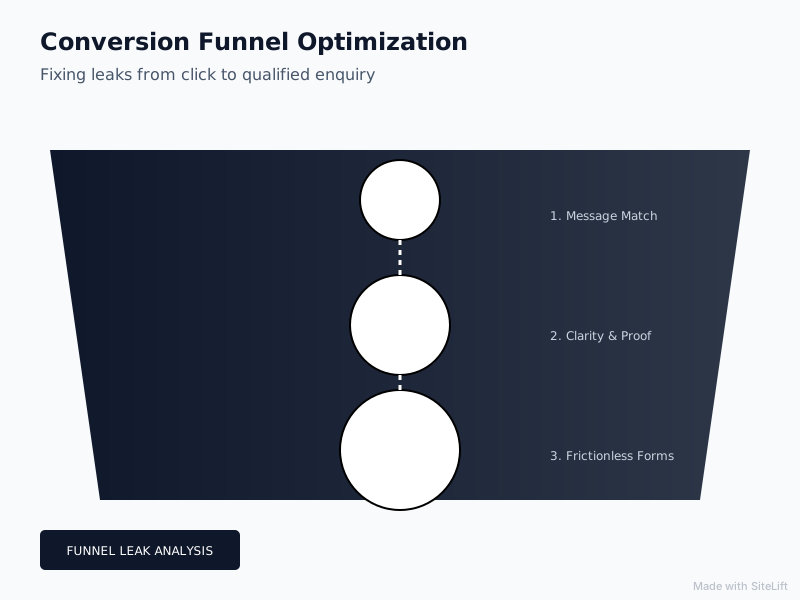
You can’t fix everything. Score opportunities by traffic x drop-off x ease.
Infographic by SiteLift
| Leak Location | Signal | Priority |
|---|---|---|
| High-intent landing page with >70% bounce | Message mismatch or slow load | Fix first |
| Service page with traffic but no pricing/process views | Lack of clarity and trust | Fix second |
| Form page with >60% abandonment | Too many fields, no alternatives | Fix third |
| After-hours enquiries with next-day reply | Speed-to-lead gap | Fix third |
| Low-traffic blog with low conversion | Content mismatch | Fix later |
Focus your first sprint on high-traffic, high-drop pages closest to revenue. One improved core service page often beats ten tweaked blog posts.
If you need tooling for this, these website conversion optimization tools for service firms cover heatmaps, form analytics, and 24/7 capture without overkill.
How Can You Fix Common Leaks at Each Funnel Stage?
Fixing Top-of-Funnel Leaks: Message Match and Page Speed
Top leaks happen in seconds. People don’t read, they pattern-match.
- Match headline to click intent. Use the same words as the ad or search query.
- State value above the fold: who you help, outcome, location/service area, and primary CTA.
- Cut hero clutter. One clear CTA like “Get a Fixed Quote” beats three competing buttons.
- Fix mobile speed first. According to Google’s analysis of mobile benchmarks, 53% of mobile site visits are abandoned if pages take longer than 3 seconds to load.
Test your top three money pages on a real phone on 4G, not just your office wifi. If the headline, proof snippet, and call button aren’t visible instantly, you’re leaking.
Fixing Middle-of-Funnel Leaks: Clarity, Trust, and Friction
Middle leaks sound like: “Looks good, but I’m not sure...” Fix uncertainty directly.
- Simplify services. One page per core service with outcomes, deliverables, timeline, and who it’s NOT for.
- Add proof near claims. Reviews with names, case results, before/after, logos, credentials, and headcount. Vague “trusted by many” doesn’t convert.
- Be transparent about process and pricing. You don’t need exact prices, but give ranges, factors, and examples. Hidden pricing creates ghosting.
- Answer objections in FAQs. Cost, timeline, guarantees, service area, what happens after enquiry.
- Offer instant answers. Live chat or an AI assistant that can answer “Do you handle X in my area?” at 10pm keeps momentum.
Remember, friction isn’t just long pages. Research from the Baymard Institute showing an average documented cart abandonment rate of 70.19% is a useful reminder: even motivated buyers quit when final steps feel hard. The same applies to enquiry forms and booking steps.
Fixing Bottom-of-Funnel Leaks: Forms, Response Time, and After-Hours Follow-up
Bottom leaks are the most painful — you earned the interest, then lost the contact.
- Ask only for essentials: name, phone/email, service needed, postcode, and one open field. Move budget and timeline to follow-up.
- Offer multiple paths: short form, click-to-call, WhatsApp, and chat. Don’t force everyone through one form.
- Add reassurance under the button: response time, what happens next, no spam promise.
- Automate instant response: SMS + email confirmation in under a minute, with clear next step.
- Build speed-to-lead SOP: assign owner, route after-hours leads to an AI qualifier or on-call inbox, and track time-to-first-contact.
Speed matters more than polish. Research covered in Harvard Business Review found that companies that contact leads within an hour are nearly 7 times more likely to qualify the lead than those that wait longer. For services, five minutes is the real benchmark.
That’s why many firms now use AI conversion optimization for 24/7 lead triage and instant qualification — not to replace humans, but to capture and route after-hours demand you’d otherwise lose.
How Do You Measure and Sustain Conversion Funnel Optimization Wins?
Conversion funnel optimization isn’t a one-time project. It’s a feedback loop between marketing, sales, and operations.
Which KPIs Prove From Click to Enquiry Improvement?
Forget vanity conversion rate. Track qualified pipeline:
- Visitor-to-enquiry rate: Total enquiries / unique visitors
- Qualified enquiry rate: Sales-accepted enquiries / total enquiries
- Cost per qualified enquiry: Ad spend / qualified enquiries
- Form completion rate: Completions / form starts
- Chat-to-meeting rate: Booked consults / chat conversations
- Speed-to-lead: Median minutes to first meaningful response
- Close rate: Won jobs / qualified enquiries
Report qualified enquiry rate alongside volume. If volume rises but quality drops, your messaging is too broad.
How to A/B Test Without Killing Lead Flow
Low-traffic service sites can’t run classic SaaS-style tests with thousands of conversions. Test smarter:
- Test big, not button colors. Test headline + offer + form length together.
- Run sequential before/after tests for 2-4 weeks with stable traffic, not underpowered split tests.
- Use micro-conversions as early signals: form starts, chat opens, pricing clicks.
- Include offline data. A variant with fewer but better enquiries wins, even if raw conversion is flat.
- Document learnings in plain language for sales: what changed, who it helped, what to watch.
Building a Continuous Optimization Playbook for Service Teams
Keep it lightweight:
- Monthly: 30-minute funnel review. Traffic, visitor-to-enquiry rate, qualified rate, speed-to-lead, top drop page.
- Quarterly: Pick 2-3 leaks for the CRO backlog. One clarity fix, one friction fix, one follow-up fix.
- Ongoing: Sales feedback loop. Tag lost enquiries by reason — price, timing, location, trust — and feed that back to pages and qualifiers.
For help scoping this work externally, this guide to conversion optimisation services and what service businesses actually buy is a solid vetting checklist.
My Honest Take: Most Service Funnels Don’t Need More Hacks
I’ll be blunt: I’ve audited dozens of service sites that had popups, sticky bars, heatmaps, and three different chat widgets — but no clear answer to “what do you do, how much, and why trust you?”
In my experience, conversion funnel optimization for services is 80% boring fundamentals. Clear headline. Proof where it counts. Honest process. Short form. Fast human follow-up. The fancy tactics only work after that’s solid.
I also think lead quality is wildly underrated as a CRO metric. I’d rather see a firm go from 50 tire-kickers to 30 qualified enquiries than celebrate a 5% form conversion rate full of spam. If marketing and sales don’t agree on what “qualified” means, no tool will fix your funnel.
And I’m biased toward keeping what works. If your site already gets found, don’t torch it for a trendy redesign. Tighten message match, remove friction, and make after-hours capture airtight. That’s where the ROI lives for established firms.
Fix Your Biggest Leak First — Without a Rebuild
You don’t need more traffic yet. You need to keep the traffic you already earned.
At growth-kings.com, we specialize in practical website improvements for established service businesses — clarity and trust upgrades, search visibility that brings the right clicks, and AI-powered assistants that answer and qualify enquiries after hours. No unnecessary rebuilds, no empty ranking promises.
Start with one high-intent service page, one form, and your speed-to-lead. Fix those, measure qualified enquiries, then expand.
FAQ
What is conversion funnel optimization?
Conversion funnel optimization is the process of improving each step from first click to final enquiry so more of the right prospects convert. For service businesses, it means aligning message match, building trust with proof and transparent process, reducing form friction, and following up fast — measured by qualified enquiries, not just leads.
How does a service enquiry funnel work from click to enquiry?
A typical service enquiry funnel flows: click from search or ads > landing page > service and proof pages > contact via form, call, or chat > qualification > booked consultation. Along the way, micro-conversions like pricing views, FAQ engagement, and chat starts signal intent before someone is ready to enquire.
How do I find where my funnel is leaking leads?
Run a funnel leak analysis by combining quantitative and qualitative data. Use GA4 funnel reports, Search Console CTR, form abandonment, call tracking, and CRM stage rates to find where drop-offs happen. Then use heatmaps, session recordings, sales objections, and after-hours mystery shopping to learn why — and prioritize high-traffic, high-drop pages first.
What is a good website conversion rate for service businesses?
It depends on intent and channel. Branded search and referral traffic often convert 5-10%+ to enquiry, while cold paid traffic may convert 1-3%. More important than a benchmark is your qualified enquiry rate and cost per qualified enquiry. Ten qualified consults beat thirty unqualified form fills every time.
How can I get more qualified enquiries without rebuilding my website?
Tighten what you have: match headlines to search intent, clarify services and pricing ranges, add specific proof and FAQs, shorten forms to essentials, add click-to-call and chat, and implement sub-5-minute follow-up with after-hours AI qualification. Most established sites win faster with these clarity and speed fixes than with a full rebuild.
— growth-kings.com
Want this working on your own site?
Tell us what’s working, what’s stuck and what you want to improve. We will reply personally.