Conversion Optimisation Services: What Service Businesses Actually Buy (and How to Choose Right)
Discover how conversion optimisation services turn service website traffic into qualified leads. Explore real pricing, agency vetting, and ROI benchmarks.
By Growth Kings. Published . 16 min read.

Conversion Optimisation Services: What Service Businesses Actually Buy (and How to Choose Right)
If you run a service business, you have likely looked at your analytics dashboard and felt a familiar frustration: qualified traffic is arriving, but prospective clients are leaving without booking a call or submitting an enquiry. When leaders look for outside help to fix this, they inevitably search for conversion optimisation services.
Yet, most information online about conversion rate optimisation (CRO) is written for direct-to-consumer e-commerce brands. High-volume split-testing, checkout upsells, and discount pop-ups make sense when you are selling £40 trainers to tens of thousands of shoppers. They fall apart entirely when you are selling £5,000 to £50,000 professional services to discerning decision-makers.
Securing high-calibre advisory, technical, or corporate services requires establishing profound trust, clarifying complex value propositions, and dismantling friction points. Here is an unvarnished look at what professional conversion optimisation services actually look like for lead generation, what deliverables move the needle, what you should expect to pay, and how to hire an agency that genuinely understands service pipelines.
Key Takeaways: What You Need to Know
| Decision Area | Service-Based CRO Reality | E-Commerce CRO Contrast |
|---|---|---|
| Primary Goal | Qualified enquiries, sales calls booked, high pipeline intent | Instant credit card transactions, higher average order value |
| Testing Methodology | Heuristic audits, qualitative UX diagnostics, messaging alignment | High-velocity A/B split-testing with massive statistical power |
| Traffic Requirement | Effective with 1,000–20,000 visits/month via qualitative insights | Usually requires 50,000+ monthly visits for statistical significance |
| Engagement Model | Targeted audits (£1.5k–£5k) or agile retainers (£2.5k–£8k/month) | Multi-variant software retainers with dedicated developers |
| Core Conversion Driver | Positioning clarity, proof stacking, interactive qualification | Scarcity timers, checkout velocity, discount incentives |
What Are Conversion Optimisation Services for Service Businesses?
At its core, conversion optimisation for service-driven organisations is the systematic process of turning more of your existing website visitors into qualified prospective clients. Rather than pouring ever-increasing budgets into paid search, LinkedIn ads, or top-of-funnel SEO, conversion optimisation identifies and remedies why good-fit visitors leave without initiating contact.
Understanding website conversion rate optimization for service businesses starts with acknowledging that your business does not operate like an online storefront.
The Fundamental Shift: Lead Enquiries vs. E-Commerce Transactions
E-commerce conversion optimisation revolves around impulse, price sensitivity, and frictionless checkout flows. By contrast, service businesses—consultancies, commercial contractors, enterprise software integrators, legal firms, and agencies—deal with high considered purchases.
Your prospects are not making a £35 impulse purchase on a lunch break. They are evaluating a partner whose failure could cost their company time, capital, or market standing. As a result, commercial conversion services for B2B and professional services focus heavily on risk reversal, credibility, and authority.
According to the Unbounce Conversion Benchmark Report, median conversion rates across professional services websites hover between 2.5% and 4.6%. That leaves tremendous headroom for growth. However, closing that gap is not about making your "Submit" button bright orange; it is about proving within seconds that you solve their specific, expensive problem.
Micro-Conversions That Precede a High-Value Service Enquiry
Rarely does a decision-maker land on a B2B homepage and immediately fill out a contact form. Service-based buyer journeys consist of layered micro-conversions:
- Information Consumption: Reading an in-depth case study to verify relevant sector competence.
- Pricing & Scope Calibration: Visiting pricing pages or delivery model breakdowns to check feasibility.
- Engagement with Interactive Tools: Using self-assessment calculators, guided pricing tools, or AI-powered conversational assistants.
- Validation: Reviewing social proof, client accreditations, and specialist credentials.
When you invest in professional conversion optimisation, the provider maps these micro-touchpoints to prevent pipeline drop-off before the formal enquiry even occurs.
Why Low-Traffic B2B and Service Sites Require a Distinct CRO Framework
The single most common mistake service firms make is hiring a traditional conversion agency that attempts classical A/B split-testing on a site receiving 3,000 visitors per month.
Mathematically, running a statistically valid split-test on low-to-medium traffic volumes with a 2% baseline conversion rate can take six to twelve months per test. That burns client budget while producing zero actionable insight.
Qualitative frameworks pioneered by research bodies like the CXL Institute show that conversion gains on low-traffic websites stem from heuristic evaluations, user session forensics, form drop-off diagnostics, and customer interviews. You do not need 100,000 visitors to notice that your contact form demands twelve mandatory fields, your value proposition is jargon-heavy, and your mobile navigation is broken.
What Deliverables Are Actually Included in CRO Packages?
When you sign a contract with a conversion rate optimisation agency, what should arrive in your inbox each week or month? Reputable agencies provide tangible assets and concrete structural recommendations, not vague strategic advice.
The In-Depth CRO Audit for Service Business Websites
The foundation of any serious engagement is an exhaustive cro audit for service business websites. This initial diagnostic unpacks how your current architecture helps or hinders user intent.
A commercial-grade audit typically examines:
- Cognitive Load & Above-the-Fold Clarity: Does the visitor immediately understand what you do, who you serve, and what outcome you deliver? Research by the Nielsen Norman Group shows that users typically leave a web page within 10 to 20 seconds unless a clear, compelling value proposition is immediately communicated.
- Technical Performance Bottlenecks: Page speed degradation, layout shifts, and mobile responsiveness bugs that kill buyer trust before copy is even read.
- User Flow Mapping: Pinpointing exact drop-off points between the initial landing page and the final scheduling screen.
Qualitative Diagnostics: Heatmaps, User Session Replays, and Form Friction Audits
Quantitative analytics in tools like Google Analytics 4 indicate where users leave, but they cannot tell you why. Qualitative diagnostic tools fill that gap:
- Heatmaps and Scroll Maps: Verifying whether prospective clients actually reach your client testimonials or stop scrolling after the hero section.
- User Session Replays: Watching real, anonymised user sessions to spot hesitation patterns, rage-clicks, and confusing design elements.
- Form Analytics: Tracking the specific fields where users abandon your enquiry forms. If visitors type their name and email but abandon the page when asked for a phone number or exact project budget, you have identified a high-leverage friction point.
Pro Tip: Never require a phone number on an initial service enquiry form unless your sales team calls back within five minutes. If your follow-up cadence is email-first, eliminate the phone field entirely; it routinely increases form submissions by double digits.
Messaging Architecture, Trust Stacking, and Friction Removal
The most effective lever in service CRO is refining your messaging architecture. Agencies examine how you present proof. Slapping five client logos across the bottom of a page is no longer sufficient; buyers want contextual evidence.
Conversion services reorganise your proof points by matching testimonials directly to client objections. If your prospective clients worry about prolonged implementation timelines, the agency restructures case studies to lead with speed-to-value metrics.
Furthermore, forward-thinking providers look beyond static forms. Implementing dynamic intake flows—such as interactive questionnaires or conversational assistants that qualify inbound leads 24/7—allows service firms to capture pipeline after standard business hours without forcing prospects to wait days for a basic email reply.
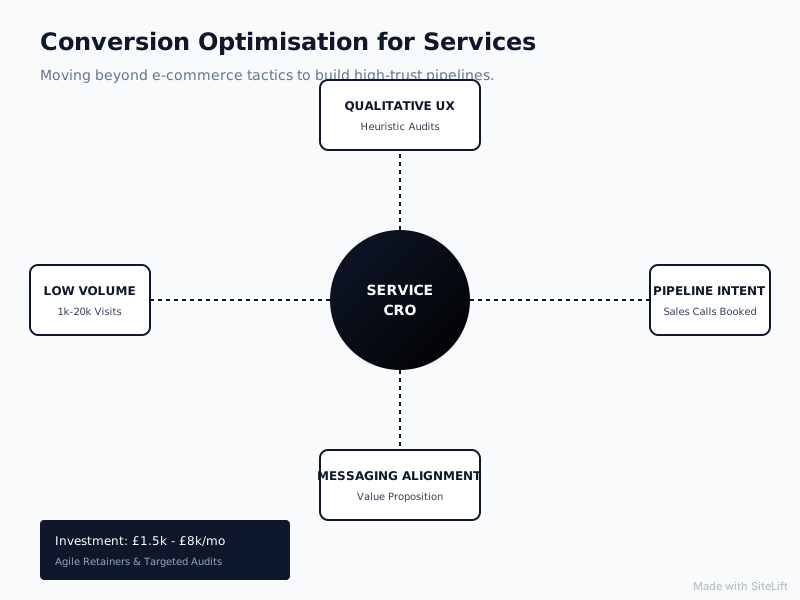
Infographic by SiteLift
How Much Do Conversion Optimisation Services Cost?
Pricing models for CRO vary dramatically based on the agency's positioning, methodology, and technical scope. Because the term encompasses everything from quick cosmetic audits to multi-channel funnel overhauls, understanding market rates prevents overpaying for vanity deliverables or underinvesting in critical fixes.
Fixed-Price Audits vs. Ongoing Monthly Retainers
Generally, service firms engage CRO partners through one of two models:
- One-Off Comprehensive Audits: Ideal for firms that possess in-house development or design talent and simply need an expert diagnostic roadmap. The agency identifies leaks, rewires messaging, provides wireframes, and leaves execution to your team.
- Ongoing Optimisation Retainers: Structured for organisations seeking continuous, hands-on improvement. The agency identifies friction, writes improved messaging, oversees wireframe design, and manages technical deployment month over month.
Conversion Optimisation Pricing: UK and Global Industry Benchmarks
Industry standards reflect the expertise required to audit high-value sales pipelines. Below is what you should expect regarding conversion optimisation pricing UK and global benchmarks:
| Service Level | Typical Investment | Expected Deliverables | Best Suited For |
|---|---|---|---|
| Heuristic & Technical CRO Audit | £1,500 – £4,000 (One-off) | Full friction analysis, UX teardown, form diagnostics, prioritised backlog | Firms with internal teams who need an expert game plan |
| Foundation Sprint (Audit + Implementation) | £4,500 – £8,500 (One-off) | Complete audit, new landing page wireframes, revised value proposition, form rebuilds | Service firms needing rapid pipeline resuscitation |
| Ongoing Pipeline Optimisation Retainer | £2,500 – £6,500 / month | Continuous session analysis, iterative UX updates, landing page creation, copy adjustments | Established firms spending £5k+/month on paid acquisition |
| Enterprise / Multi-Brand CRO Retainer | £8,000 – £15,000+ / month | Advanced multivariate testing, deep CRM/pipeline attribution tracking, bespoke development | Multi-regional B2B operations with high visitor volume |
The True Cost of Unnecessary Full-Site Rebuilds vs. Targeted CRO
When enquiries slump, the knee-jerk reaction of most leadership teams is to commission a complete website redesign. In the B2B sector, an agency redesign typically costs between £15,000 and £50,000 and takes four to nine months to launch.
In many cases, the redesign solves nothing. If your underlying value proposition is muddled, your case studies lack concrete outcomes, and your enquiry mechanism creates friction, wrapping those identical flaws in modern typography will not fix your pipeline.
Targeted conversion optimisation costs a fraction of a full rebuild, deploys within weeks rather than quarters, and addresses the actual commercial mechanisms of lead generation. If you are struggling with poor performance, take time to unpack why your conversion rate is low before throwing away your entire web infrastructure.
The Editorial View: Why Heuristic Friction Hunting Beats Split-Testing
I have sat through countless agency pitches where account managers try to sell complex, enterprise-level A/B testing software subscriptions to service businesses that barely receive 5,000 unique visits a month.
It is, frankly, commercial malpractice.
Traditional split-testing has achieved near-religious status in digital marketing, but its utility depends entirely on high sample sizes. When an agency tells a mid-sized consultancy that they will split-test three variations of a call-to-action button over a 90-day cycle, they are burning your budget to generate statistically invalid noise.
The most lucrative wins I have ever seen for service firms came from unapologetically pragmatic, qualitative friction hunting:
- We rewrote a vague hero headline ("Empowering Seamless Synergy for Modern Teams") into plain, concrete language ("We Help Mid-Market Logistics Firms Cut Warehouse Overtime by 22%"). Enquiries jumped within forty-eight hours.
- We eliminated six redundant fields from an intake form and introduced a friction-free booking calendar. Booked consultations doubled the following week.
- We installed an after-hours conversational intake tool that collected project scope and email addresses while the sales team slept. That single addition captured a six-figure contract from an overseas prospect who refused to wait for UK business hours.
None of those decisions required an eight-week statistical validation loop. They required empathy for the buyer, clarity of positioning, and ruthless elimination of friction. Service businesses do not need more laboratory experiments; they need websites that respect their prospect's time and speak plainly about the value they create.
"Fixing the commercial leaks in your existing user journey will always deliver a faster, higher-margin return than paying to drive more traffic into a broken funnel."
— growth-kings.com
How to Choose the Right Conversion Rate Optimisation Agency
Selecting a partner to optimize your firm's pipeline is high-stakes. A poor agency wastes your capital, annoys your engineering team, and leaves your sales pipeline empty.
Lead Generation Specialists vs. Generic E-Commerce CRO Agencies
Your first vetting criterion is simple: does the agency specialize in lead generation and considered purchases, or is their case study portfolio packed with fashion labels and consumer packaged goods?
An e-commerce specialist instinctively looks for cart abandonment triggers and discount mechanics. A service-focused conversion rate optimisation agency understands long sales cycles, multi-stakeholder purchasing decisions, and how to balance lead quantity against lead quality.
Five Critical Questions to Ask Before Signing a CRO Retainer
Before committing your budget, put these questions directly to the agency's lead strategist:
- "Given our current monthly traffic volume, what exact methodology will you use to validate changes?"
Look for answers centred on qualitative user research, session audits, and heuristic frameworks rather than statistical split-testing if your traffic is under 30,000 visits/month. - "How do you ensure that increasing form submissions doesn't flood our sales reps with junk leads?"
They should explain how progressive profiling, qualifying questions, and clear positioning filter out bad fits. - "Who handles the copy, design, and technical implementation?"
Clarify whether they hand you a PDF of suggestions or handle the development work inside your CMS. - "How do you evaluate message-market fit on our primary landing pages?"
They should discuss voice-of-customer analysis, client interviews, and reviewing historical sales call transcripts. - "What metrics will we use to evaluate success in the first 60 days?"
Early metrics should focus on micro-conversion velocity, reduced form abandonment, and qualitative clarity milestones, progressing quickly into qualified enquiry volume.
Pro Tip: Ask to see an anonymised deliverable from a recent client audit. If their report consists of generic automated output from tools like Google PageSpeed or automated SEO checkers, walk away. You are paying for senior diagnostic insight, not automated software exports.
Red Flags to Avoid
- Guaranteed Traffic Numbers: Traffic volume is the domain of media buying and SEO, not CRO. Agencies promising traffic spikes in a conversion proposal are mixing up disciplines.
- Premature Testing Obsession: Insisting on software tools like Optimizely or VWO before cleaning up foundational messaging, site navigation, and form mechanics.
- Template Copy Recommendations: Suggesting buzzword-filled, generic copy changes that strip your unique methodology out of your pages.
How Do You Measure ROI from an Enquiry Rate Improvement Service?
The ultimate justification for hiring an enquiry rate improvement service is simple: expanding your bottom-line revenue without expanding your customer acquisition cost (CAC).
Calculating Net Revenue Impact from Incremental Conversion Gains
Because service contracts carry substantial client lifetime value (LTV), even fractional percentage-point improvements create massive returns.
Consider a specialist environmental consulting firm with the following baseline metrics:
- Monthly Website Visitors: 6,000
- Current Conversion Rate to Enquiry: 1.2% (72 enquiries/month)
- Sales Close Rate: 20% (14.4 new clients/month)
- Average Client Value: £6,000
- Monthly Revenue Generated: £86,400
Now, suppose targeted conversion optimisation addresses messaging clarity, form friction, and introduces an interactive intake tool, lifting the conversion rate to 2.1%:
- Monthly Website Visitors: 6,000 (unchanged)
- New Conversion Rate: 2.1% (126 enquiries/month)
- Sales Close Rate: 20% (25.2 new clients/month)
- Average Client Value: £6,000
- New Monthly Revenue Generated: £151,200
By improving the website's conversion rate by less than a single percentage point, the business unlocks an incremental £64,800 in monthly revenue (£777,600 annually) without spending an extra penny on media or advertising.
Balancing Conversion Volume with Lead Qualification Standards
A common danger in unguided conversion optimization is chasing volume at the expense of quality. Removing every barrier might double your enquiries, but your sales team will waste hours disqualifying prospects who cannot afford your fees.
According to HubSpot's State of Marketing report, over 60% of B2B marketers cite generating qualified leads—not just total traffic—as their primary website performance bottleneck.
Sophisticated conversion services introduce intentional, low-friction qualification gates. For instance, using multi-step intake forms or conversational assistants can politely gather budget parameters, company size, and project scope before booking a meeting on your calendar. You capture fewer tire-kickers and close a higher percentage of the enquiries you do receive.
Tracking Post-Click Micro-Metrics That Predict Pipeline Health
To assess progress before quarterly revenue figures materialize, keep a close eye on leading pipeline indicators:
- Form Engagement-to-Completion Ratio: The percentage of visitors who begin typing into your enquiry form and actually hit submit.
- Scroll Depth on High-Value Proof Assets: Whether visitors read your primary case studies and fee structures.
- After-Hours Conversion Share: The proportion of qualified pipeline originating outside of traditional business hours through interactive mechanisms.
Transforming Your Existing Traffic into Reliable Pipeline
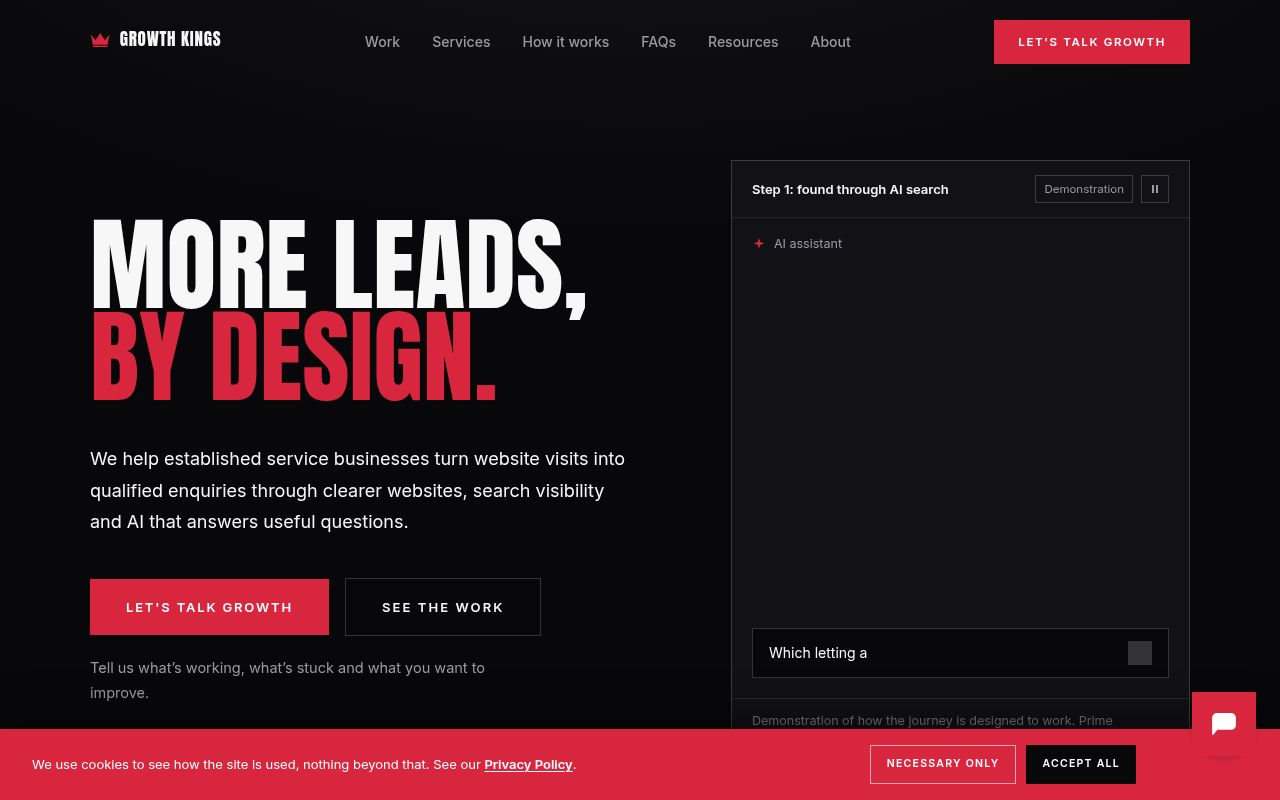
If you run an established service firm, your website should function as your most productive commercial asset—qualifying prospects, dismantling objections, and scheduling calls with decision-makers around the clock.
Rather than committing to risky, protracted website overhauls that drain capital and disrupt your operations, working with Growth Kings allows you to diagnose and repair the exact points of friction keeping qualified clients from getting in touch.
Through focused heuristic audits, messaging architecture overhauls, and intelligent conversational capture tools, our practical approach turns the visitors you already have into the pipeline you need.
FAQ: Conversion Optimisation for Service Businesses
What is the difference between a CRO audit and an ongoing conversion optimisation service?
A CRO audit is an intensive diagnostic evaluation that reviews your website's messaging, UX design, technical performance, and user flow to produce a prioritized roadmap of recommended fixes. An ongoing conversion optimization service takes that roadmap and implements, tests, and refines those changes over time—continually analyzing user behavior, creating new landing pages, and adjusting capture mechanisms to steadily increase inbound enquiries.
Can conversion optimisation work on a website with low traffic?
Yes, but the methodology must change. While high-traffic e-commerce stores rely on automated A/B testing to determine winners, low-to-medium traffic websites (1,000 to 20,000 visitors per month) benefit primarily from qualitative conversion research. This includes user session replays, form friction analysis, cognitive load evaluations, and message-market alignment, which do not require large sample sizes to identify major barriers to conversion.
How much do conversion optimisation services typically cost in the UK?
In the UK market, a comprehensive one-off conversion audit for a service business generally ranges from £1,500 to £4,500 depending on the complexity of the site. Ongoing monthly retainers for continuous analysis, copywriting, wireframing, and implementation typically run between £2,500 and £6,500 per month.
How long does it take an enquiry rate improvement service to show tangible results?
Because service firms do not have to wait months for statistical split-tests to clear, qualitative fixes often yield visible results quickly. High-leverage changes—such as clarifying the hero value proposition, fixing broken mobile forms, and introducing interactive conversational intake tools—routinely produce measurable uplifts in qualified enquiries within 30 to 60 days of deployment.
Why shouldn't we just redesign our entire website instead of hiring a CRO agency?
Full website redesigns are expensive (£15,000 to £50,000+), take months to deploy, and frequently carry over the exact same structural flaws as your old site. Web designers generally prioritize aesthetics over sales psychology and lead qualification. Targeted conversion optimization fixes the specific commercial mechanisms that drive pipeline at a fraction of the cost, without the downtime or operational disruption of a total rebuild.
Want this working on your own site?
Tell us what’s working, what’s stuck and what you want to improve. We will reply personally.