Website Optimization Services for Service Businesses: What to Buy (and What to Skip)
Discover which website optimization services drive qualified enquiries, what to skip, and how to pick a partner that grows pipeline.
By Growth Kings. Published , updated . 15 min read.

Website Optimization Services for Service Businesses: What to Buy (and What to Skip)
If your website gets traffic but few good leads, you don't have a traffic problem. You have a trust and clarity problem. That's exactly where website optimization services for service businesses should focus — not on more clicks, but on turning the visits you already get into qualified enquiries worth quoting.
I've seen established firms spend £30k on a rebuild when five targeted fixes would have doubled enquiries. I've also seen agencies sell 80-page audits full of technical noise that changed nothing in the pipeline. This guide cuts through that. We'll cover what to buy, what to skip, and how to choose help that actually moves revenue.
Key Takeaways
| What Service Firms Need to Know | Bottom Line |
|---|---|
| Goal of optimization | More qualified enquiries and better-fit clients, not more sessions or add-to-carts |
| Optimize vs redesign service website | Optimize first in 80% of cases; rebuild only if positioning, tech, or structure is fundamentally broken |
| Highest-ROI services to buy | Commercial audit for qualified enquiries, message clarity, proof architecture, high-intent pages, frictionless contact + after-hours qualification |
| Services to skip | Pure visual refreshes, bloated tech audits detached from revenue, over-engineered funnels and aggressive pop-ups |
| How to vet a partner | Ask for pipeline results, not traffic graphs; avoid guarantees and cookie-cutter playbooks |
| How to measure success | Track qualified enquiry rate, enquiry-to-proposal rate, and pipeline value — not bounce rate alone |
What Are Website Optimization Services for Service Businesses?
Generic definitions of website optimization services talk about page speed, image compression, and button colours. Useful, but incomplete. For a law firm, consultancy, clinic, contractor, or B2B agency, a single enquiry can be worth £5,000 to £100,000+. You don't need 2% more clicks. You need the right visitor to feel this firm gets my problem, I trust them, and contacting them is easy.
That is why website improvement services for service firms are a different discipline from eCommerce CRO.
The Key Difference: Service Firm Lead Generation vs. eCommerce CRO
eCommerce optimization is transactional. Reduce friction at checkout, clarify shipping, improve product imagery, recover abandoned carts. Success is measured in seconds and single sessions.
Service optimization is relational. No one hires an architect or a financial advisor from a “Buy Now” button. They research, compare, hesitate, and come back three weeks later. Your site has to educate, de-risk, and invite a conversation.
In practice that means:
- Longer consideration: Multiple visits, multiple stakeholders, higher perceived risk
- Trust over urgency: Testimonials, case outcomes, credentials, and clear process beat countdown timers
- Conversation over conversion: The win is a qualified call or detailed enquiry form, not an instant purchase
The Core Objective: Converting Traffic into High-Value, Qualified Enquiries
Good optimization doesn’t chase more form fills. It chases better form fills — prospects with budget, fit, and intent.
I look at three leaks first:
- Clarity leak: Visitor can’t tell in 8 seconds who you help, what outcome you deliver, and why you’re different.
- Trust leak: Claims with no proof. No results, no faces, no process, no pricing guidance.
- Friction leak: Contact is hard, slow, or scary. Vague “Get in Touch” pages, 12-field forms, no response-time promise, no option after 6pm.
Fix those, and the same 1,000 monthly visitors can produce twice the pipeline.
Why Traditional Technical Audits Fall Short for Professional Services
Most audits I review are 90% technical hygiene: alt tags, H1 counts, Core Web Vitals, schema warnings. Those matter for crawlability, but they rarely explain why a capable firm gets ignored.
Research published by the Nielsen Norman Group shows that users typically leave web pages within 10 to 20 seconds unless a clear value proposition catches their attention immediately, detailed in their analysis of how long users stay on web pages. Speed won’t save you if your headline is “Welcome to Our Innovative Solutions.”
And in B2B, the stakes for those first seconds are higher than ever. According to Gartner, B2B buyers spend only 17% of their total purchase journey meeting directly with potential suppliers, as outlined in their B2B buying journey research. Your website is doing the selling when you’re not in the room.
Pro Tip: Before you buy any audit, ask: “Will this tell me why a ready-to-buy visitor didn’t enquire?” If the answer is mostly Lighthouse scores, walk away.
Should You Optimize vs Redesign Your Service Website?
This is the most expensive question service owners get wrong. The optimize vs redesign service website debate isn’t about taste. It’s about risk, cost, and speed to revenue.
The False Promise of the Full Website Rebuild
Rebuilds feel decisive. New theme, new visuals, fresh start. But for established service businesses, full redesigns often:
- Take 3-6 months while leads leak
- Break URL equity and internal links that were driving high-intent traffic
- Replace messaging problems with prettier messaging problems
- Cost 5-10x more than targeted optimization with no guarantee of more enquiries
I’ve audited beautiful new sites that converted worse than the “dated” ones they replaced — because the agency rewrote headlines to sound clever instead of clear.
The Business Case for Targeted, Iterative Optimization
Optimization keeps what works and fixes what blocks enquiries. You test headline clarity, rebuild one flagship service page, add proof where anxiety is highest, simplify contact, and measure qualified enquiries for 30-60 days. Then you iterate.
It’s faster, cheaper, and far less risky. For a deeper breakdown of the usual culprits, see 11 reasons your website isn’t converting enquiries into clients.
Pro Tip: If your site brings in some good enquiries already, don’t scrap it. That proves the foundation can sell. Optimize the path around what’s already working.
A Decision Framework: When to Patch, When to Optimize, and When to Scrap
Use this honest checklist:
| Signal | Action |
|---|---|
| Site is slow on mobile, but messaging is strong and you rank for key services | Patch: Fix speed, mobile UX, broken forms, call tracking |
| You get traffic but few qualified enquiries; visitors say “I wasn’t sure what you do” | Optimize: Rework positioning, service pages, proof, and lead capture. This is 70% of service firms. |
| CMS is unsupported, site isn’t secure, can’t edit pages, or you’ve pivoted services entirely | Rebuild: Start over, but carry over SEO equity and proven messaging. Consider conversion-focused websites for service businesses built to be understood and contacted. |
Rebuild only when the platform or positioning is fundamentally unfixable. Otherwise, optimize.

What Website Optimization Services Should You Actually Buy?
Not all website optimization services are equal. For service firms, these four consistently pay for themselves.
1. Commercial UX & Website Audit for Qualified Enquiries
Forget the 120-point technical dump. A website audit for qualified enquiries traces the money path:
- Where do high-intent visitors land? (service pages, not homepage)
- What do they see in the first viewport? Is the outcome and audience crystal clear?
- Where do they drop? Heatmaps, session recordings, and form analytics show rage-clicks and hesitation.
- What do sales hear? “We get price shoppers” usually means your site attracts the wrong intent or fails to pre-qualify.
Deliverable you want: a prioritized list of 10-15 fixes ranked by expected pipeline impact and effort, with before/after wireframes for the top 3 pages. Frameworks like those in CXL’s library of conversion rate optimization frameworks are useful here because they prioritize research over opinions.
2. Message Clarity, Value Proposition, and Trust Architecture
This is the unsexy work that doubles enquiry quality.
Buy:
- Homepage and service page rewrites based on customer interviews, call transcripts, and lost-deal notes — not internal jargon
- Outcome-led headlines: “Bookkeeping for Construction Firms That Keeps You HMRC-Ready” beats “Full-Service Accounting Solutions”
- Trust architecture: Place proof where doubt spikes. Relevant case study next to pricing, process timeline next to contact form, real team photos next to testimonials, accreditations in the footer of every commercial page
- Objection handling: Pricing ranges, timelines, who you’re not for, FAQs that answer “how much, how long, how does this work?”
If an agency wants to redesign without interviewing customers or listening to sales calls, they’re decorating, not optimizing.
3. High-Intent Search Visibility and Landing Page Alignment
You don’t need 100 blog posts. You need 5-10 commercial pages that rank for what ready-to-buy clients actually type, and pages that match that intent.
What to buy:
- Keyword mapping for high-intent terms:
[service] + [city/industry],cost,near me,best,hire - One dedicated page per core service + audience, with clear next step and proof specific to that audience
- Internal linking from blogs to money pages, plus title/meta rewrites focused on click-through from qualified searchers
- AI search readiness: concise definitions, FAQs, and citable proof points so assistants can recommend you. I wrote more on this in how to get recommended by ChatGPT, AI Overviews and Perplexity.
Skip vanity traffic plays. A 10,000-visit post that brings students and job seekers doesn’t pay salaries.
4. Frictionless Lead Capture and Conversational Qualification
Most service sites lose enquiries at 8pm, on weekends, and on mobile. People won’t wait until Monday to feel heard.
Buy:
- Simplified contact: 3-4 fields max on first step, click-to-call, WhatsApp option, response-time promise (“We reply within 1 business day — usually 3 hours”)
- Smart routing: Quote estimator or 2-step qualifier that segments by budget, timeline, and location without interrogating
- After-hours coverage: An AI enquiry assistant that answers common questions, captures details, and books calls when your team is offline. Speed matters more than polish — even a helpful holding response keeps you in the shortlist.
- CRM connection: Every enquiry logged, sourced, and followed up. No more “form went to spam” excuses.
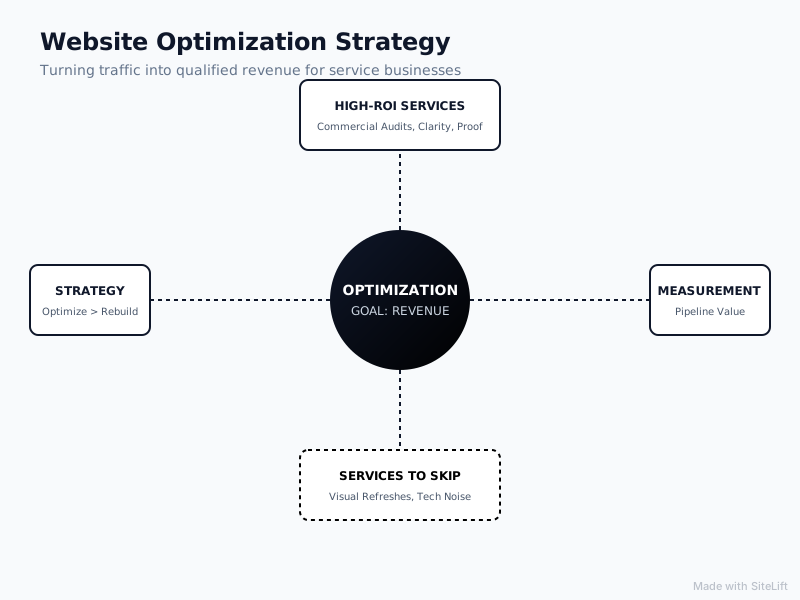
Infographic by SiteLift
This last piece is where many firms see the fastest lift. You’re not buying more traffic; you’re finally catching the demand you already earned.
What Website Optimization Services Should You Skip?
Agencies make margin on deliverables, not outcomes. Here’s what I tell service owners to question hard.
Aesthetic Overhauls Without Customer Research
New fonts, trendy animations, full-width video heroes. If there’s no research behind it — no interviews, no analytics, no test — it’s opinion.
Pretty doesn’t equal persuasive. In fact, heavy video heroes often push your value proposition below the fold and slow mobile load. Ask: “What customer insight is this design change based on, and how will we know it worked?”
Bloated Technical SEO Audits Detached from Revenue
Yes, fix broken pages, indexing issues, and terrible mobile speed. No, you don’t need to fix 400 “warnings” for missing image titles on decade-old blog posts before you fix your headline and contact flow.
I’ve seen firms spend two months chasing a perfect health score while their main service page still said “We Provide Bespoke Solutions for Diverse Needs.” Fix money pages first. Hygiene second.
Complex Interactive Funnels and Excessive Form Gates
Multi-step quizzes, gated PDFs for everything, chatbots that ask six questions before answering one — these work for some SaaS trials. For high-trust services, they feel like a barrier.
A prospect with a leaking roof, a tax deadline, or a board meeting next week doesn’t want a 10-step funnel. They want to know: can you solve this, have you solved it before, what happens next, and how fast will you reply?
Keep pop-ups restrained. One exit-intent offer for genuinely hesitant visitors is plenty. Three pop-ups plus auto-play video is how you lose a £20k client to a calmer competitor.
How to Choose a Conversion Rate Optimisation Agency You Can Trust?
Hiring a conversion rate optimisation agency is like hiring a sales coach for your website. Chemistry matters, but process matters more.
Critical Questions to Probe Strategic Capability
Ask these on the first call:
- “How do you define a qualified enquiry for a firm like ours?” Good partners dig into deal size, fit, and sales feedback. Bad ones talk about sessions and bounce rate.
- “Show me a service business where you improved enquiry quality, not just volume.” Look for pipeline, close rate, or average project value — not just “conversions up 40%” from newsletter signups.
- “What research do you do before you change anything?” Expect: analytics review, heatmaps/recordings, customer interviews, sales call listening, competitor teardown.
- “What would you not do on our site?” Strategic restraint is a green flag. If they’d do everything, they stand for nothing.
- “How do you report success?” You want qualified enquiries by source, enquiry-to-meeting rate, and revenue influence. Weekly screenshots of traffic are not reporting.
Browse their own site too. If their services page is vague, slow, and hard to contact — that’s your preview. Clear positioning and easy next steps are table stakes. You can see what scoped, fixed-fee work should look like on our services overview.
Red Flags: Traffic Guarantees, Cookie-Cutter Playbooks, and Tech Obsession
Walk away if you hear:
- Guaranteed #1 rankings or 3x leads in 30 days. No one can guarantee Google or buyer behaviour.
- Same package for a dentist, a SaaS, and a law firm. Service sales cycles are not interchangeable.
- Only developers and SEO techs, no strategist or copywriter. Your problem is usually commercial clarity, not code.
- No access to raw data. If they won’t share Analytics, Search Console, or test results, they’re hiding something.
- 12-month lock-in before any win. Start with a 4-6 week optimization sprint tied to enquiries. Earn the retainer.
Defining Success: Aligning Metrics with Sales Pipeline Realities
Agree this table before work starts:
| Metric to Track | Why It Matters | What Good Looks Like |
|---|---|---|
| Qualified enquiry rate (enquiries / high-intent sessions) | Shows if messaging + trust are working | Steady lift on service pages within 60-90 days |
| Enquiry-to-meeting rate | Shows lead quality and speed to response | Fewer tyre-kickers, more sales-ready calls |
| Pipeline value influenced | Ties optimization to revenue | Marketing-sourced proposals grow, not just form fills |
| Response time (first reply) | Fastest lever for close rate | Under 1 hour in business hours; instant after-hours acknowledgement |
Ignore micro-wins like “time on page up 12%” unless they lead to more qualified conversations.
My Honest Take: Most Service Websites Don’t Need More Traffic
I’ll say the quiet part out loud. Most established service businesses I meet don’t need a new website, more blog posts, or fancier branding. They need to be understood in ten seconds and trusted in sixty.
Your best clients are busy and slightly anxious. They’ve been burned before. They’re skimming your site between meetings while comparing you to two competitors. They aren’t thinking “wow, nice parallax.” They’re thinking “do these people handle cases like mine, what will this cost me if I get it wrong, and will they actually pick up the phone?”
That’s why I’m biased toward boring wins: a headline that names the customer and outcome, a case study that mirrors the reader’s situation, a contact page that removes fear, a follow-up that arrives in minutes not days. None of that wins design awards. All of it wins work.
If you take one idea from this guide, make it this: optimization isn’t a tech project. It’s a sales project that happens to live on your website. Treat it that way, measure it that way, and you’ll stop buying stuff you don’t need.
— growth-kings.com
Turn Existing Visits Into Qualified Conversations
You don’t have to guess what’s blocking enquiries. Start with a focused audit of your top three service pages and your contact flow, fix clarity and friction first, then layer in search visibility and after-hours capture.
If you want a practical partner for that, Growth Kings helps established service businesses turn visits into qualified enquiries with conversion-focused websites and AI enquiry assistants — scoped, fixed-fee work, no unnecessary rebuilds.
FAQ
What is the difference between eCommerce optimization and service website optimization?
eCommerce optimization aims to increase instant transactions — cart adds, checkout completion, average order value. Service website optimization aims to start high-trust conversations. Success isn’t a purchase, it’s a qualified enquiry, booked consultation, or request for proposal. That means more emphasis on positioning, proof, process transparency, and easy, fast contact rather than urgency tactics and product-page tweaks.
How much should a service business expect to invest in website optimization services?
It varies by scope, but think in sprints, not endless retainers. A focused commercial audit with fixes to 2-3 key pages typically costs far less than a full rebuild and often pays back faster because you keep your SEO equity. As a rule of thumb, if one extra ideal client covers the project fee, the maths works. Ask for fixed-fee scoping tied to enquiry outcomes, not hourly technical tasks.
How long does it take to see results from a website optimization initiative?
Clarity and friction fixes can lift qualified enquiry rate within 30-60 days, especially if you already have steady traffic. Search visibility changes take longer — usually 90-180 days to compound. A good partner will sequence quick wins (headlines, proof placement, form simplification, response time) before longer plays (new service pages, authority content).
Can website optimization replace the need for an expensive full website redesign?
In most cases, yes. If your CMS is secure and editable, you rank for relevant terms, and you get at least some good enquiries now, targeted optimization usually beats a rebuild on cost, speed, and risk. Rebuild only if your platform is obsolete, your positioning has fundamentally changed, or your site structure prevents you from creating proper service pages and capturing leads cleanly.
What metrics should I track to judge if optimization is actually working?
Track qualified enquiry rate from high-intent pages, enquiry-to-meeting rate, pipeline value created, and first response time. Traffic and bounce rate are context, not success. If enquiry quality, meeting rate, and proposal value improve while response time drops, your website improvement services for service firms are working — even if total sessions stay flat.
Want this working on your own site?
Tell us what’s working, what’s stuck and what you want to improve. We will reply personally.