A Low Conversion Rate Can Be Caused By More Than Bad Design: 9 Funnel Gaps Service Businesses Overlook
A low conversion rate can be caused by more than bad design. Discover the 9 hidden funnel gaps draining leads from your service business website.
By Growth Kings. Published , updated . 15 min read.

A Low Conversion Rate Can Be Caused By More Than Bad Design: 9 Funnel Gaps Service Businesses Overlook
When a service business owner realizes their website is generating thousands of monthly visits but barely generating any phone calls or form submissions, their first instinct is usually aesthetic. They assume the typography feels outdated, the hero image is stale, or the entire brand needs a visual overhaul.
Yet, in our experience auditing lead generation pipelines, a low conversion rate can be caused by far deeper operational and strategic issues than just bad design.
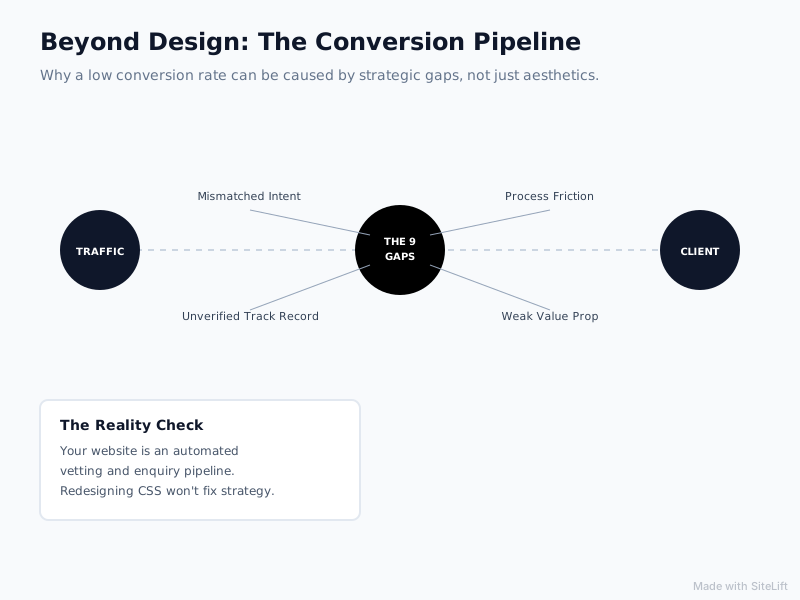
A sleek website cannot rescue an offer with mismatched intent, an unverified track record, or a contact process loaded with unnecessary friction. If you run a high-ticket B2B company, a specialized consultancy, or a local trade enterprise, your website is not an online brochure; it is an automated vetting and enquiry pipeline. When that pipeline breaks, redesigning your CSS will not fix it.
Let's dissect what causes a low conversion rate for service businesses, the nine critical funnel gaps that drain your pipeline, and how to fix them without blowing tens of thousands of dollars on an unnecessary full rebuild.
What Does a Low Conversion Rate Mean for a Service Business?
Unlike an e-commerce store selling impulse purchases from an Instagram ad, a service business sells trust, problem resolution, and specialized expertise. That fundamental distinction completely changes how you define and benchmark conversion.
How Is Conversion Rate Defined for Enquiry-Based Businesses?
In an online retail store, a conversion is simple: an item enters the cart, a credit card is charged, and an order is placed.
For an enquiry-based service business, a conversion occurs when a qualified prospect takes a deliberate step toward becoming a client. That typically looks like:
- Submitting a detailed project enquiry form
- Booking an introductory consultation on an embedded calendar
- Initiating a phone call via a mobile click-to-call link
- Engaging with an on-site chat assistant to check service availability
The operative word here is qualified. If your site generates 50 enquiries a month, but 45 of them are tyre-kickers who cannot afford your retainers or who reside outside your service territory, your conversion funnel is broken at the positioning level.
What Is a Good Conversion Rate for Service Websites?
Benchmark data varies wildly depending on your acquisition channel and transaction size. According to research published by Unbounce, the median landing page conversion rate across all industries sits around 6.6%, but service businesses often operate within a tighter 1% to 4% window when measuring cold search traffic directly to enquiry.
If your services cost $5,000 to $50,000, prospects will not fill out a contact form on a whim. They need validation, clarity, and reassurance.
Context dictates your target baseline:
| Traffic Source / Context | Typical Enquiry Conversion Rate | Primary Intent |
|---|---|---|
| High-Intent Search Ads | 3% – 8% | Immediate commercial need |
| Organic Informational Search | 0.5% – 2% | Research, education |
| Referrals & Direct Visits | 5% – 12% | High trust, pre-validated |
| Cold Social Campaigns | 0.5% – 1.5% | Interruption, passive curiosity |
Infographic by SiteLift
If you are hovering below 1% across commercial pages, something is fundamentally wrong. To diagnose the bleed, you must evaluate the entire prospect journey.
Why a Low Conversion Rate Can Be Caused by Intent Mismatches and Positioning
When founders ask why website traffic is not converting into enquiries, they usually point fingers at the landing page itself. But conversion problems frequently start long before a user lands on your site.
Gap 1: Are You Attracting the Wrong Visitors Due to Mismatched Search Intent?
One of the most frequent causes of low conversion rate service business owners run into is targeting traffic with purely informational intent.
If your accounting firm ranks number one for "what is capital gains tax," you will attract university students, casual investors, and homeowners looking for quick definitions. Almost none of them are ready to hire a corporate tax accountant. Conversely, ranking for "commercial tax planning services for transport companies" will draw a fraction of the volume, but almost every visitor has high purchasing intent.
A low conversion rate can be caused by casting too wide an organic net. If your marketing agency or SEO team reports a spike in organic traffic while enquiries stay flat, review your search queries in Google Search Console. You are likely accumulating vanity clicks that have zero commercial alignment with what you actually bill for.
Gap 2: Is Your Value Proposition Unclear in the First 5 Seconds?
When a visitor lands on your site, they need immediate answers to three basic questions:
- What specific problem do you solve?
- Who do you solve it for?
- Why should they trust you over the competitor down the street?
Too many service websites hide behind corporate word salads: "We deliver innovative business solutions that scale your potential." What does that mean? Are you a software consultancy? A commercial cleaning firm? A recruitment agency?
If a potential client cannot decipher your service within five seconds, they hit the back button. Your headline should be plain, direct, and outcome-focused.
Pro Tip: Replace vague mission statements with a concrete positioning formula: [Outcome] for [Specific Audience] through [Unique Mechanism]. For example: "We help multi-location dental clinics reduce patient no-shows by 40% using automated SMS routing."
Gap 3: Are Missing Trust Signals Making Prospects Hesitate?
High-consideration service purchases carry real risk. If a client hires the wrong civil engineer, commercial roofer, or business litigation lawyer, they face severe financial and reputational consequences.
If your site lacks proof, visitors will leave. According to local search research from BrightLocal, over 85% of consumers read online reviews before choosing a local service business.
Yet, dozens of established firms hide their testimonials on an orphaned page in the navigation bar. If you want visitors to convert, integrate trust proof directly into the conversion path:
- Prominent client logos or trade accreditations
- Verifiable reviews with names, faces, and company titles
- Mini case studies detailing the before-and-after metrics
- Clear, transparent explanations of your onboarding process

What Hidden Funnel Gaps Cause Prospects to Leave Before Enquiring?
Even if your positioning is sharp and your traffic is qualified, structural friction in the buying path can kill your numbers.
Gap 4: Is Too Much Friction Blocking the Enquiry?
Every form field you require lowers the likelihood that a lead will finish submitting. If a prospective client just wants to ask about your availability, forcing them to submit their budget, project start date, physical address, and company registration number is an immediate conversion killer.
Usability guidelines established by the Nielsen Norman Group consistently emphasize that reducing cognitive load and input effort directly improves form completion rates.
Friction also takes the form of ambiguous pricing. While you may not be able to give an exact quote on a complex service, providing pricing brackets, starting rates, or transparent "how we charge" explainers filters out bad fits while giving serious buyers the confidence to reach out.
If you are looking to streamline these enquiry paths, reviewing proven website conversion rate optimization for service businesses will show you how minor adjustments to form architecture yield major gains.
Gap 5: How Do Slow Load Times and Poor Mobile Experience Kill Conversions?
Speed is not just a technical metric; it is an empathy metric. If your website takes four seconds to load on a mobile device, you are telling the prospect that their time is not valuable.
According to data compiled by Think with Google, 53% of mobile site visits are abandoned if a page takes longer than 3 seconds to load.
When mobile users encounter tiny touch targets, jumpy layout shifts (Cumulative Layout Shift), or unformatted PDFs instead of responsive content, they abandon the session immediately. You can test your site's current vitals directly through Google PageSpeed Insights to see where code bloat or oversized images are strangling your page experience.
For practical steps on fixing load times, see our breakdown of website performance optimization tips.
Gap 6: Can Visitors Get Answers After Hours When You Are Closed?
Here is an uncomfortable reality for service operators: nearly half of your prospects are researching solutions outside normal business hours.
They are browsing on a Sunday evening while thinking about their week ahead, or browsing late on a Tuesday night after their kids have gone to bed. If your only call to action is a generic form that states, "We will get back to you within 2 business days," you are missing motivated prospects.
Modern service sites use automated booking calendars or conversational AI assistants to answer basic qualifying questions, check availability, and capture contact details 24/7. When an after-hours visitor can get immediate validation, their likelihood of leaving for a competitor drops dramatically.
How Slow Lead Response Time and Poor Follow-Up Hurt Conversion
Conversion does not end when a user clicks "Submit." If your analytics dashboard logs a conversion, but that enquiry never turns into a booked discovery call, your commercial conversion rate is zero.
Gap 7: How Fast Are You Responding to New Enquiries?
Slow lead response time and conversion failure are inextricably linked.
Groundbreaking research published by the Harvard Business Review revealed that companies attempting to contact leads within an hour are nearly 7 times more likely to qualify the prospect than those waiting even an hour longer. When firms wait 24 to 48 hours to return a contact form enquiry, they are essentially handing that client over to a competitor.
Furthermore, historic sales benchmarks from InsideSales.com indicate that 78% of buyers purchase from the company that responds to their enquiry first. Speed to lead is not an administrative detail; it is a core conversion engine.
Gap 8: Do You Have a System to Qualify and Nurture Every Lead?
Not every lead is ready to sign a contract on day one. Some are scouting service providers for a project starting next quarter.
If your team treats every lead as a binary "buy now or disappear" interaction, you waste valuable acquisition spend. A functional funnel incorporates automated email follow-ups, helpful onboarding materials, and a clear triage mechanism to separate immediate commercial buyers from long-term nurture opportunities.
Gap 9: Are You Tracking the Right Conversion Actions?
Most service business dashboards are woefully incomplete. They track standard Google Analytics form submissions, but they have no visibility into:
- Inbound phone calls generated from mobile devices
- Interactions with live chat or conversational assistants
- Clicked email links
- Form abandonment rates (visitors who started typing their name but stopped at the budget field)
If you do not track calls and chat interactions alongside web forms, your conversion data is flawed. You might conclude that your search campaign is failing, when in reality, it is generating phone calls that your CRM simply failed to attribute. Deploying the right website conversion optimization tools gives you an honest, holistic picture of where leads actually originate.
Key Takeaways: The 9 Conversion Funnel Gaps
Before looking at diagnostic steps, here is how the nine funnel gaps compare in terms of impact and effort to fix:
| Funnel Gap | Where the Leak Occurs | Typical Impact on Conversions | Effort to Fix |
|---|---|---|---|
| 1. Intent Mismatch | Traffic Acquisition | Severe (wasted spend) | Medium (keyword prune) |
| 2. Vague Value Prop | Above-the-fold Landing | High (immediate bounce) | Low (copy rewrite) |
| 3. Absent Trust Signals | Consideration Phase | High (hesitation) | Low (asset collection) |
| 4. Enquiry Friction | Form Interaction | Medium-High (abandonment) | Low (field reduction) |
| 5. Technical Drag | Site Loading / Usability | Severe (mobile bounce) | Medium (code/image clean) |
| 6. After-Hours Silence | Off-Hours Visits | High (lost night/weekend leads) | Medium (AI / calendars) |
| 7. Slow Response Time | Post-Submission Phase | Critical (lost deal to competitor) | Low (automation triggers) |
| 8. Weak Lead Nurture | Follow-Up Stage | Medium (decaying leads) | Medium (email sequences) |
| 9. Tracking Blind Spots | Analytics / CRM | Invisible leak (poor decisions) | Medium (call tracking setup) |
When a Low Conversion Rate Can Be Caused by Pipeline Leaks: Our Perspective
In our experience working with established service firms, founders almost always overcomplicate the solution to poor conversions. They convince themselves that their brand identity is broken, hire a branding agency for $40,000, and spend six months debating colour palettes and vector illustrations.
Meanwhile, their actual problem was embarrassingly simple: their contact form asked for 11 fields, their mobile site took five seconds to load over 4G, and their sales inbox sat untouched between Friday afternoon and Monday morning.
Stop rebuilding websites that don't need rebuilding. Conversion rate optimization is rarely an art project; it is an operational discipline. If you remove the friction, clarify your message, and respond to people before they close their browser tab, your pipeline will grow.
— growth-kings.com
How to Diagnose Conversion Problems Without a Full Website Rebuild
If you want to uncover exactly how to diagnose conversion problems across your existing pages, you don't need a six-month roadmap. Run this five-step audit this week.
Where to Start: A Practical 5-Step Conversion Audit
- Audit Traffic Intent in Analytics: Go to your search analytics and sort pages by impressions versus conversions. Identify landing pages that pull thousands of visits but zero enquiries. If the search terms are purely educational, add tailored, low-friction lead magnets or redirect your conversion focus to commercial service pages.
- Review the Top 3 Landing Pages on Mobile: Open your website on your phone using cellular data, not office Wi-Fi. Can you instantly tell what the business does? Is there a persistent click-to-call button or a frictionless booking button? Does the page load in under 3 seconds?
- Mystery-Shop Your Own Enquiry Form: Fill out your contact form as an anonymous prospect. Does the form work smoothly without validation errors? Does an automated confirmation email arrive immediately? How long does it take for a real person on your team to call or reply?
- Inspect Off-Hours Behaviour: Look at your traffic distribution by time of day. If 40% of your visitors land between 6:00 PM and 7:00 AM, review what happens when they land on your site. If they cannot book an appointment or get an immediate response, you are losing after-hours revenue.
- Set Up Comprehensive Attribution: Ensure dynamic call tracking is enabled for mobile visitors and that secondary micro-conversions (e.g., chat interactions, pricing guide downloads) are logged accurately in your analytics platform.
Which High-Impact Fixes Should Service Businesses Prioritize First?
To get the fastest ROI on your optimization efforts, tackle these updates in order:
- Rewrite your hero copy: Ensure your primary headline states clearly what you do, who you help, and where you do it.
- Streamline contact forms: Cut your fields down to 3 or 4 essential pieces of information: Name, Email, Phone Number, and a brief description of the project.
- Embed instant booking calendars: Let qualified leads bypass the "email tag" game by directly selecting a slot on your calendar.
- Deploy conversational capture: Implement an AI-powered conversational assistant to qualify leads and answer FAQs after hours.
- Set up automated SMS/email acknowledgements: The instant someone fills out an enquiry, confirm receipt and clarify when they will hear from your team.
At Growth Kings, we focus on these precise operational levers. Rather than pushing costly, disruptive website overhauls, our team optimizes existing digital assets for clarity, trust, and speed. By bridging the gaps between search visibility, site usability, and automated after-hours lead handling, we help established service businesses transform wasted traffic into high-value pipeline.
Frequently Asked Questions About Low Conversion Rates
What is a good conversion rate for a service business website?
For high-ticket or commercial service businesses, a site-wide conversion rate between 2% and 5% is standard for qualified commercial traffic. Pure informational traffic often converts at less than 1%, whereas targeted paid search campaigns or direct referral traffic can exceed 8% when landing pages are tightly aligned with user intent.
Why is my website getting traffic but no enquiries?
A low conversion rate can be caused by mismatched search intent, an unclear value proposition, or absent social proof. If you are ranking for broad informational queries, visitors may be looking for quick facts rather than hiring a service provider. Alternatively, your site may have excessive friction, such as complex forms or slow load speeds.
How does slow lead response time affect conversion rate?
Lead response time dramatically dictates downstream conversion. Harvard Business Review data shows that companies contacting leads within an hour are nearly 7 times more likely to qualify prospects than those that wait longer. Prospects frequently contact several providers simultaneously; the business that replies first often secures the contract.
How do I diagnose why my conversion rate is low?
Start by segmenting your analytics data by traffic source and device category. Check your page speed using Google PageSpeed Insights, review search query intent in Google Search Console, and test your own enquiry form on mobile. Look for drop-off points, check whether after-hours visitors have a way to engage, and verify that call tracking is correctly configured.
Can I fix a low conversion rate without redesigning my whole website?
Yes. In most cases, a full website redesign is unnecessary and can even harm existing rankings. High-impact improvements like clarifying the primary headline, cutting form fields, improving mobile page speed, adding clear trust badges, and installing an after-hours conversational assistant can dramatically boost conversion rates without altering your underlying site architecture.
Want this working on your own site?
Tell us what’s working, what’s stuck and what you want to improve. We will reply personally.