AI Conversion Optimization: How Smart Service Sites Turn More Clicks Into Clients
Discover how AI conversion optimization turns website clicks into qualified clients. Learn multi-armed bandit testing, 24/7 lead triage, and personalization.
By Growth Kings. Published . 17 min read.

AI Conversion Optimization: How Smart Service Sites Turn More Clicks Into Clients
If you run an established service firm, you already know the frustration of watching hard-earned traffic vanish without a trace. You invest in search visibility and paid campaigns, yet the vast majority of visitors leave without booking a call or requesting a quote.
Deploying ai conversion optimization changes this dynamic entirely, turning an otherwise static brochure site into an adaptive engine that responds to buyer intent in real time.
For years, conversion rate optimization (CRO) was built for high-volume consumer retail. If you sell $40 sneakers, running split tests across 100,000 monthly visitors is easy. But when you offer premium legal counsel, commercial consulting, engineering, or boutique agency services, your traffic is naturally more focused and your deal sizes are significantly higher. You cannot afford to wait six months for a traditional split test to reach statistical confidence while qualified prospects slip away to competitors.
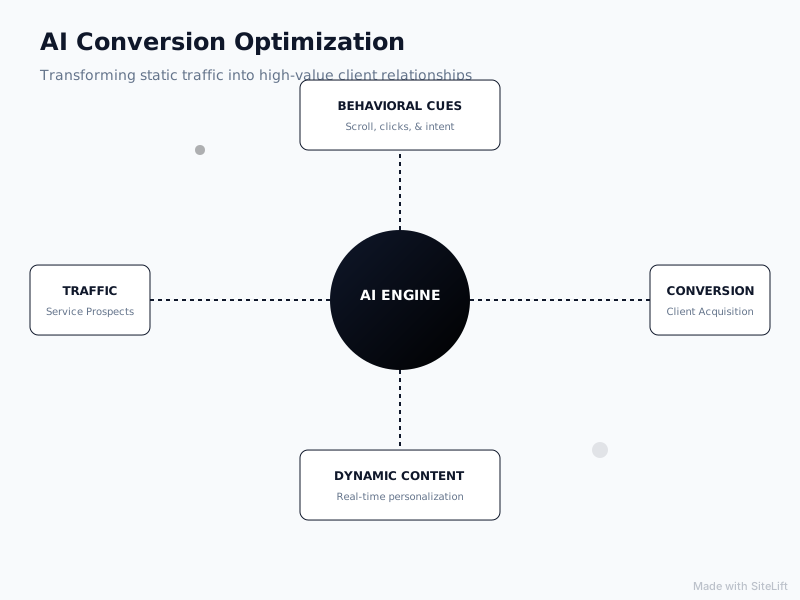
Machine learning bridges this gap. By analyzing real-time behavioral cues, predicting user intent, and tailoring messaging dynamically, modern optimization platforms help service firms capture qualified enquiries from the traffic they already have.
What Is AI Conversion Optimization (and Why Does Traditional CRO Fail Service Sites)?
At its core, ai conversion optimization refers to using machine learning algorithms, natural language processing, and predictive analytics to systematically improve the percentage of website visitors who take a high-value commercial action.
Rather than relying on human guesswork to formulate hypotheses, AI systems analyze live behavioral patterns, traffic sources, scroll velocity, and interaction data to dynamically serve the copy, layout, or call-to-action (CTA) most likely to convert that specific visitor.
The Limitations of Static A/B Testing for Moderate-Traffic Websites
Traditional CRO relies almost exclusively on static A/B split testing. In that legacy framework, you split your incoming traffic 50/50 between two static variants (Page A and Page B) and wait until a tool calculates a 95% statistical significance level.
For a consumer brand generating 500,000 pageviews a week, reaching that threshold takes days. For a specialized B2B or professional service firm pulling in 3,000 to 10,000 targeted visitors a month, a standard split test often requires four to nine months to yield a conclusive winner.
Traditional A/B Split Testing (Slow & Rigid):
Variant A (50% traffic) ──┐
                          ├──> Wait 3-6 months ──> Static Winner Selected
Variant B (50% traffic) ──┘    (Losing 50% of conversions during the test)

AI Multi-Armed Bandit Testing (Dynamic & Efficient):
Variant A ──┐
Variant B ──┼──> Machine Learning Engine ──> Automatically shifts traffic
Variant C ──┤    evaluates live intent        to top performers daily
Variant D ──┘
During those months, half of your valuable commercial traffic is deliberately routed to an underperforming variant. Even worse, static tests assume that all visitors think alike. A Chief Financial Officer arriving via organic search for enterprise compliance has vastly different priorities than an operations manager clicking a LinkedIn ad for operational troubleshooting. Forcing both into the same static test guarantees suboptimal outcomes.
How Machine Learning Transforms Conversion Rate Optimization into an Autonomous Engine
Machine learning flips this dynamic upside down. Instead of asking, "Which single headline works best for everyone?" AI CRO asks, "Which variation of our value proposition works best for this specific prospect right now?"
The system monitors micro-signals:
- Referrer channels and search terms
- Visitor geography and local business hours
- Device category, operating system, and network speed
- On-page navigation paths and interaction cadence
When the algorithm recognizes patterns that correlate with high-intent decision-makers, it adjusts the user experience instantly. This shifts optimization from a periodic, post-mortem reporting ritual into an active, continuous feedback loop.
How AI Website Testing and Personalization Deliver Real-Time Clarity
To capture high-ticket contracts, your website must answer one foundational question within seconds: "Does this firm understand my specific problem, and can I trust them to solve it?"
Employing ai website testing and personalization makes answering that question seamless by matching website presentation to visitor intent.
Dynamic Multi-Armed Bandit Testing vs. Traditional Split Testing
The biggest technical leap in modern testing is the shift from classical hypothesis testing to multi-armed bandit (MAB) algorithms. Named after the classic probability problem of choosing which slot machines to pull to maximize winnings, MAB algorithms dynamically allocate web traffic toward winning variations while the test is actively running.
If Variation C begins converting visitors at twice the rate of Variations A and B on day three, the algorithm automatically routes 70% of subsequent traffic to Variation C. It continues reserving a smaller percentage to test the other variants in case market conditions change.
| Feature | Traditional A/B Split Testing | AI Multi-Armed Bandit Testing |
|---|---|---|
| Traffic Allocation | Static 50/50 split throughout the test | Dynamically routes traffic to top-performing variants |
| Time to Impact | Months (demands large sample sizes) | Days or weeks (learns continuously) |
| Opportunity Cost | High (50% of traffic sees the loser) | Minimal (losing variations receive less traffic quickly) |
| Targeting Precision | Broad, aggregate audience average | Segment-specific and behavioral |
| Traffic Suitability | High-volume consumer sites | Ideal for low-to-moderate volume service sites |
For service businesses, this drastically shortens the time required to see meaningful enquiry increases. You avoid burning through qualified leads just to satisfy an academic sample size.
Personalizing Messaging Based on Traffic Source, Intent, and Firmographics
Prospects do not read service websites linearly; they scan for relevance. If your headline is generic, bounce rates skyrocket.
Through modern personalization tools, your site can dynamically modify hero copy, client logos, and social proof based on reverse-IP lookups and UTM parameters. For instance, if an IP address belongs to an engineering enterprise, your headline can emphasize structural compliance and technical rigor. If the visitor arrives from a boutique healthcare search query, the page highlights regulatory privacy and patient trust metrics.
According to research from McKinsey & Company, companies that excel at personalization generate 40 percent more revenue from those activities than average players. Achieving this does not require building forty separate websites. It requires an intelligent personalization layer sitting on top of your existing architecture, ensuring the messaging speaks directly to the reader's operational reality.
Pro Tip: Never personalize everything at once. Keep your core structural layout intact and focus dynamic personalization strictly on three high-leverage elements: your primary hero headline, the client proof logos directly below it, and the call-to-action trigger copy.
Maximizing Paid and Organic Traffic with AI Landing Page Optimization
High-intent organic clicks and paid search traffic represent expensive investments. When visitors land on your dedicated service pages, small frictions in page hierarchy or copy clarity can derail the conversion. Implementing targeted ai landing page optimization helps you locate and repair those friction points without months of design deliberations.
Automated Friction Detection and Layout Refinement
Traditional heatmap analysis requires a marketer to sit through dozens of hours of recorded user sessions, squinting at cursor wiggles to guess why visitors abandoned a page.
AI-powered journey mapping automates this diagnostic work. Machine learning models ingest thousands of anonymized sessions simultaneously, cross-referencing user interactions with drop-off rates. These models quickly isolate anomalous behaviors, such as:
- Rage-clicking: When users tap non-clickable elements or dead links repeatedly out of confusion.
- Scroll stalls: Sections where users abruptly stop scrolling and bounce, indicating confusing jargon, cognitive overload, or visual clutter.
- Form abandonment clusters: Specific form fields that trigger high exit rates (such as requesting phone numbers or revenue figures too early).
Instead of subjective opinions in a boardroom, you receive empirical recommendations highlighting the exact structural elements driving prospects away. If you want to dive deeper into the software powering these workflows, check out our guide on the 7 Top Website Conversion Optimization Tools for Service Firms.
Optimizing Calls to Action and Value Propositions for High-Intent Buyers
Service firm buyers rarely click a bright red button that says "Buy Now." Their buying cycle involves risk assessment, internal stakeholder sign-off, and substantial financial commitment.
AI tools evaluate semantic engagement across your page sections to align CTAs with buyer readiness. If a user spends three minutes consuming an in-depth case study, hitting them with an aggressive "Book a Paid Diagnostic" pop-up can backfire. Conversely, an algorithmic trigger presenting a contextual "Download the Structural Audit Checklist" or inviting them to a low-pressure discovery consultation can double conversion rates.
Focusing on targeted, high-impact refinements on your core service pages protects you from the expense, disruption, and SEO risks of unproven full-site redesigns.
How Conversational AI Drives Enquiry Growth After Hours
The traditional service business website is fundamentally passive. It acts like a digital brochure, presenting static paragraphs and expecting the visitor to fill out an open-ended contact form.
By integrating conversational ai for enquiry growth, you introduce an active, interactive guide that engages visitors, addresses objections, and captures qualified leads at any hour.
Passive Website Model (High Friction):
Visitor Lands ──> Reads Static Text ──> Hits 6-Field Form ──> 70% Abandonment
                                                              └──> 24-Hour Email Lag

Conversational AI Model (Zero Friction):
Visitor Lands ──> Interactive Diagnostic ──> Instant Triage ──> Real-Time Calendar
                                         ──> Answers FAQs   ──> Direct CRM Routing
Replacing Passive Contact Forms with Interactive Diagnostic Experiences
Generic forms are conversion killers. They present empty boxes, provide zero upfront value, and leave the prospect wondering when—or if—a human will respond.
Conversational interfaces flip this dynamic into an interactive diagnostic consultation. Rather than asking a visitor to submit their email and wait, an intelligent conversational assistant asks guided questions:
- "What specific operational challenge are you looking to resolve?"
- "What is your timeline for implementing this solution?"
- "What is the approximate size of your internal team?"
Because the conversation is interactive, prospects gladly provide details that they would omit on a cold, intimidating static form.
Capturing, Qualifying, and Scheduling High-Value Prospects 24/7
A massive percentage of commercial research occurs outside standard business hours. Executives and practice managers often research new service partners at 9:00 PM or over the weekend when daily meetings subside.
If their enquiry sits in an unmonitored inbox until Monday morning, that lead cools rapidly. In fact, research published by the Harvard Business Review found that businesses contacting prospects within an hour of receiving an enquiry are nearly seven times more likely to qualify the lead than those who wait even an hour longer.
Time to Contact vs. Lead Qualification Likelihood:
Within 1 Hour:  ████████████████████ (7x More Likely to Qualify)
After 1+ Hours: ███
Conversational AI solves the "speed-to-lead" crisis completely. It qualifies the prospect using your firm's specific acceptance criteria, answers detailed scope questions using your knowledge base, and embeds your scheduling calendar directly into the chat flow. The prospect goes to bed with a confirmed discovery meeting on their calendar, and your sales team wakes up with a fully briefed, high-intent consultation.
To explore the architecture behind building these workflows, read our breakdown on using an AI Lead Qualification Chatbot to automate after-hours growth.
Predictive Lead Scoring: Turning Anonymous Web Clicks into Qualified Consultations
Not all website traffic is created equal. A job seeker downloading white papers, a student researching an essay, and a prospective client evaluating your pricing require completely different responses.
Using a predictive lead scoring website framework allows you to unmask buyer intent and prioritize high-value commercial relationships automatically.
Tracking Micro-Behaviors to Quantify Buying Intent
Predictive models evaluate dozens of micro-behaviors across a user's session to assign an algorithmic intent score:
- Consumption Depth: Did the visitor browse your career page, or did they spend four minutes scrutinizing your enterprise implementation methodology?
- Pricing & Scope Signals: Did the user interact with service scope matrices or check timeline calculators?
- Velocity & Return Frequency: Has this user visited three times in the last 48 hours from a corporate network?
By correlating these behavioral markers with your historical sales pipeline, the AI identifies which anonymous visitors match the profile of a paying client.
According to Salesforce's State of Marketing report, 68% of marketing leaders report that AI has improved their ability to personalize customer experiences across digital touchpoints. Lead scoring takes those personalized experiences and connects them directly to pipeline value.
Automating Escalation and Instant Routing for Urgent Commercial Inquiries
When an anonymous user's predictive score crosses your qualification threshold, you do not have to wait for them to stumble onto a contact page.
The website can automatically elevate the experience:
- Contextual Engagement: The conversational assistant can proactively trigger: "It looks like you're reviewing our corporate restructuring framework. Would you like a brief overview of our onboarding timeline?"
- Instant Team Routing: If the prospect is engaged, an alert pings your senior consulting team via Slack or Microsoft Teams. If an advisor is online, they can step directly into the live chat, converting an anonymous visit into an active commercial dialogue in real time.
When planning these handoffs, ensuring a smooth transition between bot and human is critical. Our step-by-step guide on the AI Chat Human Handoff Protocol details how to route these leads directly into your CRM without friction.
How to Implement AI Conversion Optimization on an Existing Site (Without a Rebuild)
The single biggest misconception holding service businesses back is the belief that adopting modern AI requires tearing down their current website and spending $30,000 on an agency rebuild.
That mindset is an expensive mistake. Full-site rebuilds take months, risk existing search rankings, and introduce brand-new usability issues. You can achieve far greater conversion lifts by deploying modular AI enhancements directly onto the site you already own.
Infographic by SiteLift
Conducting a Conversion Audit to Pinpoint Immediate Gains
Before turning on any software, you must locate your baseline conversion metrics and friction points:
- Calculate Baseline Speed-to-Lead: What is the average time between an enquiry hitting your inbox and a qualified team member responding?
- Identify Primary Drop-Off Hubs: Look at Google Analytics 4 to isolate service pages with high traffic but minimal outbound clicks to your contact or booking pages.
- Audit Information Clarity: Does your hero copy clearly state what you do, who you serve, and the measurable outcome you deliver within five seconds?
Layering Modular AI Tools onto Your Existing Tech Stack
Once you know where the leaks are, implement targeted, script-based AI modules:
Step 1: Audit Current Baseline
└── Identify drop-offs, speed-to-lead delays, and copy friction.

Step 2: Install Behavioral Tracking & Intent Scoring
└── Run silent session scoring to observe buyer micro-behaviors.

Step 3: Deploy After-Hours Conversational Assistants
└── Capture evening and weekend enquiries with direct calendar booking.

Step 4: Launch Multi-Armed Bandit Dynamic Personalization
└── Test headlines and social proof continuously on your highest-traffic service pages.
By layering modular solutions over your current WordPress, Webflow, or custom CMS site, you begin capturing lost revenue immediately while gathering proprietary data about your buyers.
Key Takeaways
| Pillar | Core Challenge | The AI CRO Solution | Primary Business Metric |
|---|---|---|---|
| Testing | Low traffic makes static A/B split testing impractical | Multi-armed bandit testing dynamically routes traffic to top-performing variants | Days-to-statistical-clarity |
| Personalization | Generic messaging fails to address diverse stakeholder needs | Dynamic copy and proof-point swapping tailored to traffic source and industry | Conversion rate to enquiry |
| Landing Pages | Undetected cognitive overload and form friction drive visitors away | Algorithmic heatmapping and automated friction leak detection | Bounce rate & time on page |
| Lead Capture | Unmonitored contact forms lose high-intent buyers after hours | 24/7 conversational triage, qualification, and automated booking | Speed-to-lead & booked consultations |
| Pipeline Routing | Sales teams waste time chasing low-intent tire-kickers | Predictive behavioral scoring prioritizes high-value buyers | Cost per qualified lead (CPQL) |
Why Full Website Rebuilds Are Overrated (An Editorial Perspective)
Whenever a service firm's enquiry pipeline dries up, the default reaction is almost always: "We need a new website."
Six months, thousands of billable hours, and tens of thousands of dollars later, the company unveils a sleek, animated, aesthetically pleasing new site. And what happens to their conversion rate? More often than not, it stays exactly the same—or drops because internal page URLs, hierarchy, and legacy search signals were scrambled during the migration.
I believe full website rebuilds are one of the most over-prescribed, low-ROI investments in the digital service sector.
A pretty website does not generate clients; clarity, speed, and trust do.
Visitors do not leave your website because your typography is slightly outdated. They leave because:
- They cannot figure out what you actually do within five seconds.
- They cannot find proof that you have solved their exact problem before.
- They run into a monolithic contact form and do not want to wait 48 hours for an ambiguous email reply.
Deploying modular AI conversion optimization allows you to treat your digital presence like an evolving asset rather than a disposable brochure. You preserve your established search equity, maintain brand stability, and methodically fix the specific leaks losing you business. It is faster, more cost-effective, and directly accountable to your bottom line.
Pro Tip: Before signing a contract for a comprehensive website redesign, spend 60 days optimizing your three most important service pages using dynamic messaging and conversational triage. The revenue generated from those modular adjustments will often pay for any aesthetic upgrades you choose to make later.
Turning Traffic into Revenue with Growth Kings
At Growth Kings, we help established service businesses eliminate conversion leaks and turn existing website visitors into a steady stream of qualified enquiries.
We do not believe in pitching vanity metrics, unneeded site overhauls, or empty ranking promises. Instead, our team focuses on what drives commercial growth:
- Clarity & Trust Audits: Re-architecting value propositions and on-page proof to build immediate authority with high-intent decision-makers.
- Intelligent Conversational Engines: Deploying custom AI assistants that qualify prospects, handle objections after hours, and book meetings directly into your calendar.
- Search Visibility & Lead Capture: Ensuring your organic and paid visitors are greeted by high-converting, friction-free conversion paths.
If your website generates traffic but fails to deliver the caliber of leads your business deserves, you do not need to start over from scratch. You simply need to make your existing assets work smarter.
— growth-kings.com
Frequently Asked Questions
How does AI conversion optimization differ from traditional CRO?
Traditional CRO focuses on manual split testing that divides traffic equally between static pages for months until aggregate significance is achieved. AI conversion optimization uses machine learning algorithms (such as multi-armed bandits) to analyze visitor behavior dynamically. It continuously directs traffic to the top-performing variations, personalizes messaging based on user context, and automates lead qualification in real time.
Can AI CRO work effectively on service sites with lower or moderate traffic?
Yes, and that is precisely where it outperforms traditional methods. Static A/B testing struggles on moderate-traffic service sites because gathering sufficient sample sizes takes too long. AI systems do not need massive traffic volumes to deliver value; they identify micro-behavioral patterns, triage individual prospects through conversational tools, and adjust messaging dynamically to capture the traffic you already have.
Do we need to completely rebuild our website to use AI conversion tools?
No. The most effective AI conversion enhancements are modular. They integrate into your existing tech stack via simple scripts or API connections. You can deploy dynamic headlines, automated friction tracking, and conversational qualification assistants directly onto your current WordPress, Webflow, Squarespace, or custom CMS setup without disrupting your design or search engine rankings.
How does conversational AI qualify service leads better than a standard form?
Standard contact forms are passive, impersonal, and force users to wait hours or days for a response. Conversational AI engages prospects immediately in a dynamic, diagnostic dialogue. It asks targeted questions to determine budget, scope, and urgency, answers complex questions using your knowledge base, and schedules qualified appointments directly into your team's calendar while the buyer's intent is at its peak.
What return on investment (ROI) should a service business expect from AI CRO?
Because professional service contracts typically have substantial lifetime values, even a modest improvement in conversion rates delivers significant commercial returns. Moving a site from a 1% to a 2% qualified enquiry rate doubles inbound opportunities without requiring any additional ad spend. When paired with faster response times and automated after-hours qualification, firms routinely see lower acquisition costs and a measurable increase in closed pipeline revenue.
Want this working on your own site?
Tell us what’s working, what’s stuck and what you want to improve. We will reply personally.