How to Write Converting Service Headlines: Turn 3 Seconds Into Qualified Enquiries
Learn how to write converting service headlines that turn 3 seconds into qualified enquiries with templates & tests.
By Growth Kings. Published , updated . 14 min read.

How to Write Converting Service Headlines: Turn 3 Seconds Into Qualified Enquiries
If you're learning how to write converting service headlines, here's the payoff: a visitor should know in 3 seconds who you help, what you do, and why to trust you. Get that right and your hero section stops leaking traffic and starts producing qualified enquiries.
This is not about clever slogans. It's a step-by-step tutorial for established service businesses — plumbers, law firms, clinics, agencies, home services — to write a clear high converting H1 for services, pair it with a supporting subheadline and CTA, then test it without a rebuild.
By the end, you'll have a new H1, subheadline, CTA, and a simple testing plan.
What Is a Converting Service Headline and Why Do 3 Seconds Matter?
A converting service headline is not your brand tagline. It's a clarity-first H1 that answers three questions instantly: Is this for me? Can they solve my problem? Should I trust them?
A clever slogan like “Excellence Delivered Daily” fails that test. A converting headline like “Emergency Plumber in Austin — On-Site in 60 Minutes, Upfront Pricing” passes it.
Speed matters because attention is brutal. According to Microsoft, the average human attention span is 8 seconds, which leaves you almost no room for confusion. Research from Nielsen Norman Group shows users often leave web pages within 10-20 seconds, and clear value propositions are what make them stay. I see this constantly: vague heroes get skimmed and abandoned.
Trust is decided just as fast. Research from Stanford University's Web Credibility Project found that 75% of users admit to making judgments about a company's credibility based on website design, according to Stanford Web Credibility Research on how design impacts trust. And on mobile, According to Google, 53% of mobile site visits are abandoned if a page takes longer than 3 seconds to load, as reported in Google’s insights on mobile page speed and abandonment. Slow + vague is a double bounce trigger.
How Visitors Decide to Stay or Bounce in the Hero Section
Visitors follow a ruthless scan pattern documented in Nielsen Norman Group research on how long users stay on web pages. They read your H1, glance at the subheadline, then look for proof and a next step.
If your H1 is generic, they assume the rest of the page will be generic too. If it’s specific, they scroll.
The Link Between Website Clarity Messaging and Qualified Enquiries
Strong website clarity messaging doesn’t just increase enquiries — it improves quality. When you name the audience and outcome, wrong-fit leads self-filter and right-fit leads feel seen.
That’s why learning how to write converting service headlines is a revenue skill, not a copywriting exercise.
What You Need Before You Write Converting Headlines
You don’t need copywriting talent. You need 90 minutes, access to customer language, and analytics.
Time required: 60-90 minutes to draft, 30 minutes to test Skill level: Beginner — no design or dev skills needed Tools: Google Analytics or similar, heatmap tool (Microsoft Clarity is free), Google Doc, mobile phone for preview
How to Audit Your Current Hero Headline and Bounce Behavior
Run this 10-minute audit first:
- Read your current H1 out loud. Could a stranger guess what you do and for whom? If not, it’s vague.
- Check mobile. Is your H1 truncated into 5 lines? Is your CTA below the fold?
- Look at engagement: high bounce on homepage + low scroll depth + low CTA clicks = headline mismatch.
- Take a screenshot. You’ll compare before/after.
Pro Tip: Record your screen while a friend views your homepage for 5 seconds on mobile, then ask what you do. Their hesitation is your brief.
What Customer Research to Gather First
Pull voice-of-customer phrases before you write a word:
- Last 20 five-star reviews: highlight outcome words (“on time,” “no mess,” “explained everything”)
- Enquiry forms and emails: what problem did they describe in their own words?
- Sales calls: what fears come up? Price? Timing? Trust?
- Lost deals: what objection killed it?
You need five inputs to draft: ideal client, core service, primary outcome, proof point, main CTA. If you’re missing proof, use specificity as proof for now — location, response time, specialization.

Step 1: Define Who You Help — How to Write Converting Service Headlines That Qualify
The first rule of how to write converting service headlines is to repel as much as you attract. Broad headlines like “We Help Businesses Grow” attract everyone and convert no one.
Use this formula:
We help [specific service business audience] get [desired result] without [pain]
Examples:
- We help busy homeowners get same-day plumbing repairs without surprise fees
- We help dental clinics get fully booked implant consults without discounting
- We help law firms get qualified injury cases without chasing unqualified calls
How to Niche Your Audience Without Excluding Buyers
You’re not excluding buyers — you’re signaling relevance. Name your best buyer in the H1, welcome others in the subheadline.
Instead of “Marketing Services for All Industries,” try “SEO for Multi-Location Home Service Companies.” A restaurant owner will self-filter, which is good. A plumbing franchise will lean in.
Action: Write one sentence: “My best clients are ___ who struggle with ___.” Use their words, not your internal jargon.
How to Choose One Measurable Outcome for Your H1
Pick one outcome your H1 will promise. Not three. One.
List your top 3 client pains, then flip each to an after-state:
- Pain: waiting around all day → After: on-site in a 2-hour window
- Pain: fear of being overcharged → After: upfront flat-rate quote
- Pain: no calls after hours → After: every inquiry answered in under 5 minutes
Expected result: A clear audience + outcome statement you can plug into templates in Step 3.
Mistake to avoid: Trying to rank for everything in the H1. Save SEO variations for service pages and title tags.
Step 2: How Do You Turn Features Into Service Value Proposition Copy?
Features describe you. Service value proposition copy describes the client’s win. Visitors don’t buy “25 years experience” or “full-service solutions.” They buy speed, certainty, and ease.
Translate like this:
- We offer 24/7 dispatch → You never wait overnight for help
- Certified and insured → Vetted pros you can trust in your home
- Free consultation → Get a clear plan and price before you commit
Features vs. Benefits vs. Outcomes for Service Businesses
Think in three layers:
- Feature: What you do (drain cleaning, tax prep, Invisalign)
- Benefit: Why it’s better (no digging, no IRS stress, no metal braces)
- Outcome: What life looks like after (drains guaranteed 90 days, refund maximized, straighter teeth in 6 months)
Your H1 should lead with outcome. Your subheadline can mention the feature that delivers it.
How to Add Differentiation and Risk Reversal
Once the outcome is clear, add why you. Pick one differentiator:
- Speed: same-day, 60-minute response, after-hours answering
- Specialization: only for personal injury, only for SaaS, only for homes built before 1980
- Guarantee: upfront pricing, no-show credit, 12-month warranty
- Local trust: 4.9 stars from 480+ local reviews, licensed in [state/city]
Action: Draft your one-sentence subheadline: “How it works + who it’s for + why trust us.” Example: “Book in 60 seconds. Licensed plumbers arrive in a 2-hour window with upfront pricing and 480+ 5-star reviews.”
Pro Tip: If you have an AI assistant or after-hours answering, mention availability in the subheadline. “Answered 24/7, even at 2am” removes a huge service-business fear.
Step 3: How to Write Converting Service Headlines With Proven Templates
This is where how to write converting service headlines gets practical. Use Outcome + Audience + Timeframe/Proof.
Here are five service website hero headline examples you can steal:
- Outcome + Timeframe: “Get a Fully Booked Calendar in 90 Days for Your Dental Clinic”
- Audience + Pain Removed: “Plumbing Repairs for Busy Homeowners — No Waiting, No Surprise Fees”
- Service + Guarantee: “Flat-Rate AC Repair in Dallas, Fixed Today or You Don’t Pay the Service Fee”
- Specialist Angle: “Personal Injury Leads for Texas Law Firms — Pre-Screened, Exclusive to You”
- Local Trust Angle: “Trusted Roof Replacement in Denver — 4.9 Stars From 600+ Homeowners”
Keep your high converting H1 for services to 6-12 words, under 70 characters when possible. Front-load keywords naturally for SEO, but write for humans first.
5 Proven Service Website Hero Headline Examples and Templates
Use this before/after table to diagnose your own hero:
| Before (Vague) | After (Converting) | Why It Works |
|---|---|---|
| Welcome to Smith & Co. | Injury Lawyers for Busy Families — Free Case Review in 24 Hours | Names audience + offer + speed |
| Quality Solutions for All Your Needs | Same-Day HVAC Repair in Phoenix With Upfront Pricing | Specific service + location + risk reversal |
| We’re Passionate About Design | Websites for Service Businesses That Turn Visits Into Booked Calls | Outcome, not passion |
| Leading Provider Since 2005 | Book More Jobs: SEO + Fast Websites for Home Services | Benefit-led, niche-specific |
| Contact Us Today | Get My Fixed Quote in 60 Seconds | Action + speed + clarity |
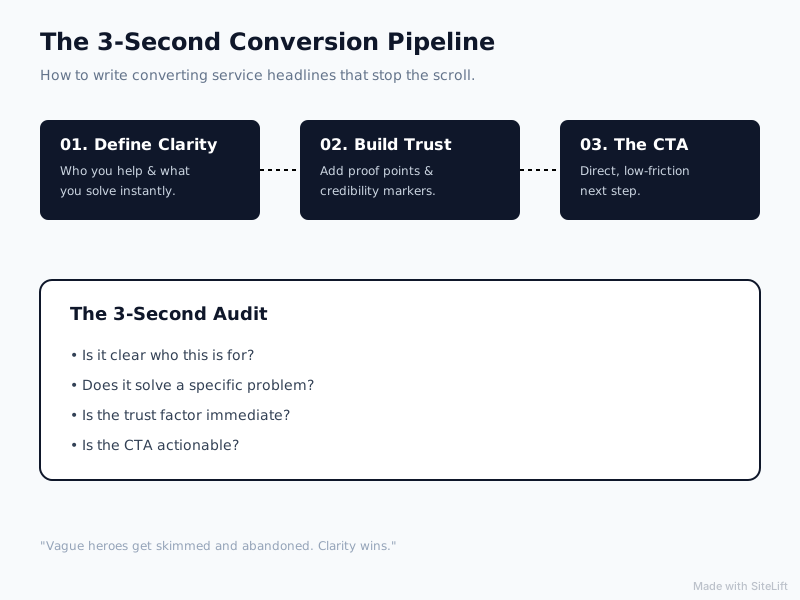
Infographic by SiteLift
For more headline inspiration backed by testing, browse the Unbounce guide to landing page headlines and conversion copy to see what patterns consistently lift conversions.
How to Pair Your H1 With Subheadline and CTA for Clarity
A great H1 fails with a weak supporting cast. Use this stack:
H1 (what + for whom): Same-Day Plumber in Austin — On-Site in 60 Minutes Subheadline (how + proof): Licensed pros, upfront flat-rate pricing, 4.9 stars from 820+ reviews. Book in 60 seconds, answered 24/7. CTA (one primary): [Get My Upfront Price] Micro-trust line: No overtime fees • 90-day guarantee
Expected result: A complete hero block ready to publish.
Mistakes to avoid: Three competing buttons, keyword-stuffed H1s like “Plumber Austin TX Best Cheap Emergency Plumber Near Me,” and desktop-only copy that wraps badly on mobile. Test on a real phone.
In my experience, most service businesses don’t have a traffic problem — they have a translation problem. I think clarity is wildly underrated because it feels too simple to be strategic. But swapping “Full-Service Digital Solutions” for “We Turn Service Websites Into Qualified Enquiries — Without a Rebuild” will always win. Clever makes you smile. Clear makes you money.
Step 4: Test and Refine Your Headline for More Enquiries
Don’t debate headlines in a meeting room. Test them with real brains and real behavior.
How to Run a 5-Second Test and Message Clarity Check
- Show your new hero to 5 people (2 colleagues, 3 ideal customers or friends who match them) for 5 seconds on mobile.
- Hide it and ask: Who is this for? What do they do? What would you click next? Would you trust them?
- If 4 out of 5 can’t answer, simplify. Cut adjectives, add specifics.
Run the same test on your old headline. The difference is usually embarrassing — in a good way.
How to A/B Test Hero Headlines Without a Full Rebuild
You don’t need a redesign. Use VWO, Optimizely, or even your CMS’s built-in test to rotate H1s.
What to track for 2-4 weeks:
- Bounce rate on homepage / service page
- Scroll depth past hero
- CTA click-through rate
- Qualified enquiry rate (not just form fills — track sales-accepted leads)
If you get clicks but no enquiries, read this breakdown of why high click through rate low conversion happens and how to fix message match. Often the ad promises one thing and the H1 says another.
Expected result: One winning H1 with data, not opinions.
What Are Common Service Headline Mistakes That Kill Conversions?
After auditing dozens of service sites, these are the repeat offenders:
1. “We do everything” syndrome “We offer plumbing, electrical, HVAC, remodeling and more!” Translation: we’re expert at nothing. Fix: one page, one audience, one H1. Create separate service pages.
2. “Welcome to our site” Wastes your most valuable pixels. Fix: delete it. Start with outcome.
3. Jargon-heavy headlines “Leveraging synergistic solutions to optimize workflows.” Fix: write like a customer talks. Read reviews out loud.
4. Missing proof Big claim, zero evidence. Fix: add stars, count, license, guarantee, or town names right under the H1. Learn how to layer website trust signals that build instant credibility directly into the hero.
5. Multiple competing CTAs “Call / Chat / Book / Learn More / Watch Video.” Fix: one primary CTA, one secondary (usually phone). Everything else moves down.
Troubleshooting checklist:
- Does H1 name audience + outcome in under 12 words?
- Does hero image show real work, team, or result — not a generic handshake?
- Are reviews visible without scrolling?
- Does mobile hero fit in one screen with CTA visible?
- Does your chat or conversational assistant continue the headline promise after hours?
That last one matters. If your headline says “Answered 24/7,” your after-hours handoff better actually answer.
What Should Happen After You Publish Your New Converting Headline?
Expect clarity first, volume second. Better headlines usually drive more qualified enquiries, not just more traffic. Watch for longer time on page, more scrolls, and sales saying “leads finally know what we do.”
Next priorities beyond the H1:
- Rewrite service page H1s with the same formula (one outcome per page)
- Add proof blocks: before/afters, reviews, guarantees, FAQs
- Tighten your site structure so authority flows to money pages — this guide to website structure optimization for service businesses is a solid next step
- Capture after-hours demand with instant response. See practical website conversion rate optimization tactics for service businesses that don’t require a redesign
When to iterate? If qualified enquiry rate hasn’t moved in 3-4 weeks with meaningful traffic, test a new angle (speed vs. guarantee vs. specialization). If it’s winning, lock it and scale the language to ads, SEO titles, and sales scripts.
Turn Your New Clarity Into Booked Jobs
You don’t need a full rebuild to get more enquiries — you need sharper messaging, proof where it counts, and fast follow-up.
At growth-kings.com, we help established service businesses turn visits into qualified enquiries with practical website optimization and AI assistants that qualify leads after hours. If your new headline is working but leads still slip through at night, that’s exactly what we fix.
FAQ
What is a converting service headline?
A converting service headline is an H1 that makes a visitor stay and act. It clearly states who you help, what outcome you deliver, and why to trust you, paired with a subheadline and single CTA. Unlike a slogan, its job is to produce a qualified enquiry, not sound clever.
How long should a high converting H1 for services be?
Aim for 6-12 words and under 70 characters. That’s long enough to include outcome + audience + proof, but short enough to read in 3 seconds and display fully on mobile. If you need more detail, put it in the subheadline.
What is the difference between a headline, H1, and value proposition?
The H1 is the HTML title of the page (critical for SEO and clarity). The headline is what visitors read in the hero — usually the H1 but styled for impact. Your value proposition is the full promise: outcome + how you deliver + why you’re different. Think H1 = hook, subheadline + proof = value proposition.
How do I know if my service headline is too vague?
Run the stranger test: show it for 5 seconds to someone outside your business. If they can’t name who it’s for and what happens next, it’s too vague. Red flags include words like solutions, quality, leading, excellence, and full-service without specifics.
How often should I test and update my website hero headline?
Review quarterly or when positioning changes. A/B test one variable at a time for 2-4 weeks until you have enough enquiries to judge. Once you find a winner that lifts qualified enquiries, keep it and test subheadlines or CTAs next.
— growth-kings.com
Want this working on your own site?
Tell us what’s working, what’s stuck and what you want to improve. We will reply personally.