Clicks But No Enquiries? Fixing High Click Through Rate Low Conversion for Service Businesses
Clicks but no enquiries? Discover why high click through rate low conversion happens on service websites and how to fix message match and form friction.
By Growth Kings. Published , updated . 14 min read.

Clicks But No Enquiries? Fixing High Click Through Rate Low Conversion for Service Businesses
You open your analytics dashboard, and at first glance, things look promising. Your paid campaigns are pulling double-digit click-through rates, organic impressions are climbing, and qualified prospects are clearly clicking your links. Then you check your CRM or inbox, and reality hits: absolute silence.
Experiencing a high click through rate low conversion pattern is one of the most maddening problems in digital marketing. Your ads and search snippets are doing their job by sparking curiosity, yet your pages fail to turn that interest into a booked call or request for a quote.
When your website gets traffic but no enquiries, pouring more money into traffic campaigns is like pouring water into a bucket riddled with holes. For service firms—where transactions depend on trust, consultation, and perceived competence rather than an impulse checkout—fixing conversion bottlenecks requires a deliberate shift in how you structure your pages, align your messaging, and engage incoming visitors.
What Does a High Click Through Rate Low Conversion Problem Actually Mean?
A high CTR coupled with a low conversion rate means one thing: your hook is working, but your destination is failing to deliver on the promise.
Your search snippet, ad creative, or social post set a specific expectation in the visitor's mind. They clicked because they believed your page held the answer to a pressing problem. But within seconds of landing, something made them hesitate, reconsider, or bounce back to Google.
High Click-Through Rate (CTR)  -->  Strong Promise / High Expectation
Low Conversion Rate (CR)       -->  Weak Delivery / High Friction / Broken Trust
Result                         -->  Wasted Ad Spend & Zero Pipeline Growth
The Expectation Gap: Compelling Hooks vs. Disappointing Destinations
When search ads or organic meta titles present an enticing hook, visitors arrive with high intent. If an ad promises "Fixed-Fee Commercial HVAC Audits in 48 Hours" and sends the user to a generic homepage talking about "Decades of Heating Excellence," the prospect feels an immediate sense of cognitive dissonance.
According to search ad research by WordStream, average search advertising click-through rates across industries hover around 3% to 6%, but conversion rates routinely plummet below 3% when campaigns suffer from poor landing page alignment. When your destination page forces visitors to hunt for the specific solution advertised in the search snippet, most simply hit the back button.
Why Service Businesses Face Different Conversion Bottlenecks Than E-Commerce
Diagnosing why clicks don't convert into leads requires understanding how service decisions differ from product sales. E-commerce CRO focuses heavily on low-friction checkout flows, cart abandonment reminders, and product photos.
Service businesses, however, operate under entirely different dynamics:
- High Risk Threshold: Hiring an agency, IT consultant, architect, or commercial contractor involves financial and operational risk. A bad purchase isn't easily returned via post.
- Delayed Value Realization: Prospects aren't buying an instant dopamine hit; they are purchasing a future outcome that requires collaboration.
- The Scoping Dilemma: Because prices rarely sit neatly beside an "Add to Cart" button, prospective clients must commit personal information and calendar time just to find out if they can afford you.
Industry data compiled in the Conversion Benchmark Report by Unbounce highlights that the median conversion rate for professional service landing pages sits at approximately 4.6%. When your page dips well below this benchmark despite high traffic, the issue rarely stems from audience quality—it stems from friction on the page itself.
Why Clicks Do Not Convert Into Enquiries: The Core Diagnoses
If your ads attract interest but your inbox remains empty, your website is likely tripping over one of three critical hurdles.
Broken Message Match Between Ads and Landing Pages
Message match is the visual and textual consistency between your marketing hook and your destination page. When message match fails, visitors experience instant disorientation.
Consider a boutique accounting firm bidding on the keyword "R&D Tax Credit Specialist for Tech Startups."
- The Ad Copy: "Claim up to $250k in R&D Tax Credits. Specialized Filing for SaaS & Deeptech."
- The Landing Page Headline: "Comprehensive Financial Management and Advisory Services for Growing Enterprises."
The ad was specific, urgent, and tailored. The landing page was corporate, generic, and vague. Within three seconds, the founder clicking that ad assumes they landed in the wrong place. To keep conversions high, your headline must immediately reflect the exact phrasing, intent, and value proposition of the source that generated the click.
High Friction and Premature Commitment in Contact Forms
Many service firms inadvertently design contact pages that scare prospective clients away. Asking an unfamiliar visitor to fill out ten form fields—including their phone number, annual revenue, and project budget—before you have offered any real value creates excessive cognitive resistance.
Forms fail when they ask for high-commitment disclosures too early in the relationship. When someone visits your site for the first time, asking them to "Schedule a 45-Minute Discovery Call" feels like agreeing to a high-pressure sales pitch.
Pro Tip: If your conversion goal demands a phone number or calendar booking, test swapping the call-to-action for a low-friction micro-commitment, such as "Check Project Availability" or "Request Preliminary Scope."
The Missing Trust Layer: Ambiguous Positioning and Inadequate Proof
You cannot convert high-ticket service clicks using clever copywriting alone; you need tangible evidence. When a prospect lands on your site, they subconsciously scan for proof that you have solved their exact problem for businesses just like theirs.
The primary trust killers on service pages include:
- Anonymous Testimonials: Quotes attributed to "John D., CEO" carry almost zero credibility today.
- Missing Process Frameworks: When prospects cannot see how you take them from problem to resolution, the engagement feels unpredictable and risky.
- Hidden Context on Pricing: While service quotes often vary, concealing your pricing framework entirely forces cautious buyers to assume the worst.

How to Diagnose Where Visitors Are Dropping Off on Your Website
Before rewriting your site or swapping headlines, you need concrete data showing where prospective clients are abandoning your pages.
Visitor Enters Page
       │
       ▼
[0 - 5 Seconds]  ──> Scans Hero Section ──> Unclear Value? ──> Bounces (High CTR, 0% CR)
       │
       ▼
[10 - 30 Seconds] ──> Scrolls Content   ──> Low Trust/Proof? ──> Leaves Page
       │
       ▼
[Engaged Visitor] ──> Views Form        ──> Too Many Fields? ──> Form Abandonment
Tracking Above-the-Fold Drop-Off with Heatmaps and Scroll Depth
Start by implementing heatmap and session recording tools. Pay close attention to your scroll depth maps:
- If 50% or more of your traffic departs without scrolling past the hero section, your headline, value proposition, or page loading speed is actively turning people away.
- If users scroll through your entire case study section but never interact with your contact mechanism, your calls-to-action are either poorly placed, unpersuasive, or too intimidating.
Reviewing drop-off patterns alongside our 21-point website optimization checklist helps quickly isolate whether your leaks stem from structural friction or copy ambiguity.
Auditing Search Query Intent Against Page Content
A high click-through rate can sometimes be an illusion caused by mismatched search intent. You may be attracting clicks from people looking for free guides, templates, or high-level definitions rather than actual service providers.
Examine your search terms in Google Ads or Google Search Console:
- Are your clicks coming from informational queries (e.g., "how to calculate commercial lease depreciation")?
- Or are they commercial queries (e.g., "commercial lease accounting firm near me")?
If your landing page targets commercial services but ranks for informational keywords, visitors will read your advice, satisfy their curiosity, and leave without ever inquiring about a commercial engagement.
Identifying After-Hours Enquiries and Speed-to-Lead Gaps
A significant portion of B2B and professional service research occurs outside standard office hours. Business owners, executives, and department leads often research service providers late in the evening or over the weekend.
When an executive lands on your website at 9:30 PM on a Tuesday, an open contact form that says "We'll get back to you in 24 to 48 business hours" feels like shouting into an empty canyon.
A widely cited study published in the Harvard Business Review demonstrated that firms attempting to reach potential leads within an hour are nearly 7 times more likely to qualify that lead than those waiting even two hours. When visitors must wait days for an email reply, their intent cools rapidly, or they simply hire the competitor who offered an instant interaction.
How Can Service Businesses Fix a High Click Through Rate Low Conversion Landing Page?
Transforming a high-traffic, low-converting page does not require a complete redesign. In fact, total rebuilds often introduce new problems while discarding what already works. Instead, prioritize targeted, high-impact refinements.
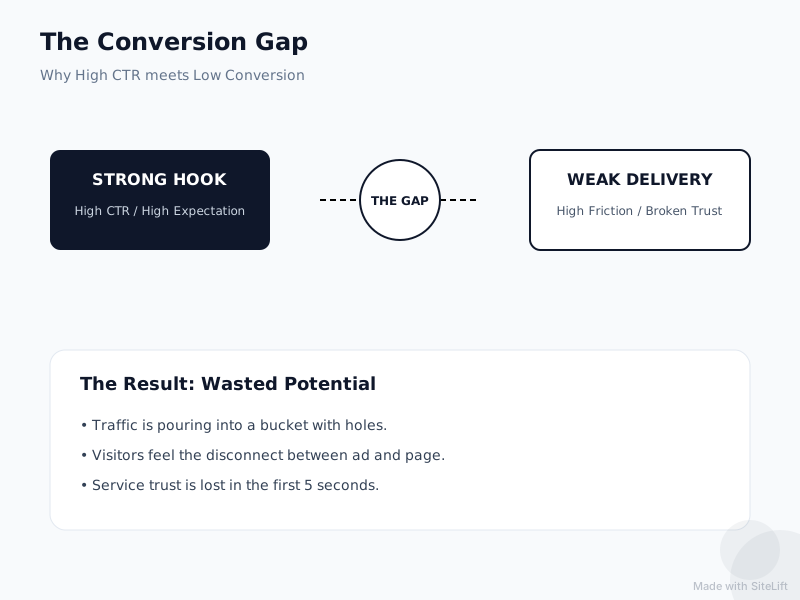
Infographic by SiteLift
Re-Engineering the Hero Section for Instant Clarity
Your hero section has five seconds to answer three foundational questions:
- What service do you actually provide?
- Who specifically is it for?
- What direct outcome occurs if they work with you?
Replace vague corporate slogans with direct, outcome-focused clarity:
| Before (Vague, Corporate) | After (High-Converting, Specific) |
|---|---|
| "Transforming Business Operations Through Modern Digital Synergies." | "We Automate Inventory Workflows for Mid-Sized Logistics Providers." |
| "Strategic Legal Counsel for Forward-Thinking Enterprises." | "Fractional General Counsel for Series A & B Tech Startups." |
| "Your Trusted Partner in Commercial Property Excellence." | "Commercial Roof Repair and Maintenance Contracts with 4-Hour Emergency Dispatch." |
Place a prominent, friction-free call to action right alongside this clear headline, backed by a concise trust statement (e.g., "Trusted by 140+ logistics facilities").
Replacing Friction-Heavy Forms with Micro-Commitments
Long, static forms create immediate drop-off. Breaking your inquiry process into a multi-step sequence can dramatically improve completion rates.
- Step 1: Ask a simple, engaging question about their current situation (e.g., "What is your estimated facility square footage?").
- Step 2: Request high-level requirements (e.g., "When do you need the inspection completed?").
- Step 3: Collect their contact details so you can deliver the custom scope or estimate.
Because the user has already invested mental energy into the first two simple clicks, they are far more likely to complete the final contact step. For a deeper breakdown of practical tweaks that improve conversion without full redesigns, take a look at our guide on website conversion rate optimization for service businesses.
Deploying Conversational Assistants to Capture After-Hours Demand
Static contact pages assume your prospects are happy waiting. Modern buyers, however, expect immediate feedback. Integrating an intelligent conversational assistant bridges the gap between passive browsing and an active sales dialogue.
An AI-driven assistant trained on your specific service scope can:
- Greet after-hours visitors instantly.
- Ask qualifying questions (project scale, timeline, budget).
- Provide immediate answers to common procedural and technical questions.
- Route pre-qualified meeting links directly to your calendar.
When you remove the friction of waiting days for an email reply, you convert late-night visitors while their purchasing intent is at its peak. Implementing a dedicated after-hours lead response strategy ensures no qualified enquiry slips away unnoticed.
What Does an Enquiry-Focused Service Page Architecture Look Like?
A high-performing service page is an argument structured to overcome doubt, build authority, and guide the visitor toward taking action.
Strategic Information Hierarchy: What Goes Where
For a service page to convert reliably, arrange your content to address the buyer's internal concerns in order:
- The Hero Section: Immediate clarity on your core offering, target client, and initial call to action.
- The Problem Landscape: Validate the specific operational pain points your visitor is trying to solve.
- Social Proof & Client Outcomes: Specific case studies showing quantifiable results (e.g., "How we reduced client onboarding time by 34%").
- The Clear 3-Step Process: Demystify how working with you works (e.g., Step 1: Initial Discovery Audit, Step 2: Custom Roadmap, Step 3: Execution).
- Frequently Asked Questions: Address objections regarding timelines, pricing ranges, and scope adjustments head-on.
- Closing Conversion Point: A secondary, low-friction entry point for visitors who have scrolled to the bottom.
De-risking the Action: Guarantees, FAQs, and Process Walkthroughs
The main reason visitors leave high-traffic service pages without inquiring is fear of the unknown. They wonder: Will I be harassed by a salesperson? Will they quote an outrageous price? Do they actually understand my industry?
To dismantle this friction:
- State explicitly what happens after an enquiry: "Submit your details, and our senior engineer will review your specs and send a preliminary assessment within 4 business hours. No aggressive sales calls."
- Include an interactive FAQ addressing pricing models, typical project durations, and common pitfalls.
- Outline your service boundaries clearly—stating who you are not a good fit for paradoxically builds immense credibility with the prospects you actually want.
Key Takeaways: Diagnosing & Fixing High CTR, Low Conversion
| Diagnostic Area | The Root Cause | The Practical Solution |
|---|---|---|
| Message Match | Ad promise doesn't match the landing page hero copy. | Mirror exact search phrases in your primary H1 and sub-headlines. |
| Form Friction | Asking for sensitive or complex information too early. | Switch to progressive, multi-step forms with micro-commitments. |
| Proof & Trust | Vague claims and missing client outcomes. | Showcase clear case studies, real names, and transparent process steps. |
| Response Lag | High-intent after-hours visitors leave without a reply. | Use conversational qualification to capture and book leads 24/7. |
| Offer Clarity | Jargon-heavy copy that obscures what you do. | State your specific service, target audience, and outcome within 5 seconds. |
The Myth of the "Complete Website Redesign"
Whenever a service firm experiences a persistent conversion problem, someone inevitably suggests: "We need an entirely new website."
In our experience, that recommendation is almost always a costly mistake.
When you scrap an existing website to start from scratch, you toss out whatever equity, search rankings, and conversion baselines you already have. You spend four to six months debating color palettes, typographic scales, and branding nuances, while the real issue remains completely unaddressed: your messaging is muddy, and your calls to action ask for too much, too soon.
Websites rarely fail because their aesthetic looks two years out of date. They fail because they speak in corporate platitudes, hide their actual services behind creative jargon, and force prospective clients to jump through unnecessary hoops just to start a conversation.
Fixing a conversion issue requires targeted adjustments. Tighten your headlines. Remove half the form fields. Add direct case studies with real numbers. Give late-night visitors a way to get answers and book an audit while your team is offline. These straightforward changes can often be made in an afternoon—and they will generate far more qualified pipeline than a six-month agency redesign ever could.
At Growth Kings, we focus on uncovering and fixing these exact friction points. Instead of selling bloated, disruptive site overhauls, we help established service firms turn their current website traffic into consistent, qualified enquiries through sharp positioning, conversion-focused page structures, and 24/7 conversational lead qualification.
— growth-kings.com
Frequently Asked Questions
What is considered an average conversion rate for a service business landing page?
According to landing page benchmark data from Unbounce, the median conversion rate for professional service landing pages is roughly 4.6%. Top-performing service pages that feature tightly aligned message matching, low-friction inquiry forms, and transparent social proof frequently achieve conversion rates between 7% and 12%, depending on the complexity of the service and price point.
Why does my Google Ads campaign have a 10% CTR but a 0% conversion rate?
A 10% click-through rate means your ad creative is highly compelling, but a 0% conversion rate points to a disconnect once users arrive. Common culprits include a broken message match (the landing page does not directly address what the ad promised), slow mobile page speeds, intimidating contact forms requesting sensitive information upfront, or targeting broad keywords that attract informational researchers rather than commercial buyers.
How does poor message match hurt my quality score and conversion rate?
Search engines like Google reward landing pages that closely reflect the intent and wording of your ads. If your ad bids on "Emergency Commercial Plumbing" but directs visitors to a generic plumbing homepage, Google recognizes the lack of relevance and lowers your Quality Score. This increases your cost-per-click while simultaneously frustrating visitors, who leave immediately when they cannot confirm they are in the right place.
Do I need to rebuild my entire website to fix a high CTR low conversion problem?
No. In most cases, a complete website rebuild is an unnecessary expense that delays results. High CTR, low conversion problems are typically caused by structural and messaging issues: vague hero headlines, excessive form friction, absent social proof, and a lack of immediate after-hours response options. Refining your hero section, simplifying inquiry forms, and clarifying your value proposition will fix conversion leaks much faster than a full redesign.
Want this working on your own site?
Tell us what’s working, what’s stuck and what you want to improve. We will reply personally.