Silos to Sales: Website Structure Optimization for Service Businesses That Want to Rank and Convert
Master website structure optimization for service businesses. Learn how to fix site architecture, improve rankings, and convert traffic into enquiries.
By Growth Kings. Published , updated . 16 min read.

Silos to Sales: Website Structure Optimization for Service Businesses That Want to Rank and Convert
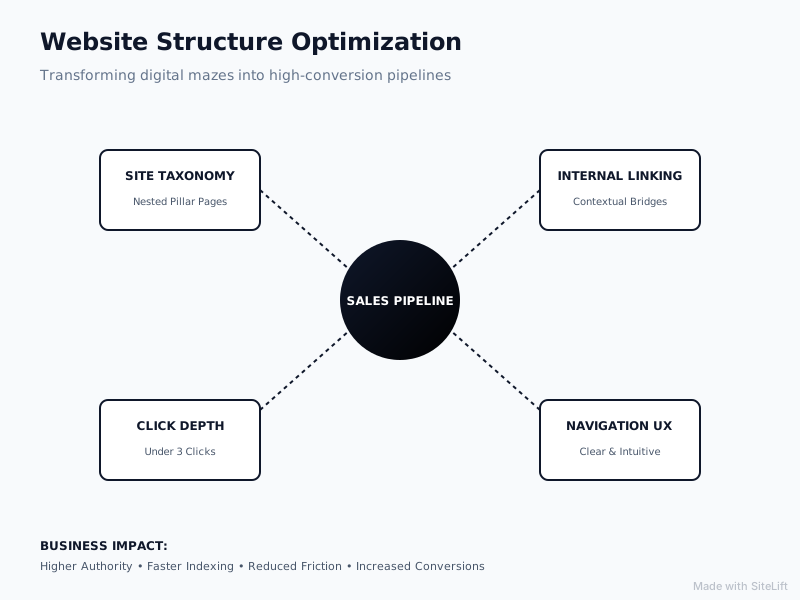
Most service business websites are built like digital filing cabinets where someone tossed folders inside without looking at the labels. You might have ten different consulting packages hidden behind vague menu items, twenty blog posts that do not point anywhere, and a contact page stranded three clicks away from your best case study. Effective website structure optimization is what transforms that digital maze into a straightforward pipeline, guiding visitors naturally from casual curiosity to a submitted enquiry.
When search engines crawl your pages, they look for structural clarity. When high-ticket buyers evaluate your firm, they look for answers without friction. If your architecture fails to deliver both, you end up with steady traffic that refuses to convert and commercial pages that never rank past page four.
Let's look at how to organize your site architecture to build domain authority, lower your crawl depth, and drive high-intent leads straight into your sales pipeline.
Key Takeaways
| Strategic Area | Common Pitfall | Structural Solution | Business Impact |
|---|---|---|---|
| Site Taxonomy | Dumping all offerings into a flat /services/ menu or disjointed subpages |
Nested parent-child pillar pages (/services/core/sub-service/) |
Stronger topical authority and clear contextual relevance for search engines |
| Internal Linking | Random blog links pointing to external sites or orphan posts | Contextual cross-linking bridging informational articles to commercial pages | Higher PageRank flow to conversion assets and reduced enquiry friction |
| Click Depth | Burying case studies and inquiry forms 4–5 clicks deep | Flat, shallow architecture keeping critical commercial pages within 3 clicks | Faster crawler indexing and lower prospect drop-off rates |
| Navigation UX | Jargon-heavy dropdowns and cluttered mega-menus | Task-oriented header navigation designed around buyer intent | Clearer path to qualification and higher task completion rates |
What Is Website Structure Optimization (And Why Do Service Businesses Get It Wrong)?
Website structure optimization is the intentional design of your site's hierarchy, taxonomy, and internal link network to make it simple for search bots to index your content and effortless for buyers to make a purchasing decision. For professional service firms—whether you run an engineering consultancy, a commercial law practice, or a specialized agency—structure dictates how value is perceived.
Unfortunately, many agencies borrow playbooks meant for completely different business models.
The Contrast Between E-Commerce Architecture and Service Site Hierarchy
E-commerce websites rely on broad parent categories, faceted filtering, and thousands of SKU pages. A visitor searching for running shoes knows what they want; they just need size, color, and a checkout button.
Service businesses operate under entirely different dynamics. Your prospects are not adding an engagement to a digital cart. They are evaluating risk, competence, and methodology before committing to an initial consultation.
When service companies replicate retail-style structures—using sprawling mega-menus and hollow category landing pages with zero persuasive depth—they confuse the user. A service site hierarchy should look more like a structured legal brief: clear propositions at the top, supported logically by granular sub-services, case studies, and immediate avenues for qualification.
How Fragmented Architecture Dilutes Crawl Equity and User Intent
When your pages exist in isolated silos, search engine spiders struggle to understand which URLs represent your primary commercial offerings. According to BrightEdge research on organic search traffic, organic search drives 53.3% of all trackable website traffic across industries. If your website wastes crawl budget on disconnected blog tags, duplicate service variations, or orphan URLs that lack internal links, your primary money pages will rarely build the topical authority needed to compete.
Fragmented architecture causes three persistent issues:
- Keyword Cannibalization: Two or three thin pages target variations of the same query (e.g.,
/b2b-consultingvs./consulting-services), forcing Google to split ranking signals between them. - Orphan Pages: High-value case studies and landing pages that receive zero internal links, leaving them invisible to web crawlers and human visitors alike.
- Commercial Drop-Off: Prospective clients find an informational article, read it, and hit a structural dead end because the page does not connect to the logical next step in their buying journey.
Moving Beyond Silos: Aligning Information Architecture with the Buyer's Journey
Traditional SEO "silos" often isolate content too strictly, preventing natural cross-topic discovery. A buyer rarely moves in a rigid, vertical line. A prospect might land on an informational guide detailing regulatory compliance, realize they have an operational vulnerability, want to see proof of how you solved that issue for an enterprise peer, and then request a consultation.
[Informational Guide] ──(Contextual Link)──> [Specialized Service Page]
                                                       │
                                              (Embedded Proof)
                                                       ▼
                                              [Client Case Study]
                                                       │
                                             (Frictionless Trigger)
                                                       ▼
                                            [Interactive Enquiry / Lead Form]
Aligning your information architecture with this reality requires connective tissue between your informational assets and your commercial offerings. You are not building walls around topics; you are building guided corridors toward a qualified enquiry.
How Should You Design a Scalable Service Website Architecture?
Building a scalable service website architecture requires a logical balance between clean taxonomies and an intuitive user experience. If your foundation is solid, you can add new capabilities and case studies over time without muddling your search rankings or breaking your site's usability.
Establishing the Pillar-and-Cluster Model for Core Services
The pillar-and-cluster model groups related topics together under a single thematic umbrella. For a service provider, this starts with identifying your primary commercial pillars.
If you run a commercial IT services firm, your architecture should not be a flat list of 25 disjointed URLs living directly on your root domain. Instead, organize them into clean thematic clusters:
- Pillar Page (Top Level):
/cloud-infrastructure/(comprehensive overview of capabilities, methodology, and scope)- Cluster Service A:
/cloud-infrastructure/aws-migration/ - Cluster Service B:
/cloud-infrastructure/disaster-recovery/ - Cluster Service C:
/cloud-infrastructure/hybrid-architecture/ - Supporting Cluster Proof:
/case-studies/fintech-cloud-migration/
- Cluster Service A:
This organization signals to search engines that your domain possesses comprehensive, deep expertise across the broad topic of cloud infrastructure.

Structuring Parent-Child URL Taxonomies That Make Sense to Google
Your URL structure should communicate context before a page even finishes loading. Clear parent-child directories inform search engines of the precise relationship between pages.
Avoid disorganised, flat URLs like:
domain.com/aws-migration-servicedomain.com/services-offered-auditdomain.com/what-we-do-disaster-recovery
Instead, build clean, predictable directory paths:
domain.com/services/it-consulting/cloud-migration/
According to Google Search Central documentation on site hierarchy, organizing content logically from general concepts to specific topics makes it substantially easier for crawlers to discover, categorize, and index your pages. Clean directory structures also generate clean breadcrumb displays in search engine results pages (SERPs), which improves click-through rates.
Optimizing Main Navigation and Header Menus to Build Instant Trust
Your main menu is not a site map; it is an executive summary of your capabilities. Nielsen Norman Group research on navigation and information architecture demonstrates that clear, intuitive navigation and strong information scent can improve task success rates by over 80% on complex websites.
When designing your header for trust and conversion:
- Limit Top-Level Items: Stick to 5–6 core elements (e.g., Services, Solutions, Case Studies, About, Insights, Contact).
- Prioritize Buyer Intent Over Internal Jargon: Replace labels like "Our Philosophy" or "Synergies" with terms that map directly to the problems your clients are trying to solve.
- Keep the Conversion Point Persistent: Ensure your primary call to action (e.g., "Request Consultation" or "Speak to a Specialist") is visually distinct and visible across every viewport.
Pro Tip: Avoid using massive, generic mega-menus with 40 links for service businesses. Present the top 3–4 core service pillars in your dropdown, accompanied by a single featured link to an exceptional case study. Cognitive overload kills decision-making.
How Does Strategic Internal Linking Turn Passive Traffic into Enquiries?
Publishing remarkable content is useless if that traffic stays trapped in your blog archive. A deliberate strategy for site structure for seo and enquiries relies on internal linking as an engine that moves authority and buyers through your funnel.
Infographic by SiteLift
Service Pages Internal Linking: Distributing PageRank to Commercial Assets
Search engines treat links as votes of confidence. While external backlinks build your domain's foundational authority, your internal links dictate how that equity circulates. As detailed in the Moz guide on internal links and PageRank distribution, strategically pointing internal links from high-authority informational articles to high-intent commercial pages effectively transfers crawl weight and ranking power.
To turn informational readership into inbound enquiries:
- Identify your top 10 most visited blog posts using Google Search Console.
- Within the first 200 words of each post, contextually link to the specific parent or sub-service page most relevant to that topic.
- Never leave a high-traffic article without an editorial bridge connecting the problem described in the post to your hands-on service solution.
If you are exploring the deeper mechanics of conversion-focused site designs, review our search engine optimization website design guide to see how layout and visibility work together.
Weaving Contextual Proof: Bridging Case Studies and Service Silos
Most service firms separate their case studies into an isolated portfolio section. This makes it difficult for potential buyers to find relevant social proof when they need it most.
Every service landing page should automatically feature 1–2 contextual summaries of relevant client outcomes, linking directly to the full case study. Conversely, every case study should feature explicit, anchored links back to the specific service page responsible for those results.
[Commercial Service Page] ◄──── Contextual Proof Link ────► [Detailed Client Case Study]
         │                                                              │
         └───────────── Both Flow Directly Into ────────────────────────┘
                                        │
                                        ▼
                             [Pre-Qualified Enquiry]
This bidirectional linking creates an authoritative web of contextual proof that reassures risk-averse buyers while confirming topical depth to search engine algorithms.
Optimizing Anchor Text for Topical Authority Without Keyword Stuffing
Internal linking anchor text should be descriptive, natural, and diverse. Avoid hyper-generic anchors like "read more," "click here," or "learn about our solutions."
| Poor Anchor Text | Optimized Anchor Text | Strategic Benefit |
|---|---|---|
| "Click here to see what we do." | "Explore our enterprise cloud migration services." | Establishes precise topical relevance for search engines |
| "Read our case study." | "Read how we reduced infrastructure downtime for logistics firms." | Communicates direct business value to decision-makers |
| "Contact us." | "Schedule an infrastructure architecture review." | Sets explicit expectations for the next step in the journey |
Vary your anchor phrasing naturally across different pages to prevent algorithmic spam triggers while reinforcing your target keyword variations.
What Technical Architecture Principles Ensure Maximum Crawlability and Conversions?
Technical site architecture is the plumbing that supports your visibility. If search engine spiders encounter excessive redirects, deep folder paths, or broken hierarchy chains, your rankings will suffer regardless of how well-written your copy is.
The Three-Click Rule: Keeping Commercial Pages Within Reach
For service businesses, no critical commercial page should ever sit more than three clicks away from the homepage. A shallow click depth ensures that both search bots and prospective clients can access essential information without unnecessary friction.
Level 0: Homepage
   │
Level 1: Core Service Pillar (/services/risk-advisory/)
   │
Level 2: Specialized Sub-Service (/services/risk-advisory/cyber-compliance/)
   │
Level 3: Specific Case Study or Enquiry Trigger (/case-studies/fintech-audit/)
When high-value URLs are buried four, five, or six clicks deep, search engine crawlers visit them less frequently. Worse, potential clients will abandon their search before discovering your relevant expertise.
Breadcrumb Navigation and Schema Markup for Enhanced SERP Visibility
Breadcrumb trails serve a dual purpose: they give users an easy way to navigate back through your site hierarchy, and they supply search engines with structured context regarding page relationships.
Implement BreadcrumbList schema markup via JSON-LD across every service page and case study. This code maps the exact taxonomy of your website directly in search engine indices, frequently generating rich breadcrumb snippets in Google's search results:
{
  "@context": "https://schema.org",
  "@type": "BreadcrumbList",
  "itemListElement": [{
    "@type": "ListItem",
    "position": 1,
    "name": "Home",
    "item": "https://yourdomain.com/"
  },{
    "@type": "ListItem",
    "position": 2,
    "name": "Services",
    "item": "https://yourdomain.com/services/"
  },{
    "@type": "ListItem",
    "position": 3,
    "name": "Cloud Infrastructure",
    "item": "https://yourdomain.com/services/cloud-infrastructure/"
  },{
    "@type": "ListItem",
    "position": 4,
    "name": "AWS Migration",
    "item": "https://yourdomain.com/services/cloud-infrastructure/aws-migration/"
  }]
}
This clear data trace eliminates ambiguity about how your specialized offerings relate to your parent service pillars.
Eliminating Dead Ends: Integrating Modern Conversational Touchpoints
A high-performing architecture never strands a user at the bottom of a page. If an executive finishes reading an analysis of your methodology, what happens next?
If your only answer is a static footer with a copyright notice, your site is leaking qualified leads. Every page should conclude with clear, logical pathways:
- A contextual link to an adjacent capability.
- A direct link to a client result.
- An interactive, conversational enquiry trigger.
Service buyers often research options outside of standard business hours. Integrating intelligent conversational assistants that can answer immediate questions, handle preliminary qualification, and book calendar appointments directly from high-intent service pages ensures you capture demand the moment it appears.
Pro Tip: Review your highest-traffic service pages on a mobile device. If reaching your enquiry trigger requires scrolling past three screens of unformatted text, add an inline qualification trigger halfway down the page.
How Do You Apply Website Structure Optimization Without a Full Redesign?
One of the most persistent myths in digital marketing is that fixing site architecture requires scrapping everything and building a new site from the ground up. In reality, a full rebuild often introduces unforced errors, broken redirects, and avoidable drops in organic traffic.
Before you invest in an expensive development cycle, read our breakdown on website redesign vs optimization to evaluate whether a structural overhaul is all your business actually needs.
Mapping Your Existing URL Inventory and Identifying Keyword Cannibalization
Start by auditing what you already have:
- Export All URLs: Crawl your website using tools like Screaming Frog or Sitebulb to map your full URL tree, response codes, and internal link counts.
- Pull Performance Data: Export 12 months of click and impression data from Google Search Console alongside conversion data from your analytics platform.
- Isolate Duplicate Intent: Identify pages competing for the same search queries. If you have four outdated blog posts and two thin landing pages all trying to rank for "mergers and acquisitions consulting," mark them for consolidation.
Pruning, Consolidating, and 301 Redirecting Outdated Service Pages
Once your inventory is mapped, group your underperforming assets into three clear buckets:
[Legacy Content Audit]
       │
       ├── KEEP ──────────► Optimize internal links & breadcrumbs
       ├── CONSOLIDATE ───► Merge thin pages into one pillar; 301 redirect legacy URLs
       └── PRUNE ─────────► Remove zero-value pages; redirect to nearest parent category
When consolidating URLs, follow these rules:
- Merge the unique, valuable insights from thin pages into a single, comprehensive pillar page.
- Implement permanent
301redirects from the old, retired URLs directly to the updated master URL to preserve historical backlink authority. - Update all hardcoded internal links across your site to point directly to the new URL, preventing internal redirect chains that waste crawl budget.
For concrete proof of how structural refinements lift revenue without total platform overhauls, review these 8 practical website optimization examples.
Benchmarking Structural Health: Key Metrics in Search Console and Analytics
Track your structural performance using metrics that measure technical health alongside commercial success:
- Average Crawl Depth: Verify via crawl logs that 95%+ of your indexable commercial pages sit at a depth of 3 clicks or fewer.
- Crawl Frequency for Core Pillars: Monitor the "Crawl stats" report in Google Search Console to confirm search bots are visiting your primary service URLs regularly.
- Average Position for Commercial Intent Queries: Track rankings for mid-tail and bottom-of-funnel service searches rather than vanity keywords.
- Qualified Enquiry Rate: Measure the percentage of site visitors who move from reading an informational page to viewing a service page and submitting an enquiry.
The Growth Kings Perspective: Why Structural Clarity Beats Shiny Redesigns
We review dozens of service firm websites every month, and we see the same mistake time and time again: a leadership team spends six figures on a flashy agency rebuild with custom video banners, only to watch their organic traffic drop and their inbox go silent.
Why does this happen? Because pretty designs do not fix bad architecture.
A website is not an art installation; it is an interactive business proposal. High-value clients are looking for specific answers to difficult problems. If your site hides your core capabilities behind cryptic branding or buries your pricing methodology under three layers of ambiguous menus, serious buyers will simply bounce to a competitor who makes those details easy to find.
Real digital growth does not come from reinventing your brand every two years. It comes from fixing technical friction, establishing clear topical authority, and structuring your navigation so that high-intent prospects naturally take the next step.
If your service business is generating steady traffic but failing to produce a consistent pipeline of qualified sales enquiries, the team at growth-kings.com can help. We focus on pragmatic, high-impact improvements—sharpening your positioning, resolving architectural bottlenecks, and deploying conversational qualification tools that capture leads around the clock—all without the disruption, risk, and expense of a needless ground-up rebuild.
— growth-kings.com
Frequently Asked Questions About Website Structure Optimization
What is website structure optimization for service businesses?
Website structure optimization is the process of organizing a website’s hierarchy, taxonomy, and internal linking to align with both search engine indexing requirements and the prospective client’s evaluation process. For service businesses, it focuses on connecting informational content to high-intent commercial offerings, ensuring search bots recognize topical authority while guiding buyers toward an enquiry.
How does website structure affect both SEO rankings and enquiry rates?
A logical structure allows search engine crawlers to discover, understand, and distribute PageRank efficiently across your commercial pages, helping your core service offerings rank higher in search results. For human visitors, an intuitive structure reduces cognitive fatigue, answers specific questions quickly, and provides natural pathways to submit an enquiry or book an initial consultation.
How many clicks away should service pages be from the homepage?
High-priority commercial pages, specialized sub-services, and primary case studies should always remain within three clicks of the homepage. Keeping your click depth shallow ensures that search engine crawlers index those pages frequently and prevents prospective clients from abandoning your site before finding the solutions they need.
Can you improve a service website's structure without rebuilding the entire site?
Yes. Structural optimization rarely requires a complete website overhaul. You can reorganize your navigation menus, build parent-child URL taxonomies, consolidate competing or thin pages using 301 redirects, and fix internal link paths directly within your current content management system without touching your core brand design or rebuilding your tech stack.
How should case studies and blog posts be linked to core service pages?
Informational blog posts should feature early, contextual links pointing directly to the specific service page that addresses the problem being discussed. Case studies should be cross-linked bidirectionally: every service page should highlight relevant client proof, and every case study should link directly back to the specific service methodology that delivered the result, followed by a clear, friction-free enquiry prompt.
Want this working on your own site?
Tell us what’s working, what’s stuck and what you want to improve. We will reply personally.