Building Trust in Seconds: The UX Psychology Every Service Website Needs
Learn how to build instant digital credibility. Master website trust signals for service companies, reduce friction, and turn clicks into qualified leads.
By Growth Kings. Published , updated . 11 min read.

Building Trust in Seconds: The UX Psychology Every Service Website Needs
When a potential client lands on your website, a silent, subconscious countdown begins. They aren't reading your carefully crafted copy yet; they are feeling their way through your layout. In the digital space, establishing credibility isn't a slow burn—it happens in the blink of an eye. For service-based firms, mastering website trust signals for service companies is the difference between a high-value inquiry and an immediate bounce. If your site doesn't feel safe, professional, and responsive within moments, visitors will quietly slip away to a competitor who got it right.
Key Takeaways
| Trust Indicator | Cognitive Impact | Best Practice Placement |
|---|---|---|
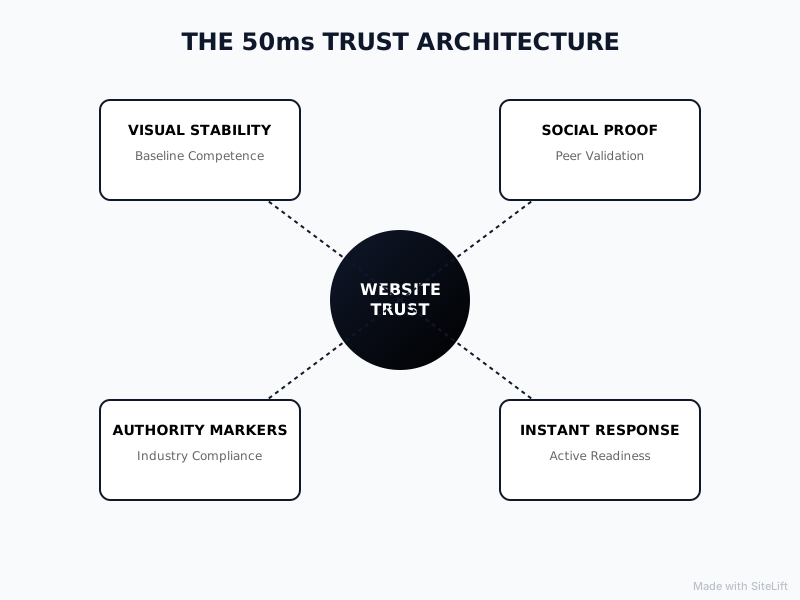
| Visual Stability & Speed | Establishes baseline operational competence. | Site-wide foundation; optimized header load times. |
| Social Proof & Reviews | Validates quality via peer experiences; reduces risk. | Above the fold and directly adjacent to conversion forms. |
| Authority Markers | Signals industry compliance and validated expertise. | Footer, about page, and near final checkout/contact areas. |
| Instant Responsiveness | Demonstrates active readiness and care. | Sticky sidebar or lower-right corner via conversational AI. |
Why Website Trust Signals for Service Companies Are Your Most Valuable Asset
The Psychology of the 50-Millisecond Impression
First impressions online are almost entirely visceral. Research published by Google shows that web users form an opinion about a site's visual appeal and trustworthiness within 50 milliseconds.
This split-second judgment happens long before a user reads your value proposition or clicks a single button. It is a survival mechanism designed to filter out digital noise. If your layout feels cluttered, dated, or structurally unstable, the brain registers "risk" and triggers an exit. For service companies, this means your visual design is your first and most critical handshake.
High-Stakes vs. Low-Stakes Online Conversions
E-commerce websites often deal with low-stakes conversions. If a consumer buys a $15 t-shirt and the quality is poor, the loss is minimal.
Service businesses, however, deal in high-stakes transactions. Whether you are an industrial contractor, a corporate consultancy, or a specialized medical practice, you are asking visitors to commit significant time, money, and confidential data. Because the buyer cannot touch or see a service before purchasing, they experience heightened anxiety. This makes improving service site credibility an absolute prerequisite for generating high-ticket leads online.
The Cost of Friction in Lead Generation
Every extra field in a form, every confusing navigation link, and every slow-loading image adds cognitive friction. When friction rises, conversion rates plummet.
We often see businesses spend thousands of dollars driving high-intent traffic to their site, only to lose those prospects to invisible micro-frictions. If a user has to hunt for your contact information or decipher what services you actually offer, they will leave. Reducing buyer friction online is about clearing the path so completely that taking the next step feels entirely effortless.
What Are the Core Website Trust Signals for Service Companies?
Strategic Social Proof Placement
Most service companies relegate their testimonials to a dusty, dedicated page that rarely gets clicked. To influence user behavior, you must master social proof placement on website layouts.
According to the Spiegel Research Center, displaying customer reviews can increase conversion rates by up to 270% for service and B2B offers. The most effective strategy is to weave these proof points directly into the user's reading path. Place highly specific client quotes, star ratings, and recognizable client logos above the fold on your homepage.
Pro Tip: Avoid generic "Great job!" testimonials. Use reviews that highlight a specific problem solved, a metric achieved, or a timeline met. Specificity breeds belief.
[ Above-the-Fold Hero Section ]
       │
       ├─► Headline (Clear Value Prop)
       ├─► Subheadline (How We Do It)
       └─► Trust Row (5-Star Rating Badge + 3 Blue-Chip Client Logos)
Clear Authority Markers and Verifiable Accreditations
Anyone can build a slick website, which is exactly why modern buyers are deeply skeptical. To stand out, you must display verifiable proof of your expertise.
According to research from the Stanford Web Credibility Project, 75% of users admit to making judgments about a company's credibility based on their website design and visible authority markers alone. This includes displaying industry certifications, local chamber of commerce badges, security protocols (like SSL/HTTPS), and professional association memberships. Crucially, make sure these badges are clean, sharp, and placed where they do not compete with your primary calls to action.
Transparent Pricing and Service Expectations
Vagueness is a massive trust killer. When a service site hides its pricing or uses overly complex jargon to describe its process, it triggers suspicion.
While you may not be able to give an exact quote for complex services, providing "starting at" pricing or a clear, three-step breakdown of your onboarding process works wonders. When clients know what to expect, their anxiety drops, and their willingness to engage rises.
How UX Design Directly Builds Service Site Credibility
Visual Hierarchy and Managing Cognitive Load
When a user is presented with too much information at once, their brain experiences cognitive overload. Studies on user experience psychology by the Nielsen Norman Group show that clear visual hierarchies and generous whitespace help users scan and process information comfortably.
By grouping related elements together and using contrasting font sizes, you guide the reader's eye naturally from your headline to your proof points, and finally to your call to action. Good ux design for lead generation is invisible; it simply feels natural to read.
Mobile UX and Technical Performance as Trust Indicators
A website that looks beautiful on a desktop but breaks on a smartphone communicates a dangerous message: We do not pay attention to detail.
Mobile responsiveness and technical performance are functional trust signals. If your page takes longer than three seconds to load, or if buttons overlap on a mobile screen, visitors assume your actual service delivery will be similarly sloppy. Ensuring your site has solid technical foundations and lightning-fast load times is the baseline of modern digital credibility.
Frictionless Forms and Clear Call-to-Action (CTA) Design
Your contact form is the final hurdle in the conversion process. Traditional forms that demand extensive personal information before a conversation has even started feel like an interrogation.
Instead, design forms that use progressive profiling or multi-step, conversational layouts. Ask for the bare minimum needed to qualify the lead first, then gather deeper details later. Keep your CTA buttons highly visible, contrasting in color, and clear about the exact outcome (e.g., "Schedule Your 15-Minute Call" instead of "Submit").
Infographic by SiteLift
How Modern AI and Real-Time Interaction Enhance Credibility
Eliminating Response Latency with AI Assistants
In the digital age, speed is a primary trust signal. If a prospect fills out your contact form and waits 24 hours for a reply, they have already moved on to your competitors.
Data from Salesforce indicates that 83% of customers expect immediate engagement when contacting a company online. By implementing intelligent conversational assistants, you can eliminate this latency entirely. An instant, helpful response signals that your business is highly organized, technologically capable, and ready to serve.
24/7 Availability without Sacrificing Authenticity
Potential clients don't just search for services during business hours. They browse late at night, on weekends, and during holidays.
Using smart AI enquiry assistants with human handoff allows you to capture, qualify, and nurture these leads around the clock. The key is transparency: never try to trick users into thinking your AI assistant is a real human. Instead, position it as a helpful digital concierge that can answer immediate FAQs, qualify their needs, and schedule a follow-up.
User visits site at 10:00 PM
       │
       ├─► AI Assistant greets user instantly
       ├─► Answers complex service questions using approved knowledge base
       ├─► Qualifies user's budget and timeline
       └─► Books a call directly onto your calendar for the next morning
Seamless Transition from AI Qualification to Human Sales
An AI assistant should never feel like a dead end. Its primary job is to bridge the gap between initial curiosity and human connection. When the conversational assistant qualifies a high-value lead, it should seamlessly route that data to your sales team. When your team follows up, they can reference the exact details discussed with the AI, making the prospect feel heard and valued from the very first touchpoint.
How Do You Implement Trust Signals Without Overwhelming Visitors?
The Principle of Progressive Disclosure
While trust signals are vital, dumping every certification, testimonial, and badge onto your homepage at once creates visual chaos. Instead, apply the UX principle of progressive disclosure.
This means presenting only the most critical trust signals above the fold—such as a single high-impact review badge and a clear authority statement—and revealing deeper proof points, case studies, and detailed accreditations as the user continues to scroll or navigates to deeper pages.
Balancing Social Proof with Minimalist Layouts
Your website needs breathing room. A clean, minimalist layout actually amplifies the power of your trust signals.
When a testimonial is surrounded by generous whitespace, it stands out and commands attention. If it is crammed into a busy sidebar alongside three banner ads and five security badges, it becomes invisible. Choose your strongest proof points and give them the stage they deserve.
A/B Testing Trust Elements for Maximum Lead Conversion
Every audience is different. What builds trust for a commercial plumbing contractor might not work for an enterprise software consultancy.
To maximize your conversions, continuously test different trust elements. Try testing video testimonials against written quotes, or compare the impact of local chamber of commerce logos against national industry certifications. Let real user data guide your final design decisions.
Editorial: Why Response Speed is the Ultimate Underrated Trust Signal
For years, the design industry has treated website trust as an aesthetic problem. Agencies sell expensive, ground-up redesigns under the promise that a sleeker layout will magically double your inbound leads. But here is the hard truth: A beautiful website cannot save an unresponsive business.
At Growth Kings, we believe the most underrated trust signal on the internet is operational responsiveness. You can have the most pristine, award-winning conversion-focused websites for service businesses, but if your contact form leads to a black hole, your credibility drops to zero the moment the user hits submit.
Real trust is built through behavior. When a client reaches out and receives a helpful, accurate response within seconds—even at 9:00 PM on a Sunday—they don't just feel prioritized; they feel safe. They realize they are dealing with a modern, highly efficient organization.
That is why we focus on practical, high-impact optimizations rather than endless aesthetic redesigns. By pairing clean visual layouts with smart, real-time interactive tools, we help service businesses build deep, functional trust that actually turns passive traffic into booked meetings.
— growth-kings.com
How We Can Help You Build a High-Trust, High-Converting Website
At Growth Kings, we don't believe in empty ranking promises or unnecessary, expensive website rebuilds. We focus on practical, results-driven improvements that make your business easier to understand, easier to trust, and easier to contact.
Whether you need to optimize your layout for maximum credibility, improve your search and AI visibility to attract high-intent leads, or deploy smart conversational tools to handle after-hours inquiries, our scoped, fixed-fee project work is designed to deliver clear ROI.
Ready to see how your site can turn more clicks into clients? Explore our full suite of digital growth services or learn how to get recommended by AI search systems like ChatGPT and Google Gemini.
FAQ
What are the most critical website trust signals for service companies?
The most critical signals include prominent above-the-fold social proof (reviews and client logos), clear authority markers (certifications, security badges, and accreditations), transparent service/pricing expectations, and instant contact responsiveness.
How quickly do visitors judge a service website's credibility?
According to Google research, users form an opinion about a website's visual appeal and trustworthiness within 50 milliseconds. This means visual structure, speed, and clean design are vital for making a strong first impression.
Where is the best place to put client reviews and logos on a service site?
Do not hide them on a separate testimonials page. The most effective strategy is to place high-impact review badges and recognizable client logos above the fold on your homepage, and strategically near your primary contact forms.
Can having too many trust badges hurt a website's conversion rate?
Yes. Overloading your site with too many badges, certificates, and ratings can create visual clutter, increase cognitive load, and ironically trigger suspicion in modern, tech-savvy buyers. Focus on your top 3-4 most authoritative markers.
How do automated AI assistants improve trust on B2B and service websites?
AI assistants improve trust by eliminating response latency. Since 83% of customers expect immediate engagement online, an instant, helpful AI assistant that answers FAQs and books meetings 24/7 proves your business is responsive, organized, and ready to assist.
Want this working on your own site?
Tell us what’s working, what’s stuck and what you want to improve. We will reply personally.