Conversion Optimization Definition: What It Really Means for Service Enquiry Growth
Learn the conversion optimization definition for services. Turn clicks into qualified enquiries, cut CAC and grow pipeline fast.
By Growth Kings. Published , updated . 10 min read.

Conversion Optimization Definition: What It Really Means for Service Enquiry Growth
If you’ve searched for the conversion optimization definition, you’ve probably seen the same dry explanation everywhere: improving your website to get more conversions. True, but useless if you run a service business.
For you, a conversion isn’t an add-to-cart. It’s a qualified phone call, a consultation booking, or a detailed form fill from someone ready to buy. In this guide, I’ll break down what is conversion optimization when the goal is enquiry growth, not e-commerce checkouts, and how to apply enquiry rate optimization basics without a rebuild.
What Is Conversion Optimization? A Practical Conversion Optimization Definition
The Literal Definition vs. Strategic Business Value
The textbook website conversion defined is simple: conversion rate optimization (CRO) is the systematic process of increasing the percentage of website visitors who take a desired action.
Mathematically:
Conversion Rate = (Total Conversions / Total Visitors) x 100
If 1,000 people visit your plumbing site and 30 request a quote, your conversion rate is 3%.
But the strategic reality is different. CRO isn’t about tricks. It’s about removing hesitation. According to the average landing page conversion rate benchmarks from WordStream, the average landing page across industries converts at 2.35%, with the top 25% converting at 5.31% or higher. That gap isn’t design talent — it’s clarity, trust, and friction removal.
Pro Tip: Don’t chase a higher conversion rate in isolation. Chase more qualified enquiries per 100 visitors. Ten tyre-kickers are worth less than three ideal clients.
E-Commerce Conversions vs. Service Industry Enquiry Optimization
This is where the CRO meaning for services diverges completely from retail.
E-commerce CRO optimizes for speed and impulse: add to cart, checkout, upsell. Service CRO optimizes for confidence and commitment. No one impulse-buys a $15,000 roofing job or a legal retainer.
Service visitors ask:
- Do I trust these people in my home / business?
- Do they understand my specific problem?
- What happens if I contact them?
- How fast will they respond?
That’s why service CRO leans heavily on positioning, proof, and responsiveness — not checkout flow tweaks.
Micro-Conversions vs. Macro-Conversions Explained
Not every action is equal. You need both:
| Type | Service Example | Why It Matters |
|---|---|---|
| Macro-conversion | Consultation booking, quote request, phone call | Direct pipeline revenue |
| Micro-conversion | Pricing guide download, video play, FAQ interaction, chat start | Builds trust and buying intent |
A visitor who watches your “how we price” video, reads two case studies, then starts a chat is warming up. If you only track form submits, you’ll miss where people drop off. Good service CRO tracks the full path from curious browser to qualified enquiry.
Learn the full sequence in this practical breakdown of what are the steps of conversion optimization for service sites.
Why the Standard Conversion Optimization Definition Fails Service Businesses
Reducing Customer Acquisition Costs (CAC)
Here’s the math most agencies won’t show you. If you pay $4,000/month for ads driving 2,000 visitors at a 1.5% conversion rate, you get 30 leads at $133 per lead.
Lift that rate to 3% with better messaging and forms, and you get 60 leads from the same spend. Your cost per lead drops to $67 without increasing budget.
That’s why optimizing existing traffic almost always beats buying more traffic first.
Unlocking Hidden Capacity in Existing Website Traffic
Most established service sites I review already get enough traffic to grow. They just leak it.
Confusing headlines, stock photos, buried phone numbers, and 12-field “contact us” forms kill intent. Research from the Nielsen Norman Group research on how little users read found users read only about 20% of text on an average page visit. If your value proposition isn’t clear in the first 5 seconds, they bounce — no matter how good your service is.
Filtering Traffic for Qualified Enquiries over Vanity Volume
More form fills isn’t the goal. More right-fit enquiries is.
Smart service CRO intentionally repels bad fits with clear pricing ranges, service areas, timelines, and qualifying questions. A conversational assistant that asks “What’s your timeline? Where are you located?” before routing to sales saves your team hours and boosts close rates.

How Does the Enquiry Rate Optimization Process Work?
Phase 1: Research, Analytics, and Friction Identification
Forget guessing. Start with evidence:
- Analytics review: Where do service pages drop off? Which sources bring callers vs. browsers?
- Session recordings & heatmaps: Are people rage-clicking your phone number? Ignoring your form?
- Form analytics: Which field causes abandonment?
- Call and chat transcripts: What objections come up repeatedly?
The VWO’s conversion optimization testing framework calls this the research-first approach — observe behavior, then hypothesize, don’t start with button colors.
Phase 2: Formulating Hypotheses and Trust-Driven Messaging
Turn findings into testable statements: “Because visitors don’t see pricing context, adding ‘Most projects $4k-$8k’ above the form will increase qualified quote requests.”
For services, the biggest levers are usually:
- Headline clarity: outcome + who it’s for + where
- Social proof near the action: reviews, before/afters, client logos
- Risk reversals: response-time promise, no-pressure consultation language
Phase 3: Implementation, Testing, and Continuous Refinement
You don’t need complex multivariate tests with low traffic. Use simple A/B tests: one headline vs. another, long form vs. short form, static form vs. chat-first.
Pro Tip: Test big, obvious changes first. “Get a Free Quote” vs. “Get My Fixed Price in 60 Seconds” will teach you more than testing two shades of blue.
To see how these tests fit into the full journey, read this guide to conversion funnel optimization from click to qualified enquiry.
What Are the Core Pillars of High-Converting Service Websites?
Clear, Value-First Copywriting and Positioning
Confusing messaging kills conversion faster than ugly design. Your hero section should answer three things instantly: What do you do, who is it for, and why trust you?
Weak: “Welcome to ABC Solutions – Excellence Since 1998” Strong: “Emergency Plumbers in Austin – On-Site in 90 Minutes, Upfront Pricing”
Use plain language, specific outcomes, and local proof.
Frictionless Contact Forms and UX Clarity
Every extra field costs you enquiries. For initial contact, ask for name, phone/email, service needed, and postcode. That’s it. Qualify later.
Best practices I see work consistently:
- Sticky call button on mobile
- 3-4 field forms above the fold on service pages
- Inline validation and clear error messages
- Trust signals right under the button: “Typically replies in <15 mins during business hours”
If your landing pages need work, this conversion rate optimization landing page playbook for service businesses is a solid next read.
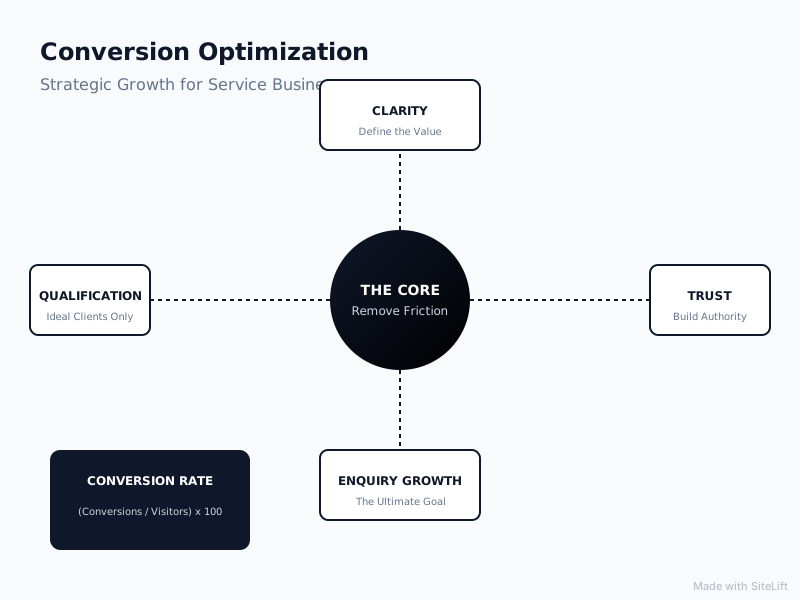
Infographic by SiteLift
24/7 Responsiveness and AI Conversational Assistants
High-intent buyers browse after hours — 8pm to 11pm is prime time for home services, legal, and clinics. If you reply next morning, they’ve already booked a competitor.
This is where immediate response wins. According to HubSpot’s research on form conversion and lead response, interactive, automated lead capture experiences drive higher engagement than static “we’ll be in touch” forms.
Modern AI assistants can answer FAQs, capture details, qualify by budget and timeline, and book directly into your calendar while you sleep. For a deeper look, explore how AI conversion optimization turns clicks into clients.
What Common Misconceptions Surround Conversion Optimization?
Misconception 1: CRO Requires a Full Website Redesign
No. Most service sites don’t need a rebuild. They need sharper headlines, better proof placement, simpler forms, and faster follow-up.
I’ve seen a 40% lift in calls just from rewriting a hero, adding real technician photos, and making the phone number tappable. Practical improvements beat a $20k redesign nine times out of ten.
Misconception 2: High Traffic Automatically Guarantees High Enquiries
Traffic without clarity just burns ad spend. Sending 5,000 visitors to a vague page is like pouring water into a leaky bucket.
Fix the bucket first, then scale traffic with SEO and ads.
Misconception 3: CRO Is Only About Button Colors and Visual Tweaks
Button color tests are the smallest lever. For services, psychology wins: perceived risk, urgency, authority, and ease.
Do I believe you can solve my problem? Do I know what happens next? Do I trust you’ll respond? Answer those, and conversion follows.
Key Takeaways: Conversion Optimization Definition for Services
| Key Concept | What It Means for Enquiry Growth |
|---|---|
| Conversion optimization definition | Increasing % of visitors who become qualified enquiries, not just clicks |
| Macro vs. micro conversions | Track calls/bookings and chat starts, guide downloads, video views |
| Benchmark to beat | 2.35% average, 5.31%+ top quartile (WordStream); services should aim for 3-5% on qualified traffic |
| Biggest levers | Clear positioning, simplified forms, proof near CTA, instant response |
| What to avoid | Full rebuilds, vanity traffic, button-color-only testing |
My Take: Why Most Service Firms Get This Backwards
I’ll be blunt: most service businesses I talk to are obsessed with rankings and redesigns, and almost completely ignore what happens after the click.
I’ve audited sites ranking #1 locally that convert under 1% because the headline says nothing, the form asks for a life story, and no one answers after 5pm. Meanwhile, a competitor at position #4 with half the traffic books twice the jobs because they’re clear, human, and fast.
In my view, website conversion defined for services should be reworded entirely. It’s not “how do we persuade more people?” It’s “how do we make it ridiculously easy for the right person to trust us and contact us right now?”
That shift changes everything. You stop hiding pricing, you show real faces, you answer in seconds not days. You don’t need more hacks — you need less friction and more follow-through. That’s the whole game.
— growth-kings.com
Turn This Definition Into More Qualified Enquiries
Understanding what is conversion optimization is step one. Applying it is where growth happens.
At growth-kings.com, we help established service businesses turn existing visits into qualified enquiries with clarity-focused website tweaks, search visibility that brings the right traffic, and AI assistants that qualify and book after-hours leads — no unnecessary rebuilds, no empty ranking promises.
If your traffic is flat or your forms feel quiet, start with a friction audit, not more ad spend.
FAQ
What is the mathematical formula for calculating website conversion rate?
Divide total conversions by total visitors and multiply by 100: (Conversions / Visitors) x 100. For services, segment it — calculate separately for calls, form fills, and bookings to see which channel actually drives qualified enquiries.
What is a good conversion rate for a service business website?
For qualified service traffic, 3-5% to enquiry is strong. For context, WordStream reports a 2.35% average landing page conversion rate across industries, with the top 25% at 5.31% or higher. Emergency and high-intent services often convert higher; complex B2B services may convert lower but at higher ticket value.
How does conversion optimization differ from SEO?
SEO brings people to your site; conversion optimization turns those visitors into enquiries. SEO without CRO wastes traffic. CRO without traffic has nothing to optimize. The best growth comes from doing both — attract the right searchers, then make it easy for them to contact you.
Do service businesses need high traffic before doing conversion optimization?
No. In fact, low-traffic sites benefit most from enquiry rate optimization basics like clearer headlines, proof, and simpler forms. You don’t need thousands of visitors to fix obvious friction. Save statistical A/B testing for later; start with qualitative fixes from recordings, analytics, and customer questions.
How long does it take to see results from conversion rate optimization?
Clarity and friction fixes can lift enquiries in 2-4 weeks. Structured A/B testing typically needs 4-8 weeks to gather enough data, especially for lower-traffic service sites. Instant response tools like AI chat often show impact in days because they capture after-hours demand you were already losing.
Want this working on your own site?
Tell us what’s working, what’s stuck and what you want to improve. We will reply personally.