What Are the Steps of Conversion Optimization? A 7-Step Process for Service Sites
Learn what are the steps of conversion optimization for service sites. Turn website visitors into qualified enquiries with this practical 7-step guide.
By Growth Kings. Published , updated . 15 min read.
What Are the Steps of Conversion Optimization? A 7-Step Process for Service Sites
If your service business generates website traffic but struggles to generate qualified phone calls or calendar bookings, you are probably asking: what are the steps of conversion optimization that actually drive client acquisition? Most online CRO advice focuses on consumer retail—urging you to change button colours, add countdown timers, or fix cart abandonments. For professional services, consulting firms, and commercial contractors, those tactics fail because high-ticket buyers do not make impulse decisions.
According to research from HubSpot, average website conversion rates across professional services hover between 2% and 5%. Closing the gap between a 2% baseline and top-tier performance requires an intentional enquiry conversion framework.
Here is what you will achieve with this guide: you will learn how to audit your site for trust gaps, prioritize high-impact fixes, test changes without massive traffic volumes, and capture higher-value client enquiries systematically.
What You Need Before Starting
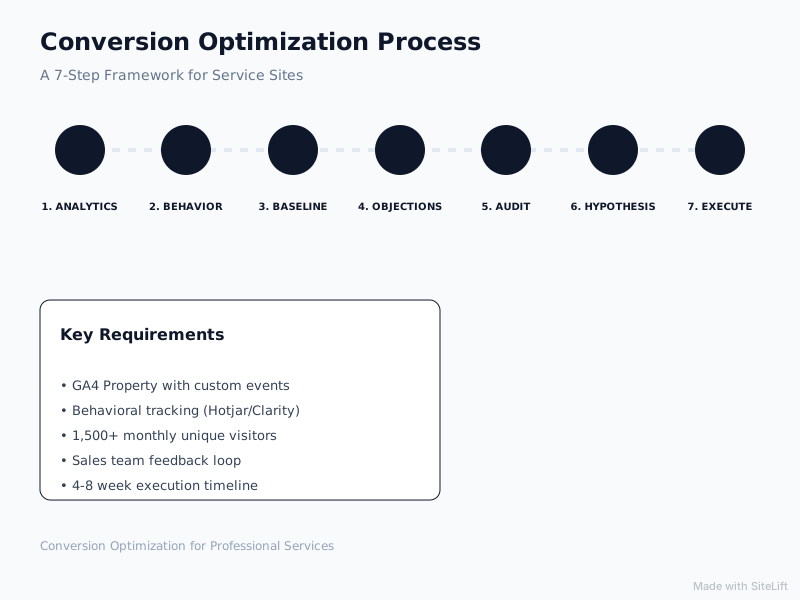
Before executing the conversion optimization process, ensure you have the following assets ready:
- Analytics Setup: An active Google Analytics 4 property with custom conversion events tracking form submissions, click-to-calls, and booking link clicks.
- Behavioral Tracking Software: Tools like Hotjar, Microsoft Clarity, or Lucky Orange installed to capture heatmaps and visitor session replays.
- Traffic Baseline: At least 30 to 90 days of consistent baseline traffic data (ideally 1,500+ unique monthly visitors across your core service pages).
- Direct Sales Access: Access to recent enquiry logs, call notes, or your sales team to uncover real customer objections.
- Estimated Timeline: 2 to 4 weeks for initial research and hypothesis generation; 4 to 8 weeks for live execution and measurement.
What Are the Steps of Conversion Optimization for Service Sites?
Service websites operate in a high-consideration environment. When an enterprise buyer or homeowner hires a professional service, the transaction involves financial and operational risk.
[Targeted Traffic]
       │
       ▼
[Clarity Above Fold] ──(Friction/Doubt)──► [Exit / Bounce]
       │
       ▼
[Social Proof & Trust]
       │
       ▼
[Low-Friction Capture] (Form / AI Assistant)
       │
       ▼
[Qualified Enquiry]
Why Service Businesses Need a Different Conversion Strategy Than E-Commerce
E-commerce CRO relies heavily on micro-conversions, dynamic cart upsells, and rapid split testing powered by tens of thousands of transactions. In contrast, service sites manage lower traffic volumes, longer sales cycles, and multi-stakeholder decisions.
As usability research from the Nielsen Norman Group shows, B2B and professional service users experience significant cognitive friction when websites bury crucial information, use vague corporate jargon, or obscure how the service is delivered. Your conversion goal is rarely a credit card payment; it is a qualified, sales-ready conversation.
Prerequisites: What You Need in Place Before Beginning the CRO Process
Attempting optimization without clean tracking leads to false assumptions. At a minimum, your team needs:
- Verified Event Tracking: Ensure form fills and phone clicks trigger exact conversion events in your analytics platform without duplicate firing.
- Clear Lead Definitions: Align marketing and sales on what constitutes a "qualified enquiry" versus an irrelevant message.
- A Documented Baseline: Record your current conversion rate, bounce rate, and average time-on-page across each primary service URL.

Step 1: Conduct a Comprehensive CRO Audit and Data Discovery
Every successful optimization sprint begins with diagnosis rather than guesswork. You must identify where prospects drop off and why they hesitate.
Quantitative Data: Uncovering Drop-Off Points in Analytics
Start inside your analytics account. Review landing page performance using the official Google Analytics documentation to configure custom exploration funnels.
Identify URLs with high traffic but disproportionately low conversion rates. Look specifically at:
- Device discrepancies (e.g., desktop converts at 4.2% while mobile languishes at 0.8%).
- Exit rates on primary contact and quote request pages.
- Scroll depth milestones on long-form service landing pages.
Qualitative Insights: Gathering Direct User and Lead Feedback
Numbers tell you where visitors leave; qualitative research explains why. Review 30 to 50 session recordings of users navigating your key service pages. Look for moments of hesitation, erratic scrolling, or dead clicks on non-clickable elements.
Next, interview your front-line sales team. Ask them:
What is the single most common question prospects ask on initial calls?
What misunderstandings do buyers have about your service scope or pricing?
Which competitors are prospects consistently comparing you against?
Concrete Action: Run a 5-question micro-survey on low-performing service pages asking: "Did you find the information you were looking for today?"
Expected Result: A prioritized list of information gaps and user objections directly from real prospects.
Common Mistake to Avoid: Skipping qualitative discovery and assuming poor performance is caused by page design rather than unclear messaging.
Step 2: Map the Enquiry Conversion Framework and User Journey
Once you know where users leave, map the psychological journey from initial discovery to submitted enquiry.
Identifying Bottlenecks Across the Decision Journey
Prospective clients rarely land on your homepage and immediately hire you. They browse a specific service page, inspect your case studies, check your team credentials, and then review your contact page. If any link in that chain lacks clarity, the session ends.
Evaluate whether your site creates unnecessary barriers:
- Are case studies siloed away from the relevant service pages?
- Do contact forms demand sensitive details (like budget minimums or phone numbers) before demonstrating value?
- Does the navigation confuse buyers with jargon instead of standard service categories?
Auditing Trust Elements and Value Propositions
According to research by Forrester, intentional, user-centric interface design can raise a website's conversion rate by up to 200%, with superior user experience design yielding conversion rates up to 400%. For service firms, user experience centers on immediate clarity above the fold.
Within five seconds of landing on a page, a visitor must understand:
- What you do (without vague marketing buzzwords).
- Who you do it for (industry, company size, or customer profile).
- The specific outcome or transformation you deliver.
If your site leaks potential deals because your messaging is unclear, explore our practical guide to website conversion rate optimization for service businesses to fix core friction points without commissioning an expensive, unnecessary redesign.
- Concrete Action: Audit the top 20% of your service pages for immediate social proof (client logos, review stars, accreditation badges) positioned directly next to the primary call-to-action.
- Expected Result: Clear visual reassurance for prospects at the exact point of decision.
- Common Mistake to Avoid: Hiding proof, testimonials, and case studies on a standalone "Testimonials" page that buyers rarely visit.
Step 3: Develop Data-Backed Hypotheses for Improvement
A hypothesis transforms an audit observation into an actionable, testable design or copy variation.
The Formula for an Actionable CRO Hypothesis
Avoid making changes based on personal preference. Instead, apply the hypothesis structure popularized by conversion training institutions like CXL:
$$\text{Based on [Data/Observation]} + \text{Changing [Element]} + \text{Will Result in [Outcome]} + \text{Because [Psychological Reason]}$$
Example: "Based on session recordings showing 45% of mobile visitors abandon the contact form midway, reducing the form from 8 fields to 3 fields will increase completed submissions by 20% because it reduces perceived effort on handheld devices."
Focusing on Clarity, Friction Reduction, and Trust
Focus your hypotheses on the three levers that govern service conversions:
- Clarity: Rewriting ambiguous headlines into concrete outcome statements.
- Friction Reduction: Eliminating non-essential form fields. Research by the Baymard Institute indicates that simplifying form design and removing redundant form fields can reduce user hesitation and increase completion rates by up to 35%.
- Trust Building: Placing contextual guarantees, client testimonials, and industry certifications adjacent to inquiry buttons.
Pro Tip: Never test a radical layout redesign until you have tested clarity in your copy. In service industries, clear value propositions routinely outperform fancy visuals.
- Concrete Action: Write three structured hypotheses addressing the primary drop-off point discovered in Step 1.
- Expected Result: A documented, evidence-backed testing backlog that your team can execute systematically.
- Common Mistake to Avoid: Writing vague hypotheses like "make the button green to get more clicks" without identifying the underlying psychological friction.
Infographic by SiteLift
Step 4: Prioritize Ideas – What Are the Steps of Conversion Optimization Prioritization?
Marketing teams often suffer from idea overload. You cannot test everything simultaneously, especially on moderate-traffic service websites.
Applying the PIE or ICE Framework to Service Websites
Rank each proposed change using a scoring matrix. The PIE framework scores ideas from 1 to 10 across three criteria:
| Evaluation Metric | Definition for Service Sites | High Score Indicator (8–10) |
|---|---|---|
| Potential | How much improvement can this page realistically generate? | The page has high traffic, high bounce rates, and obvious friction. |
| Importance | How valuable is the traffic visiting this specific URL? | Service landing pages and request-a-quote forms (bottom-of-funnel). |
| Ease | How simple is this variation to implement technically? | Copy tweaks, layout adjustments, and form simplifications without custom code. |
$$\text{Priority Score} = \frac{\text{Potential} + \text{Importance} + \text{Ease}}{3}$$
Identifying Quick Wins vs. Structural Adjustments
Focus first on high-intent URLs. Optimizing a service booking page that receives 500 targeted visitors per month delivers more commercial impact than tweaking a blog post that receives 10,000 top-of-funnel informational readers.
Why Conversational Lead Capture Is Severely Underrated
Most service firms rely exclusively on static contact forms. When a prospect visits your site at 8:00 PM on a Sunday, a static form leaves them wondering if anyone will reply.
Implementing intelligent, conversational qualification capture is one of the highest-leverage improvements an established service firm can deploy. To see how modern agencies automate after-hours qualification, read our analysis on AI conversion optimization for service sites.
- Concrete Action: Build an evaluation spreadsheet and score your top 10 optimization hypotheses using the PIE model.
- Expected Result: A sorted roadmap where high-impact, easy-to-implement changes appear at the top.
- Common Mistake to Avoid: Spending months engineering complex site features before fixing basic copy clarity and mobile form usability.
Step 5: Create a Practical Website Testing Plan
Once your ideas are prioritized, establish a disciplined website testing plan that suits your traffic volume.
Choosing Between A/B Testing and Pre/Post Sequential Testing
Classical A/B split testing requires hundreds of conversions per variation to achieve 95% statistical significance. If your service business receives 3,000 visitors and 60 enquiries a month, an A/B test could take four months to declare a valid winner.
Low / Moderate Traffic (<5,000 visits/mo) ──► Sequential Pre/Post Testing
High Traffic (>25,000 visits/mo)           ──► Classical A/B Split Testing
If your traffic is moderate:
- Use Sequential (Longitudinal) Testing: Establish a clean 30-day baseline, implement the optimized page variation, and monitor performance over the following 30 to 45 days under stable advertising conditions.
- Use Split Testing for Universal Elements: Split test sitewide elements (like navigation bars or sitewide CTAs) where traffic aggregates across the entire domain.
Managing Sample Sizes on Moderate-Traffic Service Sites
When running sequential testing, hold external variables constant. Do not change ad budgets, launch new marketing channels, or alter pricing models mid-test.
Track testing duration in complete business cycles (e.g., full 4-week blocks) to account for mid-week surges and weekend lulls typical in B2B and commercial services.
- Concrete Action: Decide whether your traffic volume justifies a split test or a sequential test, and define a locked testing window of at least 30 days.
- Expected Result: A controlled testing environment that yields actionable data rather than noise.
- Common Mistake to Avoid: Calling a test early after just five days because early numbers look promising.
Step 6: Implement Changes and Monitor Conversion Metrics
With the testing methodology selected, push your variations live cleanly and ensure tracking functions properly.
Tracking Enquiry Volume vs. Lead Quality
A successful test does not merely generate more clicks; it generates qualified pipeline value. If you simplify a form by removing qualification questions, your submission volume might increase by 40%, but your sales team may suddenly spend hours filtering unqualified spam.
Monitor both ends of the funnel:
- Total volume of incoming leads.
- The percentage of leads accepted by your sales team as genuine opportunities.
- Cost per qualified lead.
Technical QA to Prevent Conversion Leakage
Before driving traffic to your new page variation, perform comprehensive quality assurance:
- Submit live test enquiries across Chrome, Safari, and Firefox.
- Test forms on iOS and Android viewports to ensure fields do not auto-zoom or obscure buttons.
- Confirm that confirmation/thank-you pages fire conversions accurately into Google Analytics 4 and your CRM.
Pro Tip: Set up real-time email or Slack alerts for form submission errors. Broken scripts and expired webhook integrations quietly drain conversions without leaving an obvious trace in high-level analytics.
- Concrete Action: Perform a complete end-to-end conversion test on your mobile device, verifying that form submissions successfully land in your CRM with correct attribution.
- Expected Result: Elimination of technical bugs that undermine your live conversion experiment.
- Common Mistake to Avoid: Launching design changes on desktop without reviewing how mobile forms behave on real smartphones.
Step 7: Analyze Findings and Systematize Iterative Growth
The final step of the conversion optimization process closes the feedback loop and prepares your site for the next sprint.
Interpreting Test Outcomes (Win, Loss, or Inconclusive)
Every test yields one of three results:
- A Clear Win: The variation delivers a statistically meaningful increase in qualified enquiries. Deploy this variation permanently as the new control baseline.
- A Clear Loss: The variation decreased performance. Revert immediately to the control, but analyze why: did the change increase confusion, reduce trust, or break a key user habit?
- Inconclusive: There was no measurable difference. This typically means the tested change was too subtle for users to notice or care about.
Documenting Learnings and Planning the Next Optimization Cycle
Log every test outcome in an internal optimization register. Document what was tested, screenshots of the variations, the hypothesis, the final data, and the operational conclusion. Over 12 months, this repository becomes your company's proprietary playbook on client psychology.
To understand how professional agencies package, price, and structure these continuous improvement cycles, read our detailed breakdown of conversion optimisation services.
- Concrete Action: Archive your test results with screenshots and performance metrics in an accessible knowledge base before starting your next experiment.
- Expected Result: A compounding library of customer insights that guides future marketing, copy, and sales strategies.
- Common Mistake to Avoid: Treating CRO as a one-time project rather than a permanent operational habit.
Common CRO Pitfalls That Drain Service Site Conversions
When executing these CRO audit steps, avoid these costly traps:
Copying E-Commerce Tactics Uncritically
Plastering aggressive popups, exit wheels, and "limited-time discount" banners across a professional service website damages authority. High-value clients seek competence, reliability, and clear answers—not retail gimmicks.
Jumping to Full Redesigns Instead of Targeted Optimization
When a website underperforms, business owners often scrap everything and pay £15,000+ for a fresh redesign. Six months later, the new site frequently converts at the exact same rate because the underlying messaging and user pathways were never resolved. Targeted conversion optimization fixes the structural leaks without the disruption of a ground-up rebuild.
Overcomplicating Initial Contact
Requiring a prospect to fill out an exhaustive 12-field questionnaire before booking an initial call introduces unnecessary friction. Ask only for what is required to route the lead, and collect additional nuance during the initial discovery conversation.
Outcome Summary: Building Your Enquiry Engine
By working through these seven steps—auditing user behavior, mapping the user journey, forming clean hypotheses, prioritizing by impact, selecting the right testing framework, validating technical execution, and documenting your findings—you replace marketing speculation with predictable enquiry growth.
If you run an established service firm and want to turn your existing website visits into qualified appointments without paying for a bloated redesign, Growth Kings specializes in clarity-first website optimization, conversational lead capture, and commercial conversion growth.
— growth-kings.com
Frequently Asked Questions
What are the main steps of conversion optimization?
The conversion optimization process follows seven core phases: (1) quantitative and qualitative auditing, (2) user journey and friction mapping, (3) data-backed hypothesis creation, (4) impact/effort prioritization, (5) test plan execution, (6) technical implementation and tracking, and (7) outcome analysis to establish a new performance baseline.
How long does a typical conversion rate optimization process take for a service business?
An initial CRO diagnostic and planning cycle takes roughly 2 to 4 weeks. Once changes or tests go live, service businesses typically require 4 to 8 weeks per testing cycle to collect sufficient enquiry volume across standard sales cycles.
Can you do conversion rate optimization if your website has low traffic?
Yes. Sites with moderate traffic (under 10,000 monthly visits) should focus heavily on qualitative insights—such as session replays, direct customer feedback, and sales objection handling. Instead of high-velocity split tests, utilize sequential pre/post testing models and make bold, clarity-focused adjustments rather than subtle visual tweaks.
What is the difference between CRO for e-commerce and CRO for service businesses?
E-commerce CRO focuses on checkout velocity, reducing cart abandonment, and encouraging impulse purchases across high-traffic volumes. Service CRO centers on building deep credibility, addressing buyer skepticism, and streamlining paths to high-value, qualified client conversations.
How do you measure success in a service site conversion optimization campaign?
While form submissions and booking clicks indicate directional progress, true success is measured by qualified pipeline value. Monitor metrics such as sales-accepted leads (SALs), lead-to-opportunity conversion rates, and client acquisition cost (CAC).
Want this working on your own site?
Tell us what’s working, what’s stuck and what you want to improve. We will reply personally.