Conversion Rate Optimization Landing Page Playbook for Service Businesses
Master conversion rate optimization landing page strategy for service firms. Learn to build trust, reduce form friction, and double qualified inquiries.
By Growth Kings. Published , updated . 15 min read.

Conversion Rate Optimization Landing Page Playbook for Service Businesses
Most conversion advice online is built for $30 impulse purchases or software signups. If you run an established service firm—whether in commercial architecture, engineering consultancy, corporate law, or specialized B2B contracting—those consumer-centric tactics fail. Nobody lands on your site and swipes a credit card for a five-figure engagement. When planning a conversion rate optimization landing page, your objective isn't instant transaction; it is establishing instant trust and guiding a skeptical prospect toward a high-intent inquiry.
A successful service landing page must respect the buyer's anxiety. Prospective clients want to know if you understand their problem, whether you have solved it before, and what will happen if they reach out. This step-by-step playbook covers how to transform your service pages into reliable lead generation assets that convert cold traffic into qualified consultations.
Prerequisites: What You Need for a Conversion Rate Optimization Landing Page Overhaul
Before changing headlines or tweaking button colors, you need a firm grasp of your numbers and buyer intent. Attempting conversion optimization without baseline diagnostics is just guessing in the dark.
+-----------------------------------------------------------------+
|                     Diagnostic Audit Checklist                  |
+-----------------------------------------------------------------+
| [ ] GA4 Funnel & Event Tracking Configured                      |
| [ ] Session Recording & Heatmap Software Installed              |
| [ ] Macro-Conversions Separated from Micro-Conversions         |
| [ ] Traffic Source Intent Mapped (Paid vs. Organic vs. Referral) |
+-----------------------------------------------------------------+
Establishing Your Conversion Baseline and Tracking Tools
You cannot improve what you do not measure accurately. Start by setting up Google Analytics 4 along with behavioral analysis tools like Microsoft Clarity or Hotjar. If you need assistance selecting a software stack, review our guide to website conversion optimization tools to find the right fit for your tech budget.
According to the Unbounce Conversion Benchmark Report, the median conversion rate for professional service landing pages hovers around 4.6%, while top-tier performers break past 11%. If your page currently converts below 2%, you are leaking pipeline revenue every day. Review your analytics for the past 90 days to identify:
- Overall bounce rates on key service URLs.
- Average scroll depth (do visitors even reach your contact form?).
- Form abandonment rates (where do prospects drop off?).
Defining Your Primary Qualified Conversion Goal
Service firms often confuse activity with progress. A whitepaper download is a micro-conversion; an inbound phone call, a booked calendar consultation, or a completed detailed inquiry form is a macro-conversion.
Map out your traffic sources clearly. Visitors arriving from high-intent Google Search Ads (e.g., "commercial HVAC retrofitting London") have completely different expectations than people reading an educational organic blog post. Your landing page must reflect that specific commercial intent.
Step 1: Clarify Your Above-the-Fold Hook and Core Value Proposition
The top section of your page has one job: convince the visitor to stop scrolling and stay. If a prospective client cannot figure out what you do, who you do it for, and why you are qualified within five seconds, they will hit the back button.
Crafting a Client-Centric Headline Formula
Ditch vague corporate slogans like “Innovating Tomorrow’s Solutions Today.” They sound expensive, but they communicate nothing.
Instead, employ a straightforward, outcome-focused formula: $$\text{Core Service} + \text{Target Audience} + \text{Measurable Benefit / Pain Eliminated}$$
- Weak: "Premier Business Advisory Services"
- Strong: "Turnaround Financial Advisory for Mid-Market Manufacturing Firms Facing Supply Chain Shocks"
Notice the difference? The second option instantly self-selects the ideal prospect and repels bad fits.
Structuring the Supporting Sub-Headline and Immediate Visual Anchor
Your sub-headline must substantiate the headline. Use one or two sentences to explain your mechanism—how you actually deliver the outcome promised in the headline.
Avoid stock imagery of smiling models in boardrooms. Service businesses trade on human competence. Use high-resolution photography of your genuine team, an interactive project snapshot, or a short 60-second introductory video featuring the practice lead. Authentic visuals ground your claims in reality.
- Action: Rewrite your primary headline to explicitly name your service, target market, and the primary pain you resolve.
- Expected Result: A noticeable drop in immediate bounce rates as incoming traffic recognizes relevance instantly.
- Mistakes to Avoid: Using broad corporate jargon that forces visitors to guess what your firm actually does.
Step 2: Reinforce Credibility with Strategic Landing Page Trust Signals
High-ticket service purchases carry career and financial risks for the buyer. If an individual hires an incompetent contractor or consulting firm, their professional reputation is on the line. This is why landing page trust signals are the linchpin of service landing page conversion.

Positioning High-Impact Social Proof Where Doubts Arise
Social proof shouldn't be dumped into a forgotten carousel at the footer of the page. Integrate verified, attributable proof directly adjacent to high-friction areas.
Research by the Nielsen Norman Group on web usability underscores that users skim content rapidly and look for visual anchors to validate credibility. Anonymous testimonials like “Growth Kings helped us grow! — John D.” carry almost zero weight today. Replace them with:
- Full name, job title, and recognizable company logo.
- The specific problem the client had before hiring you.
- The measurable outcome (e.g., "Reduced downtime by 34% within six weeks").
- A crisp headshot or video interview snippet.
Showcasing Industry Accreditations, Guarantees, and Security Badges
Service buyers are constantly looking for reasons to rule you out. Remove their perceived risk by displaying external validations directly below your primary value statement:
- Industry regulatory memberships (e.g., ISO certifications, bar associations, engineering boards).
- Third-party review widgets with verified aggregate scores (such as Clutch or Google Reviews).
- Process guarantees (such as "Audit delivered within 5 business days or your deposit refunded").
Pro Tip: Place a row of client or industry partner logos right below your hero fold. This delivers immediate, subconscious social proof before the reader begins evaluating your pricing or methodology.
- Action: Audit your existing testimonials; discard anonymous quotes and replace them with specific case summaries highlighting metrics.
- Expected Result: Increased time on page and deeper scroll depth as buyers explore documented proof.
- Mistakes to Avoid: Hiding third-party review badges or certifications on a separate "About" page rather than the landing page itself.
Step 3: Engineer a High-Intent Landing Page Call to Action
Your landing page call to action (CTA) must feel like a logical next step, not a sales trap. The psychology of service buyers differs dramatically from retail consumers: they need to know what happens immediately after clicking the button.
Writing Action-Oriented, Low-Friction CTA Copy
Never use generic, passive verbs like "Submit," "Send," or "Click Here." These words imply effort without promising value. Instead, clearly communicate the payoff of the interaction:
- Replace "Contact Us" with "Schedule Your 20-Minute Strategy Call"
- Replace "Submit Enquiry" with "Request Your Project Feasibility Review"
- Replace "Download" with "Get the Commercial Retrofitting Checklist"
Optimizing CTA Button Placement, Contrast, and Repetition
A single CTA button at the top of a long-form service page will get lost. If your page requires extensive reading to explain a complex solution, repeat the landing page call to action at logical evaluation milestones throughout the narrative:
- Above the fold: For returning visitors ready to convert immediately.
- Post-social proof: Right after your case studies demonstrate verifiable success.
- Bottom anchor: After outlining your process, answering FAQs, and addressing pricing or timeline expectations.
Ensure your CTA button uses a high-contrast accent color that doesn't appear anywhere else on the page layout, ensuring it naturally draws the reader's eye.
- Action: Update your primary CTA button text to describe the immediate tangible outcome the client receives.
- Expected Result: Higher click-through rates from prospects who previously felt hesitant about a generic contact form.
- Mistakes to Avoid: Offering too many competing options (e.g., having "Call Us," "Download Brochure," and "Sign Up for Newsletter" right next to each other). Stick to one primary action.
Step 4: Execute Landing Page Form Optimization to Eliminate Friction
The contact form is where most service inquiries fall apart. The tension between marketing (wanting minimal friction to maximize submissions) and sales (wanting maximum qualification data to avoid wasting time) often leads to bloated forms that push prospective clients away.
Striking the Balance Between Lead Qualification and Form Length
Research by HubSpot revealed that reducing the number of form fields from four to three can boost landing page conversion rates by up to 50%. Every field you ask a user to fill out on mobile increases cognitive load and heightens hesitation.
For initial inquiries, demand only what is strictly necessary to route the lead:
- First and Last Name
- Work Email Address
- Primary Challenge or Project Scope (dropdown or short text area)
Save deep intake questions—such as exact budget thresholds, timeline constraints, and technical specifications—for the automated follow-up step or the initial discovery call.
Deploying Multi-Step Forms and Conversational Lead Capture
If your service requires upfront qualification to screen out tire-kickers, static one-page forms with eight fields will tank your conversion rate. The solution is landing page form optimization through progressive disclosure: multi-step forms or conversational assistants.
Multi-step forms break the intake process into digestible screens. Step one asks for low-friction, non-threatening details (like selecting their industry or problem type), establishing momentum. Only in the final step does the form ask for contact details.
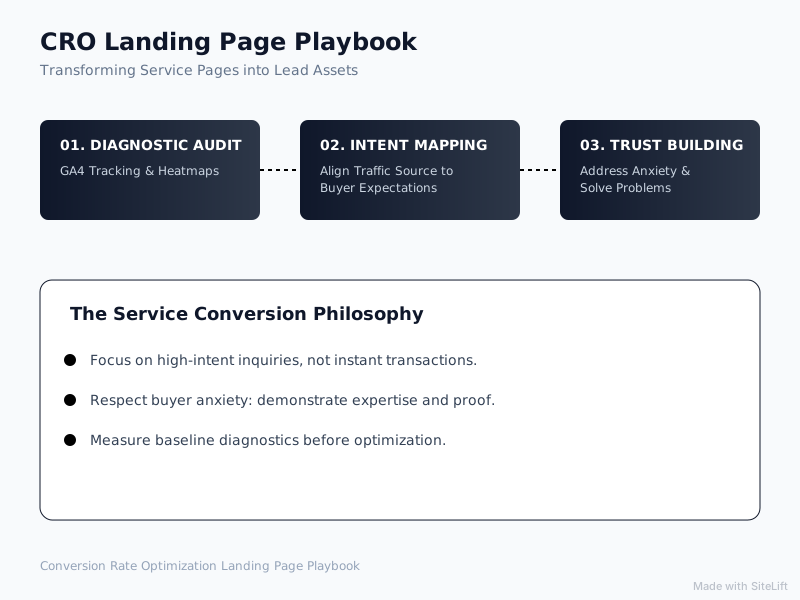
Infographic by SiteLift
| Capture Method | Typical Conversion Rate | Lead Qualification Depth | Best Used For |
|---|---|---|---|
| Traditional Single-Step Form | 2% – 4% | Low to Moderate | Low-friction introductory calls |
| Multi-Step Progressive Form | 5% – 9% | High | Multi-tier service packaging |
| AI Conversational Assistant | 7% – 12%+ | High & Contextual | After-hours capture & immediate triage |
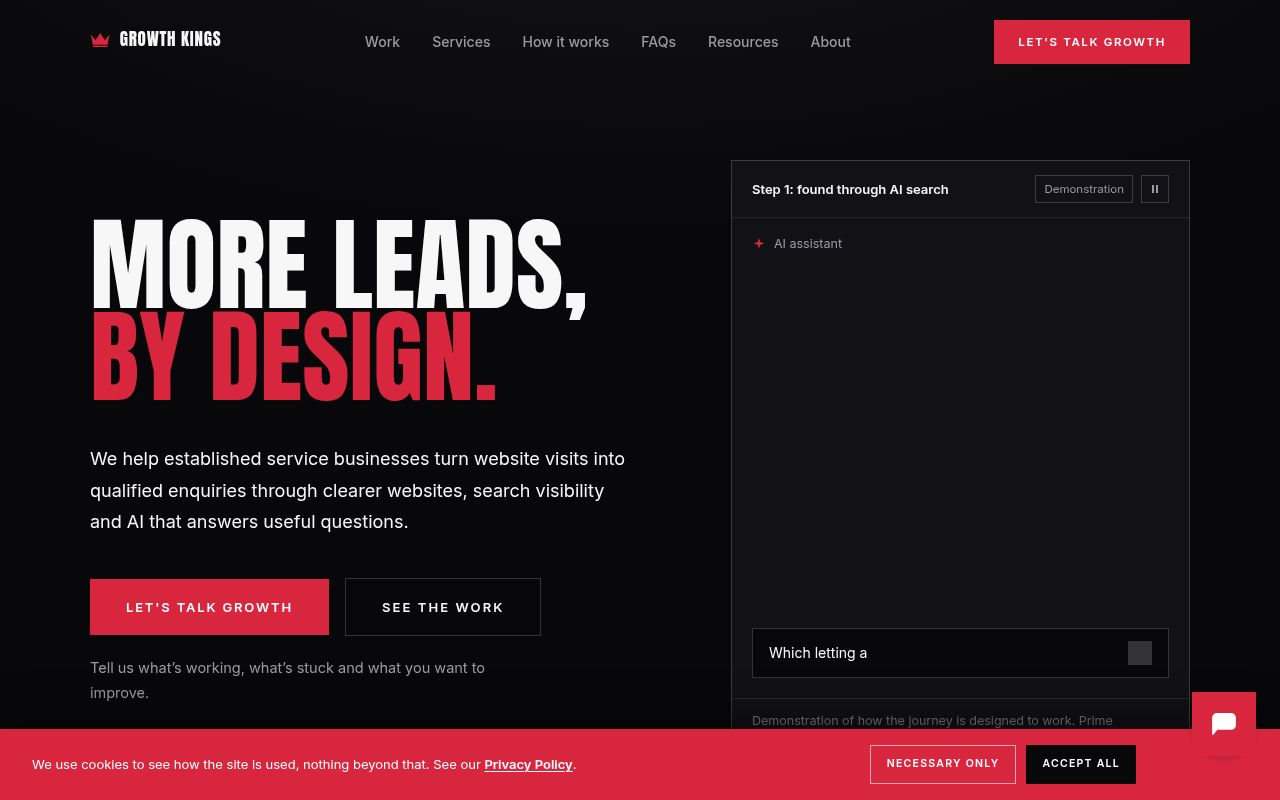
Many prospective clients browse service sites outside of traditional business hours. Deploying an AI-driven conversational capture system allows you to qualify leads instantly, answer initial scope questions, and secure calendar bookings around the clock. To explore this approach in detail, read our breakdown of AI conversion optimization for service sites.
- Action: Strip away unnecessary form fields or transition long intake forms into a clean, two-step guided process.
- Expected Result: A noticeable reduction in form abandonment rates, especially among mobile visitors.
- Mistakes to Avoid: Asking for invasive personal details (like direct phone numbers or home addresses) before you have delivered any value.
Step 5: Run Controlled Tests on Your Conversion Rate Optimization Landing Page
Conversion rate optimization is an iterative discipline. You cannot launch a page, leave it untouched, and assume it operates at peak efficiency. You need structured experiments to separate real user patterns from random statistical noise.
Selecting High-Impact Variables to Test First
When conducting A/B split tests, many site owners waste weeks testing trivial adjustments like background gradients. These micro-elements rarely move the needle for high-value services.
Focus your testing bandwidth on high-leverage elements:
- The Core Offer: Testing a "Free Technical Site Audit" against a "15-Minute Scope Consultation."
- The Hero Headline: Shifting from an outcome-first claim to a problem-led hook.
- Page Layout Architecture: Comparing a single-column long-form sales narrative against a multi-step dynamic lead funnel.
According to experimentation methodologies documented by VWO, tests must run until they achieve statistical significance (typically 95% confidence) with sufficient sample size. Terminating tests prematurely based on the first 20 conversions often leads to implementing false positives.
Analyzing Session Recordings to Uncover Drop-Off Friction
Quantitative data shows you where users leave; qualitative data reveals why. Set aside time each week to watch session replays:
Look for rage clicks on non-clickable elements (indicating unmet user expectations).
Notice where cursor movement stalls (indicating confusing copy or unexpected jargon).
Observe mobile users attempting to interact with bloated form dropdowns.
Action: Implement a split test between your existing value proposition headline and an alternative, outcome-driven variation.
Expected Result: Concrete behavioral data showing which messaging angle resonates best with high-intent buyers.
Mistakes to Avoid: Running multiple split tests concurrently on the same URL, which obscures which variable drove the change.
Why Friction Can Be Underrated in Service CRO
Here is an editorial opinion that runs counter to conventional conversion wisdom: minimizing friction at all costs is often a mistake for high-touch service businesses.
In e-commerce, any friction is a sale killer. But in complex services, zero-friction lead generation usually floods your sales team with unqualified inquiries, spam, and prospects who cannot afford your fees.
We find that strategic friction is deeply underrated. Adding a single qualifying dropdown (e.g., "What is your anticipated project timeline?") or a pre-call questionnaire filters out window shoppers while increasing the perceived value of your service. High-caliber clients actually appreciate rigorous onboarding—it signals that your time is valuable and that your expertise is in demand. Optimize to remove needless frustration, but keep the checkpoints that preserve your team's time.
Troubleshooting Common Pitfalls in Service Landing Page CRO
If you have implemented structural improvements but your inbound inquiries remain flat, check for these frequent failure points.
Diagnosing High Traffic but Zero Enquiries
When a page attracts substantial traffic without generating leads, the root cause is almost always message mismatch.
If your Google Ad promises "Fixed-Fee Commercial Lease Reviews" but directs users to a generic "Commercial Real Estate Legal Services" overview page, the prospect feels disoriented and leaves. The headline of your landing page must echo the exact query or ad copy that brought the visitor there. If you suspect deeper funnel disconnects across your site, review these underlooked funnel gaps to pinpoint where user momentum is breaking down.
Fixing the Mobile Experience and Page Speed Bottlenecks
Technical performance is a conversion metric. Research by Portent shows that a website that loads in 1 second achieves a conversion rate three times higher than a site that takes 5 seconds to load.
Test your page using Google PageSpeed Insights and address these mobile pitfalls:
- Sticky Navigation Menus: Ensure headers do not consume half the mobile viewport, pushing critical copy out of view.
- Click-to-Call Functionality: Ensure your phone numbers use proper
tel:links so mobile users can dial with a single tap. - Header Bloat: Strip out heavy uncompressed imagery, unnecessary scripts, and third-party trackers that bog down Core Web Vitals.
The Expected Outcome: Building a Predictable Lead Generation Asset
When you execute systematic conversion rate optimization across your service pages, your website shifts from a passive digital brochure into an active commercial asset. Rather than relying entirely on sporadic referrals or unpredictable outbound sales, you establish a reliable inbound channel.
Measuring Inquiry Velocity and Lead Quality Improvements
The ultimate measure of your optimization efforts isn't vanity traffic—it is sales pipeline health. Over a 60-to-90-day implementation cycle, expect to see:
- Higher conversion rates (moving from typical 1-2% industry averages toward 5-8%+ qualified inquiry rates).
- A noticeable drop in cost-per-acquisition across paid marketing channels.
- Higher qualification rates during initial discovery calls, as your page copy weeds out bad-fit clients beforehand.
For practical examples of how targeted copy and structural tweaks impact lead pipelines, explore our review of website optimization examples that transformed service firm inquiries without full site redesigns.
Scaling What Works Across Secondary Service Pages
Once you find a high-performing landing page architecture that reliably converts, template the layout. Apply the same above-the-fold structure, social proof placement, and multi-step intake flows across your firm's secondary practice areas and niche service offerings.
At growth-kings.com, we focus on helping established service providers implement these practical conversion frameworks, optimizing clarity, trust, and capture workflows to turn existing visits into valuable commercial relationships.
— growth-kings.com
Frequently Asked Questions
What is a good conversion rate for a service business landing page?
While performance varies depending on deal size and traffic source, the median conversion rate for professional services is approximately 4.6%, according to the Unbounce Conversion Benchmark Report. Top-performing pages that align high-intent traffic with targeted copy often reach between 8% and 11%. Pages converting below 2% typically suffer from message mismatch, excessive form friction, or weak trust signals.
How does a conversion rate optimization landing page differ from a standard website homepage?
A homepage is designed for broad exploration, catering to job seekers, existing clients, partners, and casual browsers with multiple navigation menus and broad overviews. A conversion-focused landing page has a single conversion objective, targeted messaging matched to a specific audience or ad campaign, minimal external navigation links, and a clear, focused call to action.
How many form fields should a service business include on a landing page?
For initial website inquiries, keep form fields to between three and five inputs (typically name, business email, phone number, and primary service requirement). If your qualification workflow demands deeper intake data, use a multi-step progressive form or an automated conversational intake assistant rather than presenting an intimidating, single-screen form.
How long does it take to see results from landing page conversion rate optimization?
Technical fixes (such as repairing slow mobile load times or streamlining broken form fields) can yield immediate gains within days of deployment. However, messaging and layout A/B tests generally require anywhere from four to eight weeks to achieve statistical significance, depending on your inbound traffic volume and sales cycle length.
Should service businesses use conversational AI assistants on landing pages?
Yes, particularly for capturing after-hours traffic. Many corporate decision-makers research vendors during evenings and weekends when your sales staff is offline. A well-configured conversational assistant can answer basic procedural questions, qualify inbound leads against your ideal client criteria, and schedule discovery calls directly into your team's calendar.
Want this working on your own site?
Tell us what’s working, what’s stuck and what you want to improve. We will reply personally.