AI Enquiry Assistant Implementation for Service Firms: From First Chat to Qualified Enquiry
Learn how to execute an AI enquiry assistant implementation for service firms. Qualify leads, capture after-hours inquiries, and book calls 24/7.
By Growth Kings. Published , updated . 15 min read.

AI Enquiry Assistant Implementation for Service Firms: From First Chat to Qualified Enquiry
If your service firm relies on high-ticket client engagements, your website has one primary job: turning interested visitors into qualified sales conversations. Yet, most agency, consulting, legal, and professional service websites lose revenue through passive, outdated contact forms. When a prospect lands on your site at 8:00 PM on a Sunday, forcing them to fill out a static form and wait 24 to 48 hours for a reply virtually guarantees they will keep browsing your competitors.
Executing a strategic ai enquiry assistant implementation for service firms fundamentally shifts how your business handles incoming digital interest. Instead of letting leads cold-soak in an inbox overnight, an automated assistant greets prospects instantly, evaluates their budget and requirements, answers specific service questions, and routes qualified prospects directly into your calendar.
Below is a breakdown of what a complete implementation roadmap looks like, from initial architecture design to continuous ROI optimization.
Key Takeaways
| Implementation Phase | Key Objective | Key Technical Output |
|---|---|---|
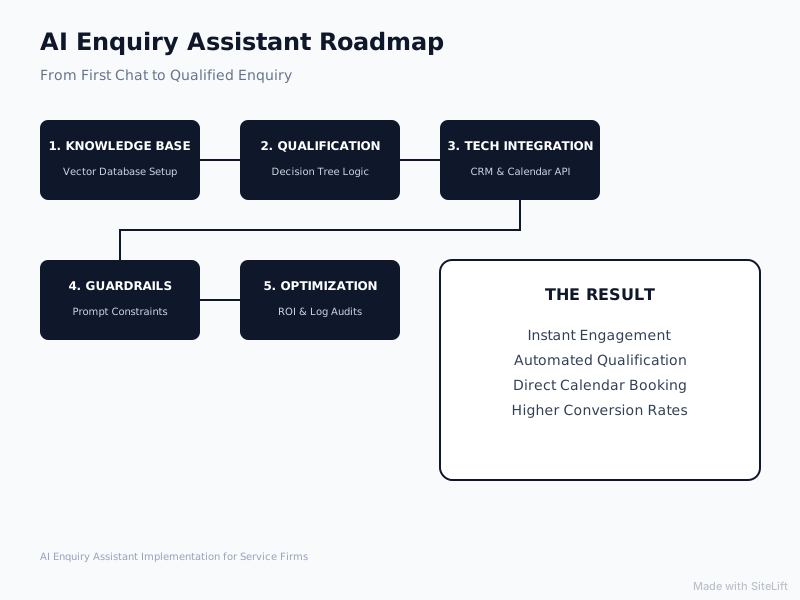
| 1. Knowledge Base Setup | Feed accurate firm data into the assistant | Structured vector database using site copy, FAQs, and case studies |
| 2. Qualification Logic | Filter high-value prospects from unqualified leads | Custom decision tree for budget, project scope, and timeline checks |
| 3. Tech Stack Integration | Connect assistant seamlessly to internal systems | Direct API sync with CRMs (HubSpot, Salesforce) & calendar booking tools |
| 4. Guardrails & Testing | Prevent hallucinated answers and off-brand replies | System prompt constraints, fallback rules, and human escalation triggers |
| 5. Continuous Optimization | Increase enquiry-to-booked-meeting conversion rates | Weekly log audits, prompt adjustments, and workflow refinements |
Why AI Enquiry Assistant Implementation for Service Firms Matters Now
The Cost of Unanswered After-Hours Inquiries
Most professional service firms operate on standard business hours, but modern buyers do not. Decision-makers frequently research vendors during off-hours, evenings, and weekends. When an executive evaluates potential partners on a Saturday afternoon, they expect immediate feedback on whether your firm can address their specific problem.
Speed to lead is not just a customer service preference; it directly dictates pipeline conversion rates. According to research published by HubSpot, responding to leads within the first 5 minutes increases conversion odds by 21 times compared to waiting 30 minutes. If a lead fills out your form after business hours and stays uncontacted until 9:30 AM the next morning, the likelihood of securing that consultation drops off a cliff.
Response Time vs. Conversion Odds Benchmark:
[0-5 Minutes]   ████████████████████████ 21x Conversion Rate
[30 Minutes]    █ 1x Baseline Conversion Rate
[24+ Hours]     ░ Near-Zero Qualification Probability
Shifting from Static Contact Forms to Conversational Qualification
Static contact forms create unnecessary friction. They ask users to submit sensitive details into a digital vacuum without offering immediate value in return. Visitors are naturally hesitant to complete generic "Contact Us" forms because they expect an aggressive sales call rather than tailored insights.
In contrast, a dynamic AI chatbot for businesses transforms passive browsing into an interactive, helpful conversation. Instead of demanding personal information upfront, the assistant invites the user to state their immediate objective, answers questions regarding your firm's methodology or service coverage, and gradually collects intake data as value is established.
Data published by Drift indicates that 55% of businesses deploying conversational AI platforms generate a higher volume of qualified leads. By lowering engagement friction, conversational interfaces pull more passive visitors into active sales conversations.
Bridging the Gap Between Web Traffic and Booked Consultations
Driving web traffic through search engine optimization or digital marketing campaigns is expensive. However, driving traffic to a site that fails to capture user intent results in inflated client acquisition costs. Conversational AI acts as a 24/7 client intake engine that converts existing traffic into pre-qualified sales calls.
Rather than serving as a basic support widget that spits out generic help center links, a dedicated conversational AI for service firms functions as an automated sales development representative (SDR). It clarifies requirements, verifies whether the client fits your ideal customer profile (ICP), and guides qualified prospects directly to your sales team's booking calendar.
What Does an Optimal AI Assistant Enquiry Workflow Look Like?
To turn cold traffic into sales-ready prospects, your AI assistant needs a clear logical progression. The goal is to move smoothly from initial greeting to lead qualification and calendar scheduling without sounding like an invasive interrogation.
+-------------------------------------------------------------------+
|                     OPTIMAL ENQUIRY WORKFLOW                      |
+-------------------------------------------------------------------+
|  1. Greeting & Intent Recognition                                 |
|     └─ Greeting adjusted by page context & user action            |
+-------------------------------------------------------------------+
                                  │
                                  ▼
+-------------------------------------------------------------------+
|  2. Dynamic Qualification Matrix                                  |
|     └─ Evaluate project scope, timeline, and budget fit           |
+-------------------------------------------------------------------+
                                  │
                                  ▼
+-------------------------------------------------------------------+
|  3. Automated Routing & Action                                    |
|     ├─ High ICP Fit ──> Direct Calendar Booking + CRM Alert       |
|     └─ Low ICP Fit  ──> Content Routing / Secondary Form Submission|
+-------------------------------------------------------------------+
The First Interaction: Friendly Greeting & Intent Recognition
The opening exchange sets the tone for the firm's brand experience. Avoid generic greetings like "How can I help you today?" precise context yields far better engagement rates.
If a prospect is browsing your specialized engineering consulting page, the assistant should initiate a contextual prompt: "Looking for assistance with commercial structural engineering compliance? I can answer questions about our past projects or help schedule a preliminary call with our engineering lead."
Effective intent recognition categorizes incoming messages immediately:
- Informational Queries: ("What industries do you work with?")
- Pricing & Scope Queries: ("What is your average engagement cost for custom software audit?")
- High-Intent Sales Queries: ("I need to hire a firm for an enterprise audit next month.")
Dynamic Qualification: Filtering High-Value Clients from Window Shoppers
Unqualified sales calls waste valuable partner and account director time. The implementation process must include a customized qualification matrix that screens leads before they hit your internal calendars.
An after-hours lead qualification bot gathers critical intake criteria conversationally:
- Service Fit: What specific challenge or service requirement brought them to your firm?
- Scope & Volume: What is the size, scale, or revenue bracket of their organization?
- Timeline: Are they looking to kick off immediately, or are they collecting preliminary quotes for next quarter?
- Budget Alignment: Does their budget match your firm's minimum retainer or project minimums?
Instead of presenting an intrusive list of fields, the assistant weaves these questions into the natural flow of conversation. For instance, after explaining your firm's advisory process, the assistant can ask: "To make sure we pair you with the right director, what is your expected timeline for launching this initiative?"
Seamless Routing: Calendar Booking and CRM Syncing
Once a lead meets your qualification threshold, the assistant transitions from inquiry handler to meeting scheduler. It displays live calendar availability directly inside the chat window, allowing high-intent decision-makers to select a convenient consultation slot immediately.
For leads that fall below your minimum engagement size or require services outside your firm's expertise, the assistant routes them gracefully toward alternative resources—such as downloadable whitepapers, standard inquiry forms, or external partner referrals—without damaging your brand reputation.

How Do You Execute AI Enquiry Assistant Implementation for Service Firms Step-by-Step?
Deploying a high-performing AI assistant requires structured execution. Skipping steps during system design leads to incorrect answers, off-brand tone, and missed lead capture opportunities.
Phase 1: Knowledge Base Ingestion & Alignment
Your assistant is only as capable as the data backing it. The initial phase of an ai enquiry assistant implementation for service firms involves compiling and structuring your company's proprietary domain knowledge.
RAW SOURCES                         VECTOR DATABASE              AI ASSISTANT ENGINE
[ Service Pages ]       ───────┐
[ Case Studies ]        ───────┼───> [ Chunking & Embedding ] ───> [ Context Retrieval ]
[ Past Proposals ]      ───────┤     (Retrieval-Augmented           (Accurate Answers &
[ Process Specs ]       ───────┘      Generation - RAG)              Structured Pitching)
Data ingestion should cover:
- Detailed Service Overviews: Core offerings, project methodologies, deliverables, and timelines.
- Case Studies & Client Results: Proven metrics, vertical expertise, and concrete client outcomes. You can review how practical workflow builds operate by reviewing our Bernardi Volvo Cars Natick case study.
- Pricing & Engagement Models: Typical retainer floors, project starting rates, and common scope boundaries.
- Operational FAQs: Location details, compliance certifications, team structure, and onboarding processes.
Using a Retrieval-Augmented Generation (RAG) framework, the assistant queries your vector database to construct precise answers using approved corporate documentation rather than generating unverified assumptions.
Phase 2: Qualification Criteria & Logic Mapping
Next, translate your sales team's implicit intake rules into explicit decision logic. Map out clear decision pathways for different inquiry types:
IF prospect_budget >= Firm_Minimum
   AND timeline <= 90_Days
   THEN Trigger Direct Calendar Integration
ELSE IF prospect_budget < Firm_Minimum
   THEN Route to Email Capture & Lead Nurture Sequence
ELSE IF request_type == "Vendor Pitch / Job Application"
   THEN Route to Vendor/Careers Contact Form
Establishing logic flows prevents low-budget inquiries from clogging up executive calendars while ensuring enterprise-level leads receive immediate access to senior strategists.
Phase 3: Testing, Guardrails, and Hallucination Prevention
Client trust is non-negotiable for professional service providers. A single inaccurate promise regarding service coverage or pricing guarantees can ruin a prospective account.
According to customer research published by Salesforce, 74% of customers expect consistent interactions across departments when engaging with a business. An AI assistant that contradicts your actual sales team damages credibility immediately.
To eliminate risk, apply strict system guardrails during implementation:
- Strict Scope Boundaries: Explicitly instruct the assistant to state, "I don’t have that specific operational detail on hand, but our senior strategy team can clarify that during your call," whenever a question falls outside the knowledge base.
- Prompt Constraints: Enforce strict guidelines regarding tone, professional vocabulary, and brand persona.
- Negative Constraint Injection: Program explicit instructions preventing the assistant from making legally binding guarantees, offering unapproved discounts, or evaluating competitor performance.
Infographic by SiteLift
How Do You Integrate Conversational AI into Your Existing Tech Stack?
An enterprise conversational AI system must integrate cleanly into your existing sales pipeline and operations software. Standardized integration points prevent data siloing and eliminate administrative work for your staff.
                                 ┌──> CRM (HubSpot / Salesforce)
                                 │    ├─ Contact Creation
                                 │    └─ Lifecycle Stage Update
                                 │
[ Website Visitor ] ──> [ AI Assistant ] ──> Calendar (Calendly / SavvyCal)
                                 │    └─ Direct Meeting Scheduling
                                 │
                                 └──> Operations Alert (Slack / Teams)
                                      └─ Immediate High-Value Lead Notification
Connecting AI Assistants to Your CRM (HubSpot, Salesforce, ActiveCampaign)
Every conversation held by your assistant provides valuable zero-party data. Integrating your AI enquiry assistant setup directly with platforms like HubSpot or Salesforce ensures all contact records, conversation transcripts, answered qualification criteria, and lead scoring values sync automatically.
Key data fields to capture and sync include:
- Full Chat Transcript & Sentiment Score
- Identified Pain Points & Service Needs
- Self-Reported Budget & Execution Timeline
- Lead Status (e.g., Qualified - Pending Call, Unqualified - Low Budget)
- First-Touch Attribution Source & Landing Page URL
Automating Real-Time Calendar Availability
When qualified prospects reach the end of the intake flow, friction must be minimized. Integrating real-time availability tools like Calendly, SavvyCal, or native CRM scheduling links directly inside the chat modal allows visitors to pick open slots without leaving the page.
Automated calendar syncing should handle:
- Time zone detection based on visitor IP address.
- Dynamic assignment based on internal sales rep routing rules (e.g., round-robin or vertical specialization).
- Automatic email confirmation dispatches containing call links and customized agendas built from the chat transcript.
Designing the Human Handoff for Complex Inquiries
Not every interaction can or should be fully automated. When a high-value account demands direct human contact or presents complex requirements, the assistant must execute a rapid handoff.
Trigger Condition: Enterprise Lead Detected OR Complex Query Expressed
  │
  ├──> Step 1: Assistant captures visitor contact info & summary of request
  ├──> Step 2: Push instant ping to internal Slack / Microsoft Teams channel
  └──> Step 3: Enable live-chat take-over OR promise direct callback within 15 mins
Setting up instant notifications via Slack or email ensures your sales team can jump into a live chat session or call a high-value account back immediately while they remain actively engaged on your website.
My Perspective: Why Most Service Firms Get AI Automation Wrong
The "Set-and-Forget" Fallacy
Over the past several years evaluating digital growth setups for service businesses, I've noticed a recurring mistake: firm leaders view AI implementations as a one-time software installation rather than an evolving operational channel.
Many agencies deploy a raw out-of-the-box chatbot, upload a couple of sales PDFs, and expect pipeline numbers to double overnight. When the bot gives a dry, generic response to a nuanced enterprise lead, they blame the technology and revert back to passive contact forms.
The reality is that conversational AI is an interactive sales channel that requires continuous refinement. An effective assistant must mirror the tone, strategy, and qualification discipline of your top-performing partner. If you wouldn't let a junior intern speak to an enterprise client without training and ongoing reviews, you shouldn't launch an unmonitored AI assistant without routine conversation auditing.
Pro Tip: Treat your AI assistant like a newly hired SDR. Schedule a weekly 20-minute audit of transcript logs to identify common objections, refine prompt responses, and continuously update your knowledge base with fresh case studies and revised service details.
How Do You Measure ROI and Continuously Refine Your AI Assistant?
To prove the business impact of your implementation, focus on core operational metrics that tie directly to revenue pipeline velocity.
Key Metrics: Engagement Rate, Lead Qualification Rate, and Cost-Per-Acquisition
Avoid tracking vanity metrics like raw message counts. Instead, monitor conversion health across three core key performance indicators (KPIs):
+-----------------------------------------------------------------------------------+
|                            AI ASSISTANT ROI DASHBOARD                             |
+-----------------------------------------------------------------------------------+
|  [ Engagement Rate ]        │ % of visitors initiating or responding to chat      |
|  [ Lead Qualification Rate] │ % of chatting users meeting ICP target criteria     |
|  [ Booking Conversion Rate] │ % of qualified leads scheduling a consultation      |
|  [ Pipeline Contribution ]  │ Total qualified deal value sourced by assistant     |
+-----------------------------------------------------------------------------------+
Technology adoption benchmarks from Gartner show that organizations optimizing conversational AI tools continuously achieve significant improvements in customer acquisition efficiency compared to static digital strategies.
Auditing Conversation Logs for Knowledge Gaps
During the first few months post-launch, audit chat transcripts weekly. Look for patterns where the assistant relies on fallback responses:
- Are visitors frequently asking about specialized pricing tiers that aren't documented in the knowledge base?
- Do prospects ask about specific vertical experience that should be backed by fresh case study data?
- Are certain phrasing patterns causing the assistant to misunderstand prospect intent?
Documenting these gaps allows your team to expand the knowledge base, keeping your system accurate and up to date over time. You can learn more about structured ongoing maintenance by reviewing our guide on AI chatbot maintenance services for firms.
Iterative Prompt Engineering for Service Businesses
Small adjustments to prompt instructions can yield notable improvements in conversion performance.
For instance, if prospect drop-off occurs during the budget question phase, tweak system instructions to reframe the ask:
BEFORE: "What is your budget for this digital transformation project?"
AFTER:  "To help us recommend the right project scale, are you looking at a baseline audit (under $10k), a targeted overhaul ($10k-$25k), or a full enterprise execution ($25k+)?"
Providing structured multiple-choice brackets lowers cognitive friction, resulting in higher response completion rates without sacrificing qualification quality.
Transforming Your Website into a 24/7 Engine with Growth Kings
Implementing an intelligent client qualification engine requires more than copying and pasting code snippets onto your site. It demands a clear understanding of client acquisition mechanics, web performance optimization, and custom technical integrations.
At Growth Kings, we focus on practical, results-driven web improvements that help established service firms convert traffic into pre-qualified sales calls. Instead of pushing for unnecessary site rebuilds, we optimize your existing assets for trust, clarity, and rapid conversion.
Our custom AI conversational architectures handle intake, answer complex service queries around the clock, and route ideal clients directly to your team.
- Want to evaluate how an automated conversational pipeline fits your operational model? Explore our specialized AI sales assistant for service businesses.
- Planning your implementation budget? Read our transparent breakdown of AI chatbot setup cost for services.
Frequently Asked Questions
How long does AI enquiry assistant implementation for service firms usually take?
A standard implementation project takes between 2 to 4 weeks. This timeline covers initial knowledge base structuring and vector database setup, custom qualification logic mapping, CRM and calendar integrations, prompt guardrail testing, and final front-end site deployment.
Will an AI enquiry assistant replace our intake staff or account management team?
No. An AI enquiry assistant is designed to augment your human team, not replace them. It handles repetitive front-line duties—such as answering basic operational questions, performing after-hours intake, and routing meeting requests—allowing your senior consultants and business development managers to focus on high-value sales calls and client work.
How does an after-hours lead qualification bot handle complex or custom service requests?
When the assistant encounters a highly complex or unusual request, it relies on system fallback routines. It captures the prospect's key project details and contact information, notes the specific query in your CRM, and lets the user know that a senior strategist will review their custom parameters and reach out personally during business hours.
What happens if the AI assistant encounters a question it cannot answer?
Thanks to Retrieval-Augmented Generation (RAG) and strict prompt guardrails, the assistant will not fabricate answers. If a user asks a question absent from the vector database, the assistant gracefully acknowledges the limitation and offers to connect the user with a human team member via email or a scheduled call.
Is conversational AI for service firms compliant with privacy regulations like GDPR?
Yes, provided the system is built with compliance in mind. Enterprise-grade AI setups ensure data transmitted during chat sessions is encrypted in transit and at rest. They include customizable consent disclaimers, respect user opt-outs, and do not use private client interactions to train public AI models.
— growth-kings.com
Want this working on your own site?
Tell us what’s working, what’s stuck and what you want to improve. We will reply personally.