AI Chatbot for Businesses: Turn After-Hours Chats Into Qualified Service Enquiries
Discover how an AI chatbot for businesses turns after-hours website traffic into pre-qualified service enquiries and booked appointments 24/7.
By Growth Kings. Published . 14 min read.

AI Chatbot for Businesses: Turn After-Hours Chats Into Qualified Service Enquiries
Most service companies lose their best leads between 6:00 PM and 8:00 AM. A prospective client visits your site after dinner, looking for a clear answer to a specific problem, only to face a generic "Contact Us" form with a vague promise that someone will reply in two business days. By morning, that lead has booked a consultation with a competitor who answered immediately.
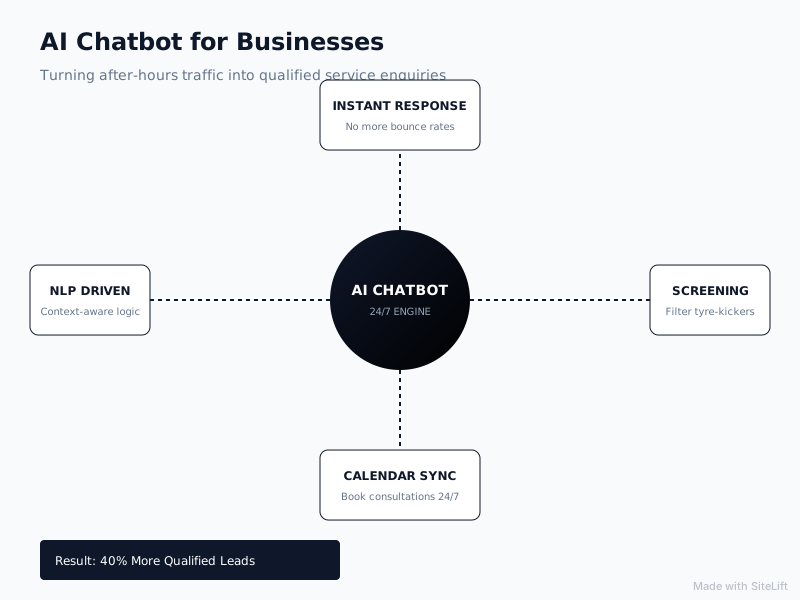
Deploying an ai chatbot for businesses changes that dynamic entirely. Rather than letting after-hours traffic bounce, modern conversational assistants engage visitors instantly, answer granular service questions, filter out tyre-kickers, and book consultations directly onto your calendar.
Below, we break down how to implement an ai enquiry assistant for services, qualify high-value prospects 24/7, and protect your margins without rebuilding your website from scratch.
Key Takeaways
| Feature / Objective | Traditional Rule-Based Bot | Modern Conversational AI Chatbot | Business Impact |
|---|---|---|---|
| Response Logic | Rigid decision trees, "I didn't understand that" errors | Context-aware natural language processing (LLM-driven) | Zero frustrating dead ends for potential buyers |
| Availability | Static forms during out-of-office hours | Real-time after-hours chatbot response 24/7/365 | Captures up to 40% more evening & weekend enquiries |
| Lead Screening | Unfiltered text fields requiring manual review | Pre-qualifies by budget, timeline, service scope, and location | Delivers sales-ready leads straight to your CRM |
| Booking Friction | Back-and-forth email scheduling | Instant calendar sync (Calendly, HubSpot, etc.) | Locks in commitments while buying intent is peak |
| Setup Overhead | Complex flowcharts; months of manual path building | Ingests existing website FAQs and docs in minutes | Fast deployment with no website redesign required |
What Is an AI Chatbot for Businesses and How Does It Drive Growth?
An ai chatbot for businesses is an intelligent conversational agent engineered to engage website visitors using natural language, replicate the consultative nuance of an experienced front-desk specialist, and guide high-intent prospects toward taking action.
Unlike legacy chat widgets that merely route support tickets, a modern commercial AI assistant is built primarily for commercial acquisition: turning casual browsing sessions into booked revenue.
Moving Beyond Rule-Based Chat to Conversational AI
For years, website chat had a bad reputation—and deservedly so. We have all experienced the frustrating "click 1 for sales, click 2 for billing" loops that break down the second a prospect types a real sentence. If a user asked, "Do you manage commercial HVAC retrofits for multi-tenant properties under 20,000 square feet?", old bots would respond with, "Sorry, I didn't get that. Please choose from the menu."
Modern generative AI assistants run on large language models trained specifically on your company's proprietary data: service menus, past case studies, pricing frameworks, and service boundaries. They understand context, intent, and subtle phrasing. When a commercial prospect asks that complex HVAC question, the AI parses the core criteria, verifies your capability from your knowledge base, gives an accurate answer, and asks a relevant follow-up question to advance the sale.
The Difference Between Support Bots and Lead-Qualifying AI Assistants
Too many agencies conflate customer support with lead qualification. While enterprise e-commerce sites use bots to track package deliveries or reset passwords, established B2B and B2C service firms need an engine that protects their team's billable time.
Visitor Lands on Site
       │
       ▼
Engaged by AI Enquiry Assistant
       │
       ├─► Asks Contextual Questions (Service, Budget, Timing)
       │
       ├─► Bad Fit? ──► Polite Redirect / Low-Touch Resource
       │
       └─► Good Fit? ──► Syncs with Calendar / Sends CRM Alert
A support bot waits passively for problems; an enquiry assistant actively uncovers buyer needs. It identifies whether the visitor is a homeowner looking for a routine inspection or a property developer needing a master agreement. By categorising leads before they hit your inbox, your senior team stops wasting time on unqualified calls.
Why After-Hours Lead Capture Is Critical for Modern Service Providers
Buyer habits have shifted permanently. Decision-makers and consumers rarely do their in-depth research during normal business hours when their own days are packed with meetings and operational fires. They research consultants, legal representation, accounting firms, and specialized trades in the evenings, early mornings, and across weekends.
The True Cost of Unanswered Evening and Weekend Enquiries
If your site relies solely on a static web form, you are silently bleeding pipeline value. When an executive or homeowner fills out a contact form at 9:00 PM on a Friday, they enter an information vacuum. They do not know if their message was received, whether you have capacity, or if you even handle their specific problem.
To hedge their bets, they open two more tabs and submit forms to your direct competitors. Whichever business responds first with competent, reassuring answers almost always anchors the relationship.
According to research from Salesforce, 80% of customers state that the experience a company provides is just as important as its products or services. Making a serious buyer wait 48 hours for a basic availability check is an immediate customer experience failure that suppresses your conversion rates.
Speed-to-Lead: Why Immediate Engagement Wins Contracts
Speed-to-lead is not just a vanity metric; it is the single strongest operational predictor of deal acquisition in service businesses.
According to research published by the Harvard Business Review, companies that attempt to contact potential leads within 5 minutes are nearly 7 times more likely to have a meaningful conversation with a key decision-maker than those who wait an hour. After 24 hours, the likelihood of qualifying that lead drops off a cliff.
Contact Delay vs. Lead Qualification Probability
─────────────────────────────────────────────────────────────
Within 5 Minutes  │ ██████████████████████████████ (Baseline Peak)
Within 1 Hour     │ █████ (7x Drop)
After 24 Hours    │ █ (Negligible Conversion)
─────────────────────────────────────────────────────────────
An automated after-hours chatbot response eliminates this delay completely. The AI initiates a warm, professional conversation seconds after the prospect demonstrates interest. It answers urgent scope questions, gathers key project details, and secures an appointment while the lead's intent is at its highest point.
Pro Tip: Configure your AI assistant to mention the exact local time when speaking to late-night visitors. A friendly "Thanks for reaching out tonight—our engineering team is off-duty until 8 AM, but I can answer your questions right now and get you on tomorrow's priority callback schedule" sets clear boundaries while providing instant gratification.

Top Service Business Chatbot Use Cases That Generate Qualified Leads
To see why conversational AI drives such high returns, consider how leading service sectors deploy these tools for frontline triage.
1. Automated Lead Screening and Qualification
The biggest drain on a service business is dealing with prospects who cannot afford your work, live outside your territory, or need services you stopped offering years ago.
An AI lead qualification chatbot asks subtle qualifying questions inside natural dialogue:
- "What is your expected timeline for completion?"
- "Where is the project site located?"
- "To ensure we connect you with the right specialist, what approximate budget have you set aside for this advisory project?"
If the answers fall outside your operational parameters, the AI gracefully lets them down or points them toward free resources—saving your team from conducting a painful 30-minute discovery call that goes nowhere.
2. Direct Calendar Scheduling and Appointment Booking
Sending links back and forth over email to coordinate a meeting time is an antiquated dance that kills momentum.
By integrating your conversational assistant directly with your team's live schedule via tools like Calendly, HubSpot Meetings, or Google Calendar, you compress the sales cycle from days into minutes. Once a visitor clears your qualification criteria, the bot displays real-time calendar availability directly within the chat interface. For a comprehensive walkthrough on connecting these integrations, read our guide on AI appointment booking bot setup.
Lead Discovered ──► Scope Clarified ──► Budget Confirmed ──► Time Slotted
   (2 minutes)          (1 minute)           (30 seconds)         (30 seconds)
The entire interaction takes under four minutes, turning an anonymous visitor into a committed calendar event while you sleep.
3. Answering Complex Service FAQs in Real-Time
Service pricing, regulatory requirements, and project processes are rarely simple. Prospects want answers before they commit to a call, but you cannot put every nuance on a public webpage without cluttering your design.
Consider these sector-specific service business chatbot use cases:
- Commercial Law Practices: Explaining the standard stages of an M&A due diligence audit without giving formal, binding legal advice.
- Specialist Medical & Dental Clinics: Clarifying whether specific private insurance policies are accepted and detailing recovery timeframes.
- B2B Growth & Marketing Agencies: Explaining technical deliverables, onboarding schedules, and performance tracking methodologies.
- High-End Architectural & Construction Firms: Answering zoning feasibility questions and clarifying initial planning fee structures.
Infographic by SiteLift
How to Implement an AI Chatbot for Businesses on Your Existing Website
Business owners often assume that deploying sophisticated artificial intelligence requires a costly, months-long rebuild of their entire digital infrastructure. That assumption is incorrect.
Seamless Integration Without Full Website Rebuilds
You do not need a new website to benefit from conversational lead capture. Modern AI enquiry assistants deploy as lightweight, asynchronous JavaScript snippets that sit non-intrusively on your current site—whether it runs on WordPress, Webflow, Shopify, Squarespace, or a custom stack.
The widget loads independently of your core code, ensuring zero drag on your page load speed or Core Web Vitals. To understand realistic financial commitments across different platforms, see our breakdown of AI chatbot setup costs for services.
Training Your AI Bot on Brand Voice, FAQs, and Knowledge Bases
Your assistant is only as smart as the information you give it. Feeding an unconstrained model raw web access will lead to hallucinations and off-brand replies.
A production-ready implementation uses a Retrieval-Augmented Generation (RAG) framework:
- Source Ingestion: Upload your service agreements, pricing sheets, case study libraries, and client onboarding handbooks into a secure vector database.
- Boundary Setting: Establish rigid guardrails instructing the AI what it cannot say. (e.g., "Never guarantee a specific settlement amount; always refer to our past average ranges").
- Tone Calibration: Program the persona to match your firm's professional voice—whether that is authoritative and corporate or warm and approachable.
Establishing Human-in-the-Loop Hand-Off Workflows
An AI assistant should never operate on an isolated island. It must integrate directly with your existing sales tech stack.
When an after-hours chat converts, the AI pushes a complete transcript, lead score, and structured summary directly into your CRM (such as HubSpot, ActiveCampaign, or Salesforce) and fires an instant alert into your team's Slack or email. If the lead hits the site during office hours and requests human intervention, the system can instantly alert a desk specialist to take over the live chat window without dropping the thread.
Pro Tip: Always make sure the AI sends a bulleted summary alongside the raw chat transcript. Sales reps rarely read through 25 lines of chat text, but they will review a 4-bullet point brief on timeline, budget, current roadblocks, and chosen services right before jumping on a discovery call.
How to Measure the ROI of Your Business AI Chatbot
Investing in website technology without clear financial attribution is a waste of capital. Tracking the success of an AI enquiry assistant requires moving past shallow operational metrics like "total messages sent" and focusing on bottom-line commercial impact.
Analysts at Gartner forecast that conversational AI will drastically lower customer contact labor costs while expanding continuous 24/7 engagement capabilities. For service firms, the primary financial lever is not just cost reduction—it is pipeline expansion.
Traditional Lead Flow vs. AI Conversational Flow
┌─────────────────────────────────┐      ┌─────────────────────────────────┐
│     Traditional Contact Form    │      │      AI Enquiry Assistant       │
├─────────────────────────────────┤      ├─────────────────────────────────┤
│ 1000 Visitors                   │      │ 1000 Visitors                   │
│   └─► 20 Form Submissions (2%)  │      │   └─► 60 Chats Started (6%)     │
│         └─► 8 Unqualified       │      │         └─► 35 Qualified (3.5%) │
│         └─► 6 Never Reply Back  │      │         └─► 24 Booked Calls     │
│         └─► 6 Calls Held        │      │               (4x Pipeline)     │
└─────────────────────────────────┘      └─────────────────────────────────┘
Key Conversion Metrics to Track Beyond Chat Volume
To calculate your actual return on investment, monitor these four metrics quarterly:
- After-Hours Capture Percentage: The proportion of total qualified enquiries that originated outside your team's operational hours (typically 30–45% in optimized systems).
- Speed-to-Meeting Duration: The average elapsed time between a user landing on your website and holding a booked calendar meeting slot.
- Form-to-Chat Conversion Delta: The difference in lead volume between pages carrying a static form versus those equipped with an active conversational assistant.
- Cost Per Qualified Lead (CPQL): Total infrastructure and management cost divided by the number of vetted, high-intent prospects captured.
Evaluating Lead Quality vs. Raw Lead Quantity
A surge in leads is counterproductive if your team spends all Monday morning wading through spam. An effective implementation should cause your total unqualified volume to decline while your closed-won contract value climbs.
By demanding specific criteria before presenting a booking link, the assistant acts as a 24/7 bouncer, preserving your senior team's focus for conversations that generate revenue.
Editorial: Why the "Contact Us" Form Is Quietly Costing You Clients
I speak with service business founders every week who believe their website is failing because of "low traffic." They spend thousands of pounds on search engine optimization and pay-per-click ads, only to direct that hard-won attention to a contact page that looks like an administrative tax document.
Here is the reality: your traffic is likely fine. Your conversion architecture is broken.
Expecting a high-value buyer to fill out a 7-field form, press a grey "Submit" button, and wait 24 to 48 hours for someone to acknowledge them is completely disconnected from how people buy today. It signals operational sluggishness before you have even had your first call.
An AI assistant does not replace human relationships; it accelerates them. It removes the unnecessary friction of preliminary fact-finding, answers the common objections keeping buyers up at night, and brings them to the table warmed up, pre-vetted, and ready to do business. Businesses that cling to static forms over the coming years will watch their acquisition costs climb while their more responsive peers capture the market.
— growth-kings.com
Turn Your Website Traffic Into Predictable Revenue
Deploying conversational technology should not require endless technical headaches, bloated agency retainers, or disruptive site overhauls.
At growth-kings.com, we help established service providers turn dormant site visits into booked, qualified enquiries. We look at your digital presence with a practical, results-driven focus—identifying where high-intent traffic drops off and implementing dedicated AI assistants that represent your brand with precision.
If you are ready to stop losing high-value evening and weekend prospects to faster-responding competitors, explore our specialized growth implementations and see how simple it is to turn after-hours conversations into predictable business pipeline.
FAQ
What is an AI chatbot for businesses and how does it work?
An ai chatbot for businesses is an automated conversational tool powered by artificial intelligence and natural language processing. It sits on your website to greet visitors, interpret complex queries, answer questions using your company's proprietary service documents, qualify leads according to your business criteria, and automatically book consultations or route prospect data to your CRM.
How does an after-hours chatbot response help convert service enquiries?
Most buyers research service providers during evenings and weekends. If they cannot get instant confirmation that your firm handles their specific problem, they leave to contact a competitor. An after-hours chatbot response engages prospects immediately, answers their urgent questions, and secures an appointment on your calendar while their intent is at its peak.
Can an AI chatbot integrate with my current website without a full redesign?
Yes. You do not need a site overhaul. Modern AI assistants deploy through a lightweight code snippet that works across WordPress, Webflow, Squarespace, and custom-built websites. The bot connects behind the scenes to your existing calendar systems (like Calendly) and CRMs (like HubSpot) via webhooks or native integrations without disrupting your existing design.
Will an AI chatbot sound natural to prospective high-value clients?
Modern commercial AI assistants use advanced large language models configured with strict brand guidelines and domain-specific knowledge bases. They communicate with the professional nuance, clear terminology, and empathy of a trained team member. Visitors receive relevant, articulate answers rather than the canned, frustrating responses associated with old rule-based chat widgets.
How does an AI enquiry assistant qualify leads before sending them to my team?
The assistant is trained on your ideal customer profile. During the conversation, it asks targeted questions regarding budget, project scope, timeline, and geographic location. If a prospect meets your criteria, the assistant prompts them to schedule a meeting. If they do not fit, the bot politely directs them to alternate resources, ensuring your sales team only spends time on revenue-generating opportunities.
Want this working on your own site?
Tell us what’s working, what’s stuck and what you want to improve. We will reply personally.