AI Chatbot Maintenance Services for Firms: Keep Your Enquiry Assistant Accurate and Booking
Learn what ai chatbot maintenance services for firms include, costs & KPIs. Keep your assistant accurate and booking. Get audit tips now.
By Growth Kings. Published , updated . 14 min read.

AI Chatbot Maintenance Services for Firms: Keep Your Enquiry Assistant Accurate and Booking
If you launched a chatbot to capture enquiries and then left it alone, you are not alone — and you are probably losing bookings. I see this pattern constantly with established service firms: a great launch, then slow decay. That is exactly why ai chatbot maintenance services for firms matter more than the initial build. Launch is day one. Maintenance is what keeps your assistant accurate, trusted, and actually booking qualified calls while you work.
According to Salesforce State of Service research, 83% of customers expect to interact with someone immediately when contacting a company. Your after-hours visitor does not want to wait until Monday. They want an answer now.
Key Takeaways
| What You Need to Know | Why It Matters for Your Firm |
|---|---|
| AI drift is real — prices, services, staff, and booking links go stale fast | One wrong answer can kill a high-value enquiry for legal, accounting, consulting, home services, and clinics |
| Maintenance = monitoring + updates + optimization + support | Monitoring finds problems, updates fix facts, optimization improves booking rate |
| Weekly log review, monthly knowledge audit, quarterly full test | Catches hallucinations, fallbacks, and broken CRM/calendar syncs early |
| Track accuracy, fallback rate, lead capture rate, and booked calls | Proves ROI and shows where chatbot training and handoff tuning is needed |
| Most firms need an ai enquiry assistant support plan | Internal teams lack time for prompt tuning, integration checks, and compliance reviews |
Why Do Firms Need AI Chatbot Maintenance Services for Firms?
What happens when an enquiry assistant goes unmaintained?
An unmaintained assistant does not stay the same. It gets worse.
I call it quiet decay. Your firm updates the website with new pricing, adds a service, hires a new partner, changes opening hours, or switches booking tools. The chatbot does not know. So it confidently quotes last year’s fees, recommends a solicitor who left six months ago, or sends people to a dead Calendly link.
Then there are the invisible breaks. A website redesign changes your URLs. The knowledge base still points to old service pages. A CRM field changes and lead data stops flowing. A model update from the provider subtly changes tone or instruction-following. User language shifts too — people ask about new regulations, new treatments, new tax deadlines.
For a low-stakes e-commerce store, that is annoying. For a firm where one enquiry can be worth £5,000 to £50,000, it is expensive. Trust evaporates fast in high-trust services.
How does ongoing maintenance protect lead flow and client trust?
Maintenance protects two things: accuracy and booking completion.
Accuracy means every answer is grounded in your current services, pricing logic, team, policies, and compliance boundaries. Booking completion means the assistant does not just chat — it qualifies, captures name/phone/email, checks real availability, sets expectations for after-hours replies, and hands over cleanly.
According to Gartner research, chatbots are forecast to become the primary customer service channel for about a quarter of organizations by 2027. If chat becomes your front desk, you cannot treat it like a set-and-forget widget.
Pro Tip: Pull your last 100 chatbot conversations. If more than 10% contain outdated facts, dead links, or “I don’t know” loops, you don’t have a traffic problem — you have a maintenance problem.
What Do AI Chatbot Maintenance Services for Firms Actually Include?
A proper maintenance service is not just “we’ll keep an eye on it.” Here is what grown-up ai chatbot maintenance services for firms actually cover:
AI assistant monitoring and updates: what is checked daily, weekly, monthly?
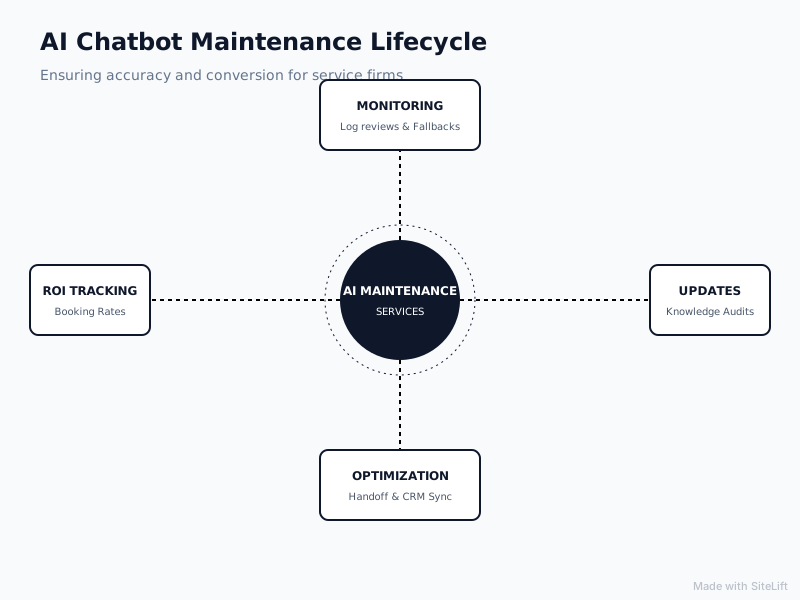
AI assistant monitoring and updates is the heartbeat work:
- Daily / automated: uptime monitoring, error alerts, booking integration health checks, spam/abuse detection
- Weekly: conversation log review, fallback analysis (where the bot said “I don’t understand”), lead capture QA, after-hours performance check
- Monthly: knowledge source refresh — service pages, FAQs, pricing pages, policies, team bios, opening hours, compliance disclaimers
Monitoring finds the smoke. Updates put out the fire. Without both, you are flying blind.
For example, I worked through logs for a home services firm where 22% of after-hours chats ended after the bot asked for a postcode in the wrong format. No one noticed for two months. A 10-minute validation fix recovered those leads.
Chatbot accuracy optimization: knowledge base, prompts, and grounding
Chatbot accuracy optimization is different from just adding new FAQs. It is about how the bot answers.
This includes:
- Cleaning and chunking knowledge — removing duplicates, archiving old PDFs, linking to live service pages instead of pasting static text
- Prompt tuning — tightening system instructions, defining what the bot must never do (never quote exact legal fees, never diagnose, never promise outcomes)
- Grounding rules — forcing the bot to cite or pull only from approved sources, and to say “Let me connect you” when confidence is low
- Negative examples — teaching it what not to say based on real bad answers
OpenAI’s own guidance discusses limitations like hallucinations in AI assistants and the need for grounding and safeguards. That is technical speak for: if you do not anchor it, it will make things up politely.
If you want to understand how this connects to lead quality, read our guide on building an AI lead qualification chatbot that books meetings while you sleep.
AI enquiry assistant support plan essentials: security, integrations, and reporting
An ai enquiry assistant support plan should also cover the boring stuff that breaks bookings:
- CRM and calendar sync testing (HubSpot, Salesforce, Clio, Cliniko, Jobber, etc.)
- Email/SMS notification checks and human handoff routing rules
- Data privacy review — what personal data is collected, where it is stored, retention periods
- Access control, audit logs, and compliance wording for legal, financial, and healthcare contexts
- Monthly reporting in plain English: accuracy, containment, handoff rate, booked calls
According to IBM, conversational AI solutions can help businesses reduce customer service costs by up to 30%. But that saving only holds if the assistant stays reliable. A broken handoff that dumps enquiries into no-man’s land costs more than it saves.

How Do You Keep Your AI Enquiry Assistant Accurate and Booking?
Chatbot training and handoff tuning for qualified enquiries
Chatbot training and handoff tuning is where most firms win or lose.
Training is not a one-time upload. My preferred workflow:
- Add real customer language from logs, not just polished marketing copy
- Add service pages, pricing guardrails, objection handling (“why are you more expensive?”, “do you offer payment plans?”), and after-hours FAQs
- Add policies: cancellations, no-shows, emergency vs. routine triage
- Add 10-15 negative examples every month — actual wrong answers, corrected
Handoff tuning is even more critical. The bot should escalate when:
- Enquiry value is high or urgency is high (“burst pipe”, “arrest”, “dental trauma”)
- User shows frustration, repeats a question, or asks for a human
- Confidence is low or compliance risk is present
A good handoff captures name, phone, email, service needed, urgency, and preferred time, sets expectations (“Our team replies weekdays 9-5, usually within 2 hours”), creates the CRM contact, and notifies the right person. No dead ends.
We break this down step-by-step in our AI chat human handoff protocol for CRM integration — especially useful if leads are getting lost between chat and your inbox.
Conversation design tweaks that improve booking completion rates
Small friction kills bookings. I have seen booking completion double after three tiny changes:
- Ask one question at a time, not a five-field interrogation
- Offer smart defaults: “Want Tuesday at 10:30 or Wednesday at 2pm?” instead of “When suits you?”
- Confirm instantly: summary + calendar invite + SMS reminder to cut no-shows
- Qualify before you calendar: 2-3 questions max (service type, location, urgency) then offer booking
Also test your after-hours path separately. That is when 40-60% of service enquiries often arrive, and when no human is there to rescue a confusing flow.
Pro Tip: Mystery-shop your own bot at 10pm on mobile. If you cannot get from “hello” to booked or handed over in under 2 minutes with thumbs only, simplify it.
Preventing hallucinations, dead-ends, and misquotes
Three rules I never break for firms:
- Never let it invent numbers. Prices, timelines, success rates, and legal outcomes must come from approved ranges or trigger a human handoff.
- Never let it hit a dead end. Every fallback needs a next step: offer top 3 topics, live chat handoff, phone number, or callback form.
- Ground everything. Link answers to live pages where possible and timestamp knowledge updates.
If your assistant is already misquoting, do not just add more data. Review prompts first. Most misquotes I audit come from vague instructions, not missing information.
How Often Should Firms Update, Test, and Audit Their Chatbot?
Recommended maintenance cadence for busy service firms
You do not need daily tinkering, but you do need rhythm. Here is the cadence I recommend for busy firms:
- Weekly (30-45 mins): review unresolved conversations, tag fallbacks, fix urgent facts/links
- Monthly (2-3 hours): knowledge audit, prompt check, CRM/calendar integration test, after-hours test, privacy check
- Quarterly (half-day): full conversation audit, UX test on mobile/desktop, competitor objection refresh, compliance review, booking funnel analysis
This is the core of any solid ai enquiry assistant support plan — predictable, documented, and tied to bookings.
Infographic by SiteLift
Key performance checks: accuracy, containment, handoff, and booking rate
Track these six numbers monthly:
| KPI | What It Tells You | Healthy Signal |
|---|---|---|
| Answer accuracy | % of answers correct and grounded | 90%+ on top 50 questions |
| Fallback rate | % of “I didn’t understand” | Falling month-over-month, under 8-10% |
| Lead capture rate | % of chats that yield contact details | Improving after handoff tuning |
| Booked calls / jobs | Actual appointments from chat | Tied to CRM, not just chat clicks |
| False handoffs | Unnecessary escalations | Low — means qualification works |
| CSAT / thumbs up | User satisfaction | Steady or rising |
If you only track chat volume, you will miss the point. Ten chats that book three qualified consults beat 100 chats that go nowhere.
For broader context on turning visits into enquiries, see these AI tools for website optimization that boost clarity and trust.
When to trigger an urgent update vs. routine optimization
Trigger an urgent update when:
- Prices, fees, or service scope change
- Staff join/leave, locations or hours change
- New regulation, compliance, or disclaimer requirement appears
- Website redesign, URL changes, or booking tool switch
- Spike in fallbacks, complaints, or zero-booking days
Everything else — tone tweaks, new FAQs, better qualification flow — can wait for the monthly optimization slot.
How Much Do AI Enquiry Assistant Support Plans Cost and How to Choose One?
Common pricing models for chatbot maintenance and monitoring
Firms usually see three models, and none should require a full rebuild to start:
- Hourly tune-ups: pay for fixes as needed. Cheap short-term, expensive when something breaks at scale.
- Monthly retainer: fixed hours for monitoring, updates, and reporting. Best for steady enquiry volume.
- Tiered support plan: priced by conversation volume, number of knowledge sources, and integrations (CRM, calendar, phone, ticketing). Higher tiers include SLAs and faster response.
I will not quote specific prices here because scope varies wildly — a single-location clinic with one calendar is not the same as a multi-office law firm with intake routing, compliance, and three CRMs. Ask for pricing tied to outcomes and response times, not vague “AI optimization hours.”
DIY maintenance vs. hiring a specialized support partner
You can maintain in-house if you have someone who owns it weekly, understands prompts and grounding, and will actually test integrations. Most firms do not.
The hidden cost of DIY is time and risk: 3-5 hours a month of log review, plus the expertise gap on hallucinations, privacy, and handoff logic. Plus the cost of one lost high-value case because the bot misquoted fees.
A specialized partner makes sense when they understand conversion, not just tech. Your bot is not a toy — it is your after-hours receptionist. You want someone who thinks in qualified enquiries and booked calls, not just API uptime.
Checklist: what to look for in ai chatbot maintenance services for firms
Use this before you sign anything:
- Do they start with an accuracy and booking audit, not a rebuild pitch?
- Do you get transparent logs and monthly reporting (accuracy, fallbacks, bookings)?
- Who owns training data and prompts if you leave?
- What are SLAs for urgent fixes (broken booking, wrong pricing live)?
- Experience with your CRM/booking stack and after-hours flows?
- Data privacy, retention, and compliance process in writing?
- No unnecessary full rebuild upsell — practical improvements first?
If a vendor cannot explain how they will improve booking rate, keep looking.
My Honest Take: Nobody Brags About Maintenance, But It Is Where the Money Is
I will be blunt: I love a slick new chatbot demo as much as anyone. But after auditing dozens of assistants for service businesses, I have never seen ROI come from launch features.
It always comes from unsexy maintenance.
The firms winning with AI are not the ones with the fanciest bot. They are the ones whose bot knew the new partner’s name on day one, stopped quoting 2024 prices, fixed the broken booking link within hours, and learned to ask one better qualifying question that filtered out tyre-kickers.
I personally think most agencies oversell build and undersell upkeep because upkeep is harder to demo. You cannot show off a fallback report in a sales pitch. But that fallback report is what tells you 30 people asked about emergency call-outs last month and got a generic “check our services page.” That is lost revenue hiding in plain sight.
My rule is simple: if you would not leave a new receptionist untrained for six months, do not leave your AI receptionist untrained either. Budget for chatbot accuracy optimization and chatbot training and handoff tuning from the start, measure booked calls religiously, and treat every wrong answer as a bug worth fixing fast.
That mindset turns AI from a novelty into a reliable enquiry engine.
Keep Your Assistant Accurate Without Rebuilding Everything
If your bot is giving shaky answers or bookings have dipped, you do not need to start over. You need a focused accuracy and booking audit: logs, knowledge gaps, prompt issues, and handoff breaks.
That is how we work at growth-kings.com — practical, results-driven improvements to what you already have, not unnecessary rebuilds. We look at clarity, trust, and conversion first, then tune the assistant to qualify and book better after hours.
Start with the logs. Fix the facts. Tighten the handoff. Then measure booked calls for 30 days. You will know very quickly if maintenance is paying for itself.
FAQ
What is included in ai chatbot maintenance services for firms?
It typically includes conversation log review, fallback analysis, knowledge base refreshes, prompt and grounding tuning, CRM and calendar integration checks, uptime and after-hours testing, compliance review, and monthly reporting on accuracy and bookings. Good services tie every update to lead quality and booking completion.
How often should we update and retrain our AI enquiry assistant?
Review logs weekly, refresh knowledge and test integrations monthly, and run a full conversation and UX audit quarterly. Retrain immediately after price changes, new services, staff changes, website redesigns, or spikes in wrong answers or fallbacks.
Why is my AI chatbot giving wrong answers or losing bookings?
The most common causes are outdated knowledge sources, vague prompts with no grounding rules, broken booking or CRM links, poor handoff logic, and asking too many questions before offering booking. Start with a log audit to see exactly where conversations drop off or hallucinate.
How much does an ai enquiry assistant support plan cost?
Most providers offer hourly tune-ups, monthly retainers, or tiered plans based on chat volume, knowledge sources, and integrations. Costs vary widely by complexity and SLAs, so ask for a scoped proposal based on an initial audit rather than a flat fee with no reporting.
Can we maintain our chatbot in-house or do we need ongoing expert support?
You can handle basic FAQ updates in-house if someone owns it weekly. Most firms need expert help for prompt tuning, hallucination prevention, integration maintenance, compliance, and booking optimization. A hybrid model often works best: internal team provides business updates, partner handles monitoring and optimization.
— growth-kings.com
Want this working on your own site?
Tell us what’s working, what’s stuck and what you want to improve. We will reply personally.