Website Strategy for Service Growth: Plan Pages, Search and Assistants That Drive Enquiries
Learn a proven website strategy to plan pages, boost search and use AI assistants to turn visits into qualified enquiries.
By Growth Kings. Published , updated . 14 min read.
Website Strategy for Service Growth: Plan Pages, Search and Assistants That Drive Enquiries
If your site gets visits but not enough good enquiries, you don't have a traffic problem. You have a website strategy problem.
I've seen this pattern dozens of times with established service businesses: decent reputation, steady referrals, a website that looks fine but doesn't sell. The fix is rarely a flashy rebuild. It's an enquiry-led website strategy that connects clear pages, helpful content, search visibility, and fast follow-up into one system built to drive qualified calls and form fills.
This guide walks through exactly that — a practical service website growth plan you can use whether you run a law firm, clinic, agency, trades company, or consultancy.
Key Takeaways: Website Strategy at a Glance
| Pillar | What It Does | First Action |
|---|---|---|
| Page architecture | Makes it obvious who you help and how to enquire | Clarify homepage + one page per core service |
| Website content strategy | Builds trust and captures search demand | Map one keyword intent per page, add cost/process guides |
| Website optimization roadmap | Fixes speed, mobile, and local visibility | Improve Core Web Vitals, titles, internal links, reviews |
| Conversion + AI assistants | Captures after-hours and unqualified traffic | Add instant answers, qualification, and fast follow-up |
| Measurement | Proves ROI in enquiries, not vanity traffic | Track enquiry rate, qualified rate, and cost per enquiry |
In short: plan pages for clarity, create content for trust, optimize for search, and never let a good lead wait.
What Is an Enquiry-Led Website Strategy for Service Businesses?
A website strategy for a service business is a growth system for turning the right visits into qualified enquiries. Not just traffic. Not just a pretty homepage.
Traffic without enquiries is expensive. Rankings without calls don't pay salaries. An enquiry-led approach starts from the end goal — a qualified person contacting you — and works backward to pages, content, and search tactics that support it.
How Does an Enquiry-Led Website Strategy Differ From Design-First Thinking?
Design-first thinking asks: Does it look modern?
Rankings-only thinking asks: Are we #1?
An enquiry-led website strategy asks better questions:
- Does a visitor understand in 5 seconds who we help and what outcome we deliver?
- Do they believe we can do it, based on proof and process?
- Can they enquire in one click without friction or confusion?
According to Stanford University Web Credibility Research, 75% of users admit to making judgments about a company's credibility based on its website design. Design matters, but credibility comes from clarity, proof, and ease — not animations.
That is why I always audit before I recommend. Check clarity, credibility, and friction first:
- Clarity: Is your headline specific about service + audience + location?
- Credibility: Can I find real results, reviews, team photos, and process in two clicks?
- Friction: How many fields, steps, and distractions stand between interest and enquiry?
If those three are weak, a rebuild won't save you. Focused optimization will.
What Are the Core Pillars of a Service Website Growth Plan?
A strong service website growth plan rests on four pillars:
1. Clear page architecture. One page per core service and location. No lumping five services into one vague page.
2. Trust-building content. Service pages, pricing/process explainers, FAQs, and case studies that answer real buying questions.
3. Search visibility. Technical health plus local relevance and topical authority so the right people find you.
4. Conversion and follow-up. Simple CTAs, short forms, click-to-call, reviews near decision points, and AI assistants for instant response.
According to Salesforce, 80% of customers say the experience a company provides is as important as its products and services. For services, your website is that first experience.
Pro Tip: Before you spend on SEO or ads, record five sales calls. The exact phrases prospects use about problems, costs, and fears should become your headlines, FAQs, and service page subheads.
How Does Your Website Strategy Plan Pages That Turn Visits Into Enquiries?
Most service sites don't need more pages. They need the right pages with the right job.
Think of your sitemap as a sales conversation. Each page should answer what the visitor needs to know, what they need to believe, and what to do next.
Which Core Pages Does Every Service Website Need?
Start with this lean architecture:
- Homepage: Who you help, outcomes, proof, and paths to services. One primary CTA.
- Individual service pages: One page per core service. Never combine divorce law and conveyancing, or emergency plumbing and bathroom remodels, on one page.
- Pricing / process page: Even ranges and factors help. Transparency pre-qualifies.
- About / team: Real photos, credentials, and why clients trust you with high-stakes work.
- Proof hub: Case studies, before/afters, video testimonials, and third-party reviews.
- Location / service-area pages: Only if you truly serve those areas with unique proof and details.
- Contact / quote page: Short form, phone number, hours, response-time promise, and what happens next.
For a deeper breakdown of architecture and internal linking, see this website structure optimization guide from silos to sales.
User intent mapping keeps each page focused:
- Homepage = “Am I in the right place?”
- Service page = “Can you solve my specific problem and what will it cost/involve?”
- Proof hub = “Have you done this for someone like me?”
- Contact page = “How fast and easy is it to start?”
What Clarity and Trust Elements Increase Enquiry Rates?
Use this above-the-fold formula on every money page:
Who you help + what outcome + where + proof + single primary CTA.
Example: “Emergency Plumbers for Landlords in Manchester — 60-Minute Response, 4.9 Stars from 800+ Reviews [Get Help Now]”
Then add trust builders down the page:
- Specific outcomes, not superlatives. “127 boiler installs last year, 98% fixed on first visit.”
- Process transparency. 3-4 steps with timelines: audit, quote, schedule, aftercare.
- FAQs that handle objections: cost, timing, guarantees, what if it doesn't work.
- Real photos of team, vans, office, work — not stock.
- Third-party reviews embedded near the CTA, not buried.
- Guarantee or risk reversal where possible.
According to Gartner, B2B buyers spend only 17% of their total purchase time meeting with potential suppliers. Your site has to sell when you aren't in the room. Clear copy and proof do that heavy lifting.
Pro Tip: Put your phone number, response time, and primary CTA in your sticky header on mobile. Most service enquiries happen on phones, often in a hurry.
What Should Your Website Strategy Include for Content That Wins Search and Trust?
Your website content strategy has two jobs: get found by the right people, and make them confident enough to enquire.
That means balancing commercial pages that convert with educational guides that pre-qualify.
How to Map Keywords and Topics to Service Pages and Guides?
One page, one intent. That simple rule prevents cannibalization where three blog posts compete with your main service page.
Map it like this:
- Service pages target commercial intent: [service] + [location] or [problem] + [service]. Example: “accounting for dentists in Austin.”
- Guides target informational intent: cost, comparison, timeline, mistakes, how-to. Example: “how much does a loft conversion cost in London?” or “fixed fee vs hourly for bookkeeping.”
For keyword research basics and on-page principles, the Moz SEO learning center on keyword mapping and on-page optimization is a solid reference.
A starter map for a service business:
- /services/[service-1]/ — primary commercial keyword
- /services/[service-2]/ — primary commercial keyword
- /pricing-process/ — cost + process keywords
- /blog/[service]-cost-guide/ — supports service page, links up to it
- /blog/[service]-vs-alternative/ — comparison intent, strong CTA to quote
- /case-studies/[result]/ — proof, links to relevant service
Every guide should end with a contextual CTA, not a generic “contact us.” Try: “Get a fixed quote for [service] in [area] — reply within 1 business hour.”
How to Create Educational Content That Pre-Qualifies Leads?
The best service content doesn't just rank. It filters out bad fits and warms up good ones.
Use these templates:
Service page template: Headline with outcome + audience + area > proof bar > problems you solve > process > pricing factors > results/cases > FAQs > team > final CTA.
Enquiry-driving blog template: Specific question as H1 > short answer in first 80 words > factors/costs/options > real example with numbers > mistakes to avoid > “Is this right for you?” checklist > CTA to service or quote page.
Build E-E-A-T signals naturally: name the expert author, show real project photos and data, cite sources, update dates and prices yearly, and link to your profiles and reviews.
If design and SEO feel disconnected, this practical guide to search engine optimization website design shows how to combine both for enquiries.

How Does Search Visibility Fit Into Your Website Strategy and Optimization Roadmap?
Search is still the highest-intent channel for services. According to BrightEdge research, organic search drives 53.3% of all website traffic. But visibility only matters in a website optimization roadmap tied to enquiries.
I like phased roadmaps. No 50-point audits that never get implemented. Just sequenced wins.
What Technical Foundations Must Come First?
Fix what blocks users and crawlers before you chase links.
- Speed and Core Web Vitals: Compress images, cut unused scripts, use caching. According to Google, 53% of mobile site visits are abandoned if pages take longer than 3 seconds to load. That stat alone justifies speed work, and you can explore more in this Think with Google research on mobile speed.
- Mobile UX: Thumb-friendly CTAs, tap-to-call, short forms, no pop-ups covering content.
- Crawlability: Clean sitemap, logical internal links from homepage to services to guides, no orphan pages.
- Titles and meta: Unique, intent-matched titles with service + location where relevant.
- Schema: Add structured data for LocalBusiness, Service, Reviews, and FAQ using the Schema.org vocabulary for LocalBusiness and Service.
- Foundations: For crawler and indexing best practices, keep the Google Search Central documentation on crawling and indexing bookmarked.
Pro Tip: Link every new blog post up to its parent service page with descriptive anchor text. Internal links pass relevance faster than most small businesses expect.
How to Build Local Relevance and Topical Authority Over Time?
For local services, alignment wins:
- Keep Google Business Profile categories, services, hours, and areas consistent with your site.
- Keep NAP (name, address, phone) consistent everywhere.
- Build one strong location page per true service area with local proof, photos, and FAQs — not 30 thin doorway pages.
- Systematically earn reviews and reply to them. Embed the best ones on service pages.
- Earn links via partnerships, suppliers, local press, charities, and genuinely helpful resources. Directories help for consistency, but real mentions move the needle.
Set realistic timelines and KPIs:
| Phase | Timeline | What to Expect |
|---|---|---|
| Conversion fixes | 30-90 days | Higher enquiry rate from existing traffic |
| Technical + local cleanup | 1-3 months | Better crawl, speed, and map visibility |
| Content + authority | 4-9 months | Compounding impressions, calls, and qualified forms |
Track impressions, qualified calls/forms, cost per enquiry, and close rate — not just rankings. A #3 ranking that drives 20 qualified quotes beats a #1 that drives tire-kickers.
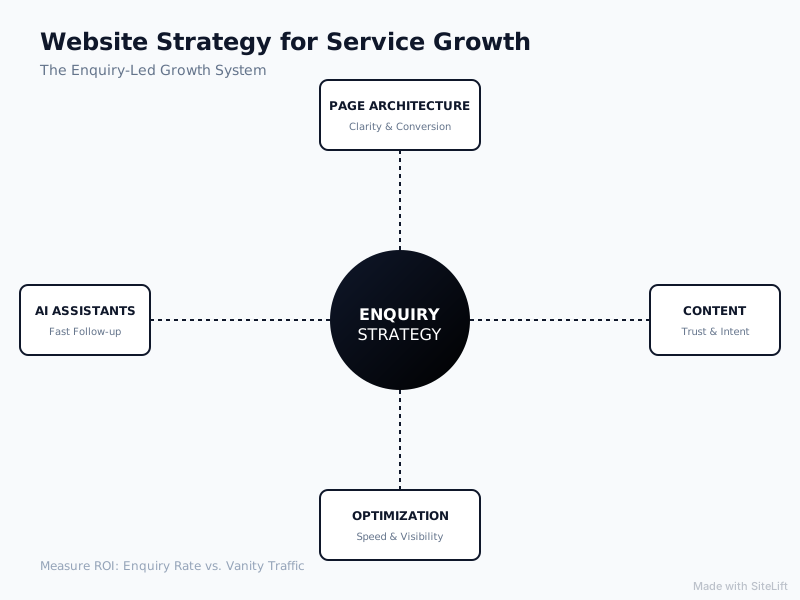
Infographic by SiteLift
How Can AI Assistants Strengthen Your Website Strategy to Capture More Enquiries?
Here's where most service businesses leak money: after hours, slow replies, and unanswered pricing questions.
An AI conversational assistant doesn't replace your team. It ensures no good enquiry waits until Monday morning.
Where Do Conversational Assistants Fit in the Enquiry Journey?
Best use cases I see working right now:
- After-hours capture: Answer FAQs on pricing, availability, and service area instantly, then book or take details.
- Instant qualification: Ask 3-4 smart questions — location, need, timeline, budget range — and route hot leads to call, warm leads to email nurture.
- Booking and triage: Offer calendar slots, reschedule options, and prep checklists.
- Sales support on high-intent pages: Trigger on pricing, service, and contact pages after 20-30 seconds or on exit intent.
Best practices matter more than the tool:
- Train on real FAQs, call transcripts, and pricing ranges — not brochure copy.
- Be transparent it's an assistant and offer human escalation in one click.
- Connect to CRM and email for instant follow-up. Speed to lead is everything.
- Review transcripts weekly to find new objections and content ideas.
How to Measure and Optimize Assistant and Page Performance?
Measure what creates revenue:
- Enquiry conversion rate: enquiries / sessions by page and source
- Qualified enquiry rate: qualified / total enquiries
- Response time: median time to first human or automated useful reply
- Chat-to-call rate: assistant chats that turn into calls or bookings
- Assisted conversions: enquiries where assistant or guide played a role
Then test iteratively. A/B headlines, CTA wording, form length, social proof placement, and assistant opening scripts. Small changes compound. Changing “Submit” to “Get My Fixed Quote” and cutting three form fields has lifted conversion for many of my clients more than any redesign.
My Take: Why I’d Rather Optimize Than Rebuild
I’ll be honest — I talk more businesses out of rebuilds than into them.
Most established service firms already have domain authority, reviews, and pages that Google trusts. Tearing that down for a prettier theme is risky and often pointless. I’ve watched companies spend five figures on a new site that loads slower, ranks worse, and converts the same — because no one fixed the messaging, proof, or follow-up.
My bias is simple: keep what earns, fix what leaks.
Start with message clarity above the fold, one page per service, real proof, and a frictionless way to contact you. Add speed, internal linking, and local signals. Layer in helpful guides that answer pricing and process questions your sales team hears every week. Then add an assistant to catch the 7pm “are you available next Tuesday?” message that would otherwise bounce to a competitor.
Rebuild only when there are red flags: hacked or unstable CMS, no mobile usability, impossible to edit, or information architecture so broken that patching costs more than restarting. Even then, migrate carefully and preserve URLs, content, and schema.
If you want a clear-eyed comparison, read this website redesign vs optimization compared on cost, SEO risk and ROI. It will save you from an expensive mistake.
Enquiries are earned page by page, answer by answer, minute by minute. That’s the whole game.
— growth-kings.com
Turning Strategy Into Enquiries With a Little Help
You don’t need to do all of this alone, and you definitely don’t need a six-month rebuild to start seeing movement.
At growth-kings.com, we specialize in practical website improvements for established service businesses — clearer pages, stronger search visibility, and AI assistants that qualify and capture enquiries after hours. No empty ranking promises, just focused changes tied to calls and forms.
If your traffic is flat or your enquiries are inconsistent, start with a clarity and friction audit. You’ll be surprised how often three or four targeted fixes outperform a brand-new site.
FAQ
What is a website strategy for a service business?
A website strategy for a service business is a plan that turns visits into qualified enquiries. It covers page architecture, messaging, proof, website content strategy, search visibility, and follow-up. Unlike a design brief, it defines audiences, intents, KPIs like enquiry rate and cost per enquiry, and a phased website optimization roadmap to improve them.
How does an enquiry-led website strategy drive more qualified leads?
An enquiry-led website strategy drives qualified leads by matching each page to buyer intent, answering pricing and process objections upfront, and making the next step frictionless. Clear service pages filter out bad fits, educational guides pre-qualify good ones, and fast follow-up — including AI assistants — ensures high-intent visitors don’t slip away. You get fewer tire-kickers and more sales-ready conversations.
What pages should a service website growth plan prioritize first?
A service website growth plan should prioritize homepage clarity first, then individual service pages, then a pricing/process page and simple quote/contact page. Next, build a proof hub with case studies and reviews. Add location pages only for areas you truly serve. This order fixes conversion before you invest heavily in driving more traffic.
Do we need a full website rebuild to improve enquiries?
Usually no. Focused optimization beats a rebuild when your CMS is stable, mobile experience is usable, and you have some authority and content to build on. Quick wins in messaging, CTAs, speed, and reviews often lift enquiries in 30-90 days. Consider a rebuild only for severe technical debt, broken mobile UX, or unfixable architecture — and plan redirects and SEO migration carefully.
How do AI assistants fit into a website strategy for service growth?
AI assistants fit into a website strategy as 24/7 front-desk support. They answer common questions on price and availability, qualify by need, timeline and location, book meetings, and push details to your CRM for fast follow-up. Placed on high-intent service and pricing pages, they lift after-hours capture and reduce lost leads without adding headcount.
Want this working on your own site?
Tell us what’s working, what’s stuck and what you want to improve. We will reply personally.