SEO Web Design for Service Businesses: Turn Your Site Into an Enquiry Machine
Learn search engine optimization website design to boost local visibility and turn visits into enquiries. Practical guide for services.
By Growth Kings. Published , updated . 19 min read.

SEO Web Design for Service Businesses: Turn Your Site Into an Enquiry Machine
If your website looks good but your phone isn't ringing, the problem usually isn't your services. It's that your search engine optimization website design wasn't built to do two jobs at once: get found and get contacted.
I see this constantly with established service businesses. A plumber ranking on page three. A law firm with a beautiful homepage and a contact form nobody can find. A cleaning company getting traffic from three cities away but nothing from the suburbs they actually serve.
This guide fixes that. You'll learn how seo friendly website design for service businesses combines technical SEO, local visibility, and conversion focused web design to build a service website that generates enquiries — without necessarily starting from scratch.
Key Takeaways: SEO Web Design at a Glance
| What You Need | Why It Matters for Enquiries | Quick Action |
|---|---|---|
| Clear service + location structure | Matches how locals search: [service] + [city] and near me |
One dedicated page per core service + area served |
| Technical health: speed, mobile, crawlability | Slow or confusing sites lose rankings and calls | Compress images, fix Core Web Vitals, simplify navigation |
| Trust signals above the fold | Service buyers choose the business that feels safest | Reviews, real photos, credentials, pricing ranges |
| Frictionless enquiry paths | Every extra click costs you jobs | Click-to-call, short forms, sticky CTAs on every page |
| After-hours capture | Most enquiries happen when you're on the job | AI assistant or chat that answers FAQs and books calls |
| Measure enquiries, not just rankings | Visibility without bookings is vanity | Track calls, forms, qualified enquiry rate in Search Console + CRM |
If you remember nothing else: rank for the right intent, make the next step obvious, and never let a good lead go cold because no one answered at 8pm.
What Is Search Engine Optimization Website Design for Service Businesses?
Search engine optimization website design means designing and building your site so search engines can easily crawl, understand, and rank it and so visitors can easily trust you and contact you.
Traditional web design asks: Does it look good? Does it reflect our brand?
SEO web design asks: Can Google crawl it? Does it load in under 3 seconds on mobile? Does each page target one clear search intent? And once someone lands, can they figure out who you help, where you serve, and how to get a quote in five seconds?
How SEO web design differs from traditional web design
A traditional brochure site is built around the company: About Us, Our Services (all on one page), Gallery, Contact.
An SEO-friendly structure is built around the customer’s search:
- Homepage for brand + primary service area
- Individual pages for each core service:
/drain-cleaning/,/emergency-plumber/ - Individual pages or sections for areas served:
/plumber-austin-tx/,/service-areas/ - Helpful supporting content: pricing guides, FAQs, case studies
- Clean internal linking so authority flows to your money pages
Google’s own SEO starter guide makes the same point: clear hierarchy, descriptive URLs, and helpful content built for people are foundational to being discoverable.
Why service businesses need visibility plus enquiries, not just traffic
E-commerce lives on volume. Service businesses live on trust and proximity.
Someone searching for “emergency electrician near me” isn’t browsing. They want proof you’re local, available, credible, and easy to call. If your site ranks but hides your phone number, has stock photos, and no reviews, they’ll bounce straight to a competitor.
That’s why search visibility for local services has to be paired with conversion design. Traffic that doesn’t turn into calls, forms, or booked estimates doesn’t pay the bills.
How search engine optimization website design drives ROI
Think of it as a simple equation:
Relevant local visibility x Clear trust x Easy contact = Qualified enquiries
When those three line up, you don’t need 10x more traffic. A heating company I reviewed went from 400 to 550 monthly organic visits after fixing service pages — but enquiries doubled because they also added click-to-call, upfront pricing ranges, and reviews on each page. Same market, better system.
Pro Tip: Audit your top 5 service pages for one question: can a visitor see what you do, where you do it, why to trust you, and how to contact you without scrolling? If not, fix that before you chase more traffic.
How Does Search Engine Optimization Website Design Help You Get Found?
Search engine optimization website design helps you get found by removing technical blockers, structuring content around local intent, and proving relevance to both Google and humans.
Let’s break it into three layers.
Technical foundations: speed, mobile, crawlability, and site architecture
You can’t rank consistently if Google can’t crawl you or users bounce because pages crawl.
Core essentials for any seo friendly website design for service businesses:
- Speed and Core Web Vitals: Compress images (WebP where possible), lazy-load below-fold media, limit heavy sliders and page-builder bloat. Google’s Core Web Vitals guidance explains how Largest Contentful Paint, Interaction to Next Paint, and Cumulative Layout Shift affect page experience.
- Mobile-first UX: Buttons big enough to tap, click-to-call in the header, forms that work one-handed. This matters because 53% of mobile site visits are abandoned if a page takes longer than 3 seconds to load, according to Think with Google’s mobile page speed benchmarks.
- Crawlability: Clean URLs (
/air-conditioning-repair-denver/not/page?id=123), logical navigation, XML sitemap submitted in Search Console, no important content trapped only in JavaScript. - Schema markup: Add
LocalBusiness,Service,Review, andFAQPageschema so search engines understand your services, areas, hours, and reviews. - HTTPS and site health: Secure site, no broken links, no duplicate title tags, 301 redirects for old pages.
Common blockers I see: slow drag-and-drop builders loaded with plugins, 2MB hero images, duplicate thin location pages with only the city name swapped, and contact info buried in images Google can’t read.
Search visibility for local services: service pages, areas served, and Google Business Profile
For search visibility for local services, your website and your Google Business Profile have to tell the same story.
Here’s the structure that works for most established firms:
- One page per core service. Don’t lump “Plumbing, Drainage, Water Heaters, Gas Fitting” on one page. Give each its own H1, intro, process, pricing signals, FAQs, reviews, and CTA.
- Service-area pages with real substance. A useful location page isn’t just “[Service] in [City]” repeated 20 times. Add local proof: jobs completed there, travel times, parking/access notes, local regulations, photos from real jobs, and embedded reviews from that area.
- Strong internal linking. Link from blog posts and area pages back to your main service pages with natural anchor text like “furnace repair in Boulder.”
- NAP consistency. Name, address, phone must match your website footer, contact page, and Google Business Profile exactly.
- Reviews engine. According to BrightLocal’s Local Consumer Review Survey, 87% of consumers used Google to evaluate local businesses. Link your review profiles, embed recent Google reviews, and ask for reviews after every completed job with a direct link.
For a deeper dive into technical foundations and content search engines can actually understand, see Search and AI Visibility for Service Businesses.
Content structure that matches commercial and local intent
Service searches fall into three buckets. Your site needs pages for all three:
- “I need it now”:
emergency plumber austin,24/7 locksmith near me— these need fast-loading service pages with phone-first CTAs, hours, service area, and instant proof. - “I’m comparing”:
best HVAC company denver reviews,how much does roof replacement cost— these need pricing guides, comparison content, case studies, before/after galleries. - “I have a question”:
why does my drain keep clogging,do I need a permit for...— these need helpful FAQs and blog posts that link to your service pages.
Practical formatting rules:
- One clear H1 per page that includes service + location where relevant
- H2s written as customer questions
- Short paragraphs, bullet lists, and real FAQs with schema
- Original photos with descriptive alt text (
technician-replacing-furnace-denver.jpg, notIMG_4421.jpg)
Pro Tip: Don’t create 30 location pages overnight. Start with 3-5 areas that actually drive revenue, make those pages excellent, then expand based on Search Console impressions.

What Turns a Service Website Into One That Generates Enquiries?
Ranking is half the battle. A service website that generates enquiries turns that attention into calls, forms, and booked estimates. That shift comes down to clarity, trust, and frictionless contact.
Clarity and trust: messaging, proof, and credibility signals
Visitors decide fast. Stanford University’s Web Credibility Research found that 75% of users admit to making judgments about a company’s credibility based on its website design alone. For service businesses, that judgment is everything.
Above the fold on every key page, answer four things in five seconds:
- Who you help: “Residential plumbing for homeowners in North Austin”
- What you do: “Same-day drain clearing, water heaters, leak detection”
- Where you serve: List 3-5 primary areas
- Next step: “Call for same-day service” or “Get a fixed quote in 60 seconds”
Then stack proof:
- Star rating + number of Google reviews near the header
- Real team and van photos, not stock
- Licenses, insurance, guarantees, years in business
- Before/after photos and short case studies with location and outcome
- Transparent pricing ranges: “Most drain clears: $149-$289” beats “Call for pricing”
If you’re in a high-trust niche like legal, medical, or home services, add bios, credentials, and a clear process: What happens after they enquire? Who calls? How fast?
Conversion focused web design: frictionless enquiry paths and calls to action
Conversion focused web design isn’t about aggressive pop-ups. It’s about removing every tiny reason to leave.
Checklist for service sites:
- Sticky header with phone number and “Get Quote” button on mobile and desktop
- Click-to-call everywhere, especially on emergency services
- Short forms: Name, phone, service needed, postcode. That’s it. Ask for details later.
- Service-specific CTAs: “Book AC Tune-Up” converts better than generic “Contact Us”
- Quote estimators or guided quizzes: 3-4 questions to pre-qualify and increase commitment
- Live availability signals: “Next available: Today 2-4pm in Denver Metro”
- Exit-intent or scroll offers: “Download: 2026 Boiler Replacement Cost Guide + $50 Off”
Place a CTA after every major section, not just at the bottom. Someone convinced halfway down shouldn’t have to hunt for how to contact you.
Learn how scoped improvements to messaging and layout work in practice on Conversion-Focused Websites for Service Businesses.
After-hours capture: AI assistants, chat, and instant follow-up
Here’s the leak most owners miss: enquiries don’t keep office hours. Google has reported that 76% of people who search on their smartphones for something nearby visit a business within a day. Many of those searches happen at night, early morning, or while you’re on a job.
If your only option is “leave a voicemail,” you lose to whoever answers first.
What works:
- AI-powered conversational assistant that greets visitors, answers FAQs (pricing, areas, availability), qualifies by service and urgency, and books a call or collects contact details
- Instant SMS + email follow-up: “Thanks, Mike — we got your request for furnace repair in Lakewood. We’ll call within 15 mins during business hours. Is this urgent?”
- Missed-call text-back for phone-first businesses
- Simple routing: Urgent jobs to phone, non-urgent to form + calendar booking
The goal isn’t to replace humans. It’s to make sure every after-hours visitor becomes a morning follow-up, not a lost competitor’s customer.
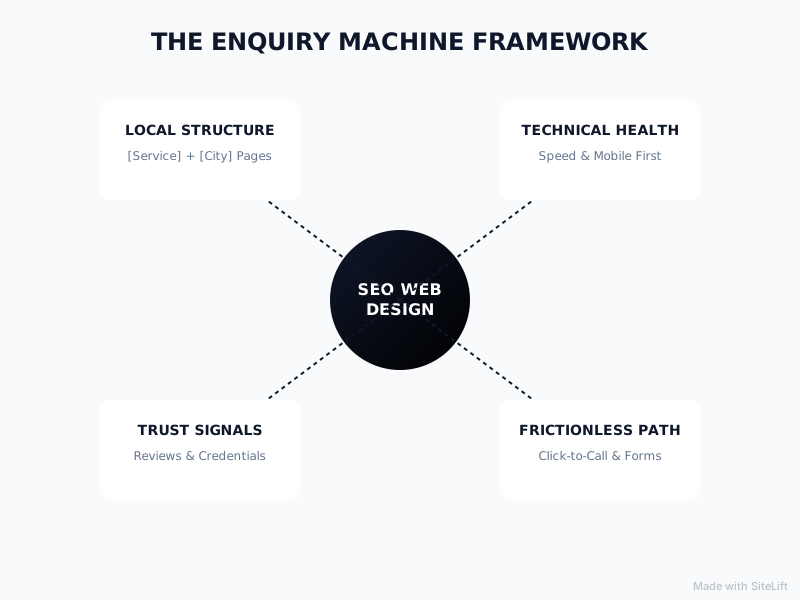
Infographic by SiteLift
| Enquiry Blocker | What Visitors Think | Conversion-Focused Fix |
|---|---|---|
| No pricing info | “They’ll be too expensive” | Add starting prices / typical ranges |
| Generic stock photos | “Is this a real local company?” | Real team, vans, job-site photos |
| Long contact form (8+ fields) | “Too much hassle” | 4 fields max + callback promise |
| No after-hours option | “I need help now” | AI chat + booking + instant SMS |
| Slow mobile load | Back button | Compress images, simplify layout |
How Can You Get Conversion-Focused Web Design Without a Full Rebuild?
Here’s good news for established firms: you rarely need to tear everything down. Targeted optimization usually beats a full rebuild for ROI — faster, cheaper, and less risky for rankings.
Start with a practical SEO and conversion audit
Run this 30-minute check before you spend anything:
SEO health:
- Test 3 key pages in PageSpeed Insights — mobile score above 80?
- Check Search Console for crawl errors, “Discovered - not indexed,” and mobile usability issues
- Search
site:yourdomain.com— are service pages indexed with unique titles? - Are H1s unique and descriptive? Any duplicate title tags?
- Is analytics + call tracking actually working?
Content and local:
- Do you have one strong page per core service?
- Do your top 3 revenue areas have dedicated, helpful pages?
- Does content match
[service] + [city]andnear meintent? - Is NAP consistent with Google Business Profile?
Conversion:
- Can visitors call or request a quote from every page in one click?
- Is your form under 5 fields? Does it work perfectly on mobile?
- Do you have reviews, guarantees, and real photos above the fold?
- What happens after hours? Test your site at 9pm on your phone.
If you want a second pair of eyes, browse practical breakdowns in Resources or get a scoped review rather than guessing.
High-impact optimizations that improve rankings and enquiries fast
Prioritize by effort vs. return:
- Rewrite titles and H1s for your top 5 money pages. Example:
Drain Cleaning in Austin | Same-Day Service from $149 | [Brand]+ H1:Fast Drain Cleaning in Austin, TX - Add proof blocks to those pages: review carousel, 2 case snippets, guarantee badge, technician photo
- Simplify navigation: Services, Pricing, Reviews, Areas Served, Contact. No clever labels.
- Shorten forms and add click-to-call. Add sticky mobile call button if you don’t have one.
- Improve speed: Compress hero images to under 200KB, remove unused plugins, enable caching.
- Build 2-3 excellent location pages instead of 15 thin ones.
- Add FAQ schema to service pages using real customer questions from calls and emails.
- Set up after-hours capture: Even simple chat + SMS follow-up can recover 10-20% more leads.
Most of these can be done in weeks, not months, and they compound: better speed helps rankings, better trust helps conversion rate, better capture helps close rate.
When to optimize vs. when to rebuild
Optimize when:
- Your CMS is modern (WordPress, Webflow, etc.) and mobile experience is decent
- You already have some rankings and reviews to preserve
- Problems are messaging, speed, and enquiry flow — not foundation
- Your services and brand are still accurate
Rebuild when:
- Site isn’t mobile-responsive or fails Core Web Vitals badly with no easy fix
- CMS is obsolete, insecure, or impossible to edit
- Site architecture is flat — 40 pages with no service focus and massive technical debt
- You’ve pivoted services or rebranded and the site actively misleads visitors
Pro Tip: If an agency pushes a full rebuild before showing you Search Console data, heatmaps, and call recordings, get a second opinion. Practical improvements often outperform a shiny new site that tanks your rankings for three months.
How Do You Measure If Your SEO Web Design Is Working?
Don’t measure “SEO” and “design” separately. Measure one system: Did visibility turn into qualified enquiries?
Search visibility metrics service businesses should track
In Google Search Console and your rank tracker, watch monthly:
- Organic impressions for priority service + city terms
- Clicks and average position for top 10 money keywords
- Local pack visibility: Are you in the top 3 map results for core terms?
- Indexed pages: Are new service/area pages getting indexed and gaining impressions?
- Core Web Vitals: Pass rate on mobile for key templates
- Google Business Profile actions: Calls, direction requests, website clicks
Trend matters more than daily rank. A steady climb in impressions for “boiler repair [city]” plus more profile calls is a win, even if you’re position 4 instead of 2 that week.
Enquiry conversion metrics that prove ROI
This is where most reports go vague. Get specific:
- Enquiry conversion rate: (calls + forms + chats) / organic visitors
- Qualified enquiry rate: % of enquiries that are in-area and in-scope
- Cost per enquiry: Marketing spend / qualified enquiries
- Call tracking: Which pages and keywords drive calls? Record and review.
- Form-to-booking rate: How many forms become booked estimates?
- Chat-to-booking rate: How many after-hours chats become morning jobs?
Tie it to revenue. Example dashboard line: “Organic drove 68 enquiries, 41 qualified, 19 booked jobs worth $42k in March.” That beats “We rank #3 for 12 keywords.”
How to run continuous testing and improvement
Set a monthly 60-minute cadence:
- Review Search Console: Which service pages gained/lost impressions? Expand winners with FAQs, photos, reviews.
- Review calls/forms: What questions keep coming up? Add them to the page.
- A/B test one thing: Headline, CTA text (“Get Fixed Price” vs. “Request Quote”), form length, proof placement.
- Fix one friction point: Slow page, confusing pricing, missing area info.
- Add one trust asset: New case study, video testimonial, license update.
Small, consistent gains beat big redesigns every time.
My Take: Pretty Websites Don’t Pay Bills — Enquiry Systems Do
I’ll be blunt because I’ve watched too many good service businesses waste money here.
Most web design is still sold like art. Agencies show mockups, talk about fonts and animations, promise “SEO included” which usually means they installed Yoast and wrote three meta descriptions. Then six months later the owner has a prettier site and the same quiet phone.
From what I’ve seen working with established firms, the sites that actually generate enquiries are often a little boring. Clear headline. Real photo of the team. Reviews you can verify. Big phone number. Short form. Fast load. No cleverness.
I also think the rebuild obsession is backwards. If you already have domain authority, reviews, and some rankings, ripping it all up for a new theme is the riskiest move you can make. I’d rather see a business fix titles, rebuild five money pages properly, add honest pricing ranges, and install after-hours capture. That’s usually 20% of the cost for 80% of the result.
And my strongest opinion: if you’re a service business without after-hours capture in 2026, you’re donating jobs to competitors. Your best leads search when they have a problem — burst pipe at 9:40pm, AC dead on a Sunday. An AI assistant that can answer “Do you serve Round Rock? What’s the call-out fee? Can someone come tomorrow morning?” and book the slot will outperform any ranking tweak.
Rankings get you in the game. Clarity, trust, and speed of response win it.
— growth-kings.com
Turn Your Current Site Into an Enquiry Machine
You don’t need more traffic for the sake of traffic. You need search engine optimization website design that puts the right service pages in front of local buyers and makes it effortless to contact you.
That’s exactly how we work at growth-kings.com: practical, fixed-fee improvements to clarity, trust, search visibility, and follow-up — not unnecessary rebuilds or empty ranking promises. We tighten your service structure, strengthen your local relevance, and add AI assistants that qualify and book enquiries even when you’re on the tools.
If your site is close but not converting, start with a focused review:
- Explore Services to see scoped, fixed-fee project options
- Contact Growth Kings about your website, search visibility, or an AI enquiry assistant — use the short enquiry form or email info@growth-kings.com
Bring your toughest page — the one that should drive jobs but doesn’t. That’s usually where the fastest win lives.
FAQs About Search Engine Optimization Website Design
What is search engine optimization website design?
Search engine optimization website design is the practice of building and structuring a website so it ranks well in search engines and converts visitors into enquiries. It combines technical SEO (speed, mobile UX, crawlability, schema), content structure (service pages, location pages, FAQs), and conversion design (clear messaging, trust signals, easy contact options) from the start, rather than adding SEO as an afterthought.
How does SEO-friendly website design for service businesses generate more enquiries?
Seo friendly website design for service businesses generates enquiries by matching local search intent and removing friction. Dedicated service + area pages help you show up for [service] + [city] searches, while clear headlines, reviews, real photos, click-to-call buttons, short forms, and after-hours chat make it easy to contact you. More of the right visitors plus an easier path to contact equals more qualified calls and quote requests.
How long does it take for SEO web design to improve search visibility for local services?
Technical and conversion fixes can lift enquiries in 2-6 weeks (faster pages, better CTAs, clearer messaging). Improvements in search visibility for local services typically take 2-4 months for low-competition service + city terms, and 4-6+ months in competitive markets or for new location pages. Timelines depend on competition, review velocity, content quality, and site history. Track Search Console impressions monthly — steady growth in relevant impressions usually comes before calls.
Do I need a complete website rebuild to get more enquiries, or can I optimize my current site?
In most cases you can optimize your current site. If your CMS is modern, your site is mobile-friendly, and you have existing rankings and reviews, targeted fixes — rewriting titles and H1s, improving speed, adding proof, simplifying forms, and adding after-hours capture — often outperform a full rebuild. Consider a rebuild only if your site has major technical debt, isn’t mobile-responsive, or no longer reflects your services and brand.
What is the difference between SEO and conversion focused web design?
SEO gets people to your site; conversion focused web design gets them to contact you. SEO focuses on crawlability, rankings, and relevant traffic through technical health and content structure. Conversion design focuses on clarity, trust, and frictionless enquiry paths — messaging, reviews, CTAs, forms, click-to-call, and follow-up. A service website that generates enquiries needs both: visibility without conversion wastes traffic, and great conversion design without traffic has no one to convert.
Want this working on your own site?
Tell us what’s working, what’s stuck and what you want to improve. We will reply personally.