Service Pricing Page That Converts Enquiries: Structure, Trust and Transparency That Sells
Learn how to build a service pricing page that converts enquiries. Master package structure, price anchoring, and transparency tactics that win clients.
By Growth Kings. Published , updated . 16 min read.

Service Pricing Page That Converts Enquiries: Structure, Trust and Transparency That Sells
If you run a service business, you have likely asked yourself the multi-thousand-dollar question: Should we put our fees on the site, or hide them behind a booking form? Most firm owners err on the side of secrecy, worrying that visible rates will scare away high-ticket prospects. Yet creating a service pricing page that converts enquiries is rarely about slapping an inflexible rate card on your homepage.
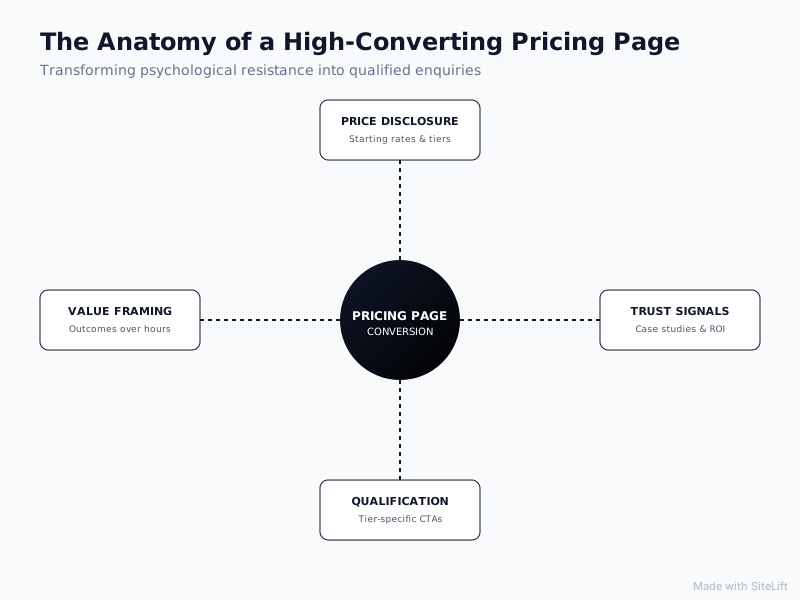
It is about removing psychological resistance, qualifying intent early, and framing your investment around tangible client value.
When done right, a dedicated pricing page does not just capture casual clicks—it primes your prospects to buy before they ever get on a discovery call.
Key Takeaways
| Element | Poor Service Pricing Page | High-Converting Service Pricing Page |
|---|---|---|
| Price Disclosure | "Contact us for custom quote" (zero numbers) | Starting rates, typical project bands, and clear deliverable tiers |
| Page Layout | Buried in an FAQ or a contact form dropdown | Distinct service packages page design with 3 structured tiers |
| Value Framing | Billable hourly rates and task lists | Measurable outcomes, deliverables, and ROI-based milestones |
| Trust Signals | Generic star ratings or logos tucked away elsewhere | Tier-matched case studies, guarantees, and onboarding timelines |
| Qualification | Lengthy, rigid contact forms causing bounce | Tier-specific booking CTAs and conversational self-qualification |
Why Most Service Websites Struggle to Build a Service Pricing Page That Converts Enquiries
The traditional agency mindset tells you that quoting prices on a website commoditizes your service. We have all heard the advice: "You need to get them on a phone call so you can sell the value."
While that approach worked a decade ago, today's buyer journeys look radically different. When potential clients hit a stone wall on your site, they do not pick up the phone; they hit the back button and visit your competitor.
The Hidden Cost of the "Contact for Quote" Barrier
Gating every shred of commercial information behind a contact form creates immense friction. According to research published by Gartner, 83% of B2B buyers prefer researching services and reviewing digital pricing parameters independently before engaging a sales representative.
When you refuse to provide any financial frame of reference, you inadvertently communicate two things to prospective buyers:
- "We are probably outside your budget."
- "We intend to trap you in an aggressive sales pitch before giving you a straight answer."
This dynamic is especially damaging if you suffer from clicks but no enquiries, where paid traffic lands on your site with high commercial intent only to bounce when they encounter opaque qualification gates.
How Pricing Transparency Builds Immediate Buyer Trust
Extensive usability evaluations from the Nielsen Norman Group show that the absence of pricing information is consistently one of the primary reasons prospective clients abandon business websites. Buyers feel manipulated when basic commercial boundaries are withheld.
Adopting pricing transparency for trust does not mean you must quote a rigid, fixed price for an enterprise-level implementation. It means giving the buyer enough context to self-select:
- Giving clear starting rates ("Engagements start at $5,000/month").
- Displaying typical investment ranges for specific company stages.
- Defining precisely what is included—and excluded—in baseline scopes.
When a visitor sees that you are willing to discuss numbers openly, they immediately perceive your firm as confident, experienced, and candid.
Balancing Lead Qualification with Conversion Friction
A common fear among service founders is that publishing prices will decrease total lead volume. That may well be true—you will get fewer unqualified, budget-mismatched submissions.
However, your qualified pipeline will dramatically expand. Inbound lead qualification analysis from HubSpot indicates that inbound leads who review a pricing page prior to conversion close at a rate up to 35% higher than leads who do not.
Instead of burning your sales team's energy fielding calls with businesses that cannot afford your baseline retainers, a transparent pricing structure acts as an automated qualification filter. It protects your calendar while attracting prospects who have already mentally committed to your tier of investment.

What Is the Ideal Structure for a Service Pricing Page That Converts Enquiries?
Bespoke services require a different structural architecture than off-the-shelf software tools. A SaaS pricing page relies on toggles and instant checkout buttons. A service pricing page that converts enquiries, by contrast, must translate intangible expertise into a concrete, scannable product.
The Three-Tier Pricing Model Adapted for Service Businesses
The most resilient structure for professional service firms is the classic three-tier package model. When applied to service firms, this layout establishes clear scope boundaries and sets expectations for different client growth stages.
Here is how to map a three-tier model for high-ticket service delivery:
┌─────────────────────────┐   ┌─────────────────────────┐   ┌─────────────────────────┐
│       TIER 1            │   │       TIER 2            │   │       TIER 3            │
│       Foundation        │   │       Growth            │   │       Enterprise        │
│                         │   │   [MOST POPULAR]        │   │                         │
│ • For emerging teams    │   │ • For scaling firms     │   │ • For complex orgs      │
│ • Fixed baseline scope  │   │ • Full execution stack  │   │ • Fully custom scope    │
│ • "Starting at $3,500"  │   │ • "Starting at $7,500"  │   │ • "Custom scoping"      │
│                         │   │                         │   │                         │
│ [ Book Assessment ]     │   │ [ Apply for Retainer ]  │   │ [ Request Scoping Call ]│
└─────────────────────────┘   └─────────────────────────┘   └─────────────────────────┘
- The Entry Package (Foundation): Solves a specific, tightly bounded bottleneck. It carries your lowest financial barrier to entry and serves as a low-risk entry point for cautious clients.
- The Flagship Package (Growth): The core engine of your business. This tier contains the complete solution that delivers the best results for your primary target persona. It should be visually accented as your "Most Popular" or "Recommended" selection.
- The Advanced Package (Enterprise / Custom): Designed for larger clients with legacy infrastructure, complex stakeholder approvals, or multi-departmental requirements. This tier can afford to be less rigidly priced, featuring a "Starting at..." baseline alongside a custom scope discovery process.
Designing Scannable Deliverables and Clear Inclusions
Service deliverables often sound vague. When prospects read bullet points like "Holistic Strategy Review" or "Ongoing Optimisation," their brains assign minimal concrete value to them.
To make an intangible service tangible in your service packages page design, replace corporate buzzwords with operational clarity:
- Instead of: "SEO Monitoring"
Use: "Bi-weekly keyword index tracking with competitor position alerts" - Instead of: "CRO Services"
Use: "Monthly qualitative user testing and 2 fully coded split tests" - Instead of: "Advisory Support"
Use: "Direct Slack channel access with guaranteed 4-hour response windows"
Clear language prevents misunderstandings during delivery and helps prospects justify the investment to internal stakeholders.
Strategic Placement of Enquiries and Consultation CTAs
Never use a generic "Submit" or "Contact Us" button on your pricing table. Every tier serves a different buyer intent, so your calls-to-action should reflect that reality:
- Tier 1 CTA: "Book Diagnostic Session"
- Tier 2 CTA: "Apply for Growth Retainer"
- Tier 3 CTA: "Request Enterprise Scoping Call"
If your team struggles with form abandonment, consult our 21-point website optimization checklist to ensure your form length and input fields do not introduce unnecessary conversion friction.
Infographic by SiteLift
How Can You Use Price Anchoring and Framing to Drive Enquiries?
Pricing is inherently contextual. A client rarely knows in a vacuum whether $6,000 per month is expensive or affordable; they judge the figure against the reference points around it.
Implementing Strategic Price Anchoring for Enquiries
Price anchoring for enquiries is the practice of establishing a prominent, high-value reference figure so your standard engagement tiers appear significantly more manageable.
Anchor Rate (Enterprise Engagement)
$25,000+ Setup & Architecture
       │
       ▼
Establishes high baseline of expertise & corporate scale
       │
       ▼
Target Retainer (Core Growth Engine)
$6,500/month
Perceived as accessible, high-ROI value by comparison
You can execute this strategy on your page in two distinct ways:
- Vertical Hierarchy: Place your most comprehensive, premium tier on the far right (or top on mobile). When a buyer first encounters an enterprise package starting at $20,000, the adjacent $6,000 growth tier immediately feels like a balanced, calculated investment.
- Alternative Cost Anchoring: Directly compare your pricing to the real-world cost of building an in-house capability. Remind the buyer that hiring an in-house director, data analyst, and technical specialist costs upwards of $280,000 annually in salaries, recruitment fees, and overheads. Suddenly, a $75,000 annual agency engagement shifts from an "expensive expense" to a massive financial efficiency.
Framing Costs Around ROI Rather Than Billable Hours
Hourly rates encourage clients to scrutinize your input rather than celebrate your output. If you bill at $175 per hour, the client spends discovery calls wondering if a project could take 10 hours instead of 15.
Shift your messaging entirely to value metrics:
- Highlight business outcomes (revenue recovered, pipeline generated, hours automated).
- Bundle your team's collective horsepower into milestones.
- State clearly: "We do not bill by the hour. We price by deliverable velocity and commercial impact, meaning our incentives align with completing your objectives quickly and thoroughly."
Highlighting the 'Recommended' Option to Eliminate Decision Fatigue
When faced with three identically styled choices, buyers freeze. High-performing pricing tables deliberately guide the buyer's eye using subtle visual hierarchy:
- Increase the physical card size of your target tier by 5–10%.
- Apply a contrasting border color or a distinctive badge ("Recommended for Mid-Market").
- Pre-select this tier when visitors navigate to the page.
Pro Tip: Give your recommended tier a descriptive label tied to client maturity rather than arbitrary vanity. A tier titled "Scale-Up (For Teams Generating $2M–$10M)" converts better than a vague title like "Pro Tier" because it lets buyers immediately confirm: 'That is us.'
How Do You Handle Pricing Transparency When Services Are Custom or Bespoke?
One of the most persistent pushbacks against service pricing pages is the bespoke dilemma: "Every project we take on has a custom scope. If I put a fixed number down, I will either box myself in or mislead the client."
You do not have to bind yourself to rigid flat rates to provide clarity. High-ticket firms solve this challenge using three practical frameworks.
1. Using "Starting At" and Estimated Price Ranges Effectively
If your scopes vary based on technical debt, user base, or asset volume, state your pricing thresholds clearly:
| Project Tier | Scope Profile | Typical Range | Engagement Model |
|---|---|---|---|
| System Audit & Roadmap | Complete architectural review & blueprint | $4,500 – $6,000 | Fixed One-Off Fee |
| Full Build & Execution | Turnkey implementation (Standard Scope) | $15,000 – $35,000 | Milestone-Based |
| Fractional Retainer | Ongoing execution, QA & team leadership | Starting at $5,500/mo | 3-Month Minimum |
By publishing minimum thresholds ("Engagements begin at $15,000"), you weed out tire-kickers whose budget is $2,000, while signaling to enterprise buyers that you operate at an appropriate scale of capability.
2. Deploying Interactive Cost Estimators and Calculators
Interactive calculators are an exceptional mechanism for turning curious pricing page visitors into qualified enquiries. Instead of browsing a static sheet, prospects choose their operational variables:
- Current platform or tech stack.
- Number of active team users or monthly leads.
- Primary business goal (lead quality, speed to market, pipeline recovery).
The calculator provides an immediate ballpark range ("Estimated Investment: $6,000 – $9,000"), and invites the prospect to request the full scope breakdown via email or discovery booking. This approach transforms a passive pricing page into an interactive lead qualification mechanism.
3. Integrating AI Assistants to Qualify Scope in Real Time
Many prospects visit pricing pages outside standard business hours. When they have complex scope questions, waiting two days for an email reply causes drop-off.
Integrating intelligent conversational assistants directly on your pricing page bridges this gap. A custom-trained assistant can answer scope queries instantly:
- "Does your Growth tier cover custom CRM API integrations?"
- "What is your typical turnaround time for the Audit phase?"
The assistant clarifies parameters, provides estimated investment ranges based on business rules, and books the qualified discovery call right inside the chat window. If you want to dive deeper into systematically fixing site drop-offs, review our guide to website conversion rate optimization for service businesses.
What Trust Signals Must Every High-Converting Pricing Page Include?
A pricing page is the highest-friction step on your website. This is the moment where the client is forced to transition from browsing theoretical solutions to evaluating financial commitments. Your page must proactively defuse that anxiety.
Embedding Contextual Proof and Outcome-Driven Testimonials
Do not dump generic client testimonials at the bottom of the page where no one reads them. Instead, match specific social proof to the exact package being reviewed.
- Place a case study quote directly underneath your Tier 1 package detailing how a quick audit uncovered a 22% operational leak.
- Place a mid-market testimonial directly inside the Tier 2 column highlighting a 3.4x pipeline expansion.
- Embed verified client company logos right alongside the pricing headers.
When trust signals sit adjacent to the investment figures, the prospect processes the price through the lens of proven outcomes rather than abstract cost.
De-risking the Commitment with Guarantees and Transparent Onboarding Timelines
Service purchases fail to convert when prospects fear buyers' remorse or messy onboarding. You can de-risk the engagement using clear, operational safety nets:
- Milestone Commitments: "Phase 1 is an architecture blueprint. If you are not completely confident in the roadmap, walk away with full asset ownership and zero further obligation."
- Onboarding Transparency: Display an explicit 30-day onboarding workflow directly below the pricing grid. Show them what Day 1, Day 7, and Day 14 look like.
Onboarding Visual Flow
Day 1: Kickoff & Workspace Access
  └──> Day 7: Diagnostic Audit Complete
         └──> Day 14: Execution Begins
                └──> Day 30: First Sprint Review
Uncertainty creates paralysis. By laying out the path forward step-by-step, you turn an intimidating financial commitment into a logical next step.
Addressing Common Objections Directly on the Pricing Grid
Every industry has predictable client objections. Instead of waiting for a sales call to handle them, dismantle them on your pricing page with a targeted FAQ grid placed directly below your packages:
- "What happens if we need to adjust our scope mid-retainer?"
- "Do we own all intellectual property and assets immediately?"
- "How quickly can our team realistically expect to see measurable results?"
This proactive clarity reinforces the principles of service pricing page best practices: minimize unanswered questions, validate buyer concerns, and make booking a conversation feel effortless.
Pro Tip: Include a direct comparison of "Who this package is NOT for" inside each tier column. Stating that a package is not suitable for startups with zero revenue dramatically increases its perceived value among the mature businesses it was designed to attract.
The Flawed "Bespoke Only" Dogma in High-Ticket Services
There is a stubborn myth in high-ticket consulting that providing upfront pricing details somehow devalues the sophistication of your work. Many agency founders hold onto this belief as an excuse to avoid committing to clear packages, clear deliverables, and defined operational parameters.
Here is the reality: your prospective clients are busy executives. They are not browsing your website looking for a mystery novel; they are trying to solve an urgent operational problem with finite resources.
When you hide your pricing entirely behind a gate, you are not projecting exclusivity or high status. You are creating work for the buyer. And in modern procurement, friction is the fastest way to lose qualified opportunities.
Giving prospects clear ranges, transparent tiers, and explicit inclusions does not box you in. It establishes leadership. It proves that you have solved this exact problem often enough to know what it costs, how long it takes, and what results it delivers.
Firms that embrace transparency close deals faster, encounter less pushback during discovery, and maintain higher profit margins because their value is defined before the initial call even takes place.
Transforming Pricing Pages Into High-Converting Assets
Building a pricing page that drives enquiries is not an academic exercise—it is one of the highest-leverage conversion improvements a growing service business can make. You do not need to tear down your entire website or switch to a fixed-fee commodity model to capture qualified demand.
At Growth Kings, we focus on turning existing service firm websites into predictable lead-generation assets. We eliminate the conversion friction that causes qualified visitors to slip away. By pairing crystal-clear page architecture and trust-centered messaging with 24/7 conversational qualification assistants, we help established service providers capture high-value inbound enquiries without forcing a full website redesign.
If your current pricing page leaks opportunities or creates friction for high-value prospects, examine how you package your capabilities. Replace ambiguity with clarity, pair every dollar figure with an outcome, and give your buyers the transparency they need to choose you with confidence.
— growth-kings.com
Frequently Asked Questions
Should service businesses display exact prices or starting rates on their website?
Displaying starting rates or estimated project bands is usually the best approach for service businesses with variable project scopes. While standardized services can feature fixed package prices, bespoke consulting and agency work benefit from "Starting from" anchors (e.g., "Engagements start at $5,000"). This provides prospects with a clear financial frame of reference, filters out mismatched budgets, and preserves your ability to scope complex requirements accurately.
Will displaying prices on my website scare away enterprise clients?
Displaying pricing will not scare away enterprise buyers if your packages are framed around business maturity and high-tier scope. Enterprise clients are primarily concerned with operational risk, capability, and clarity. Including an "Enterprise" or "Custom Scoping" tier alongside your starting rates signals that you routinely handle complex, multi-stakeholder engagements while maintaining commercial rigor.
What is the most effective call-to-action (CTA) on a service pricing page?
The most effective CTA is tier-specific and action-oriented, rather than a generic "Contact Us" or "Submit" button. Use language that reflects the buyer's stage in the decision process, such as "Book a Diagnostic Assessment" for lower tiers, "Apply for Retainer" for growth packages, or "Schedule Scoping Call" for custom solutions. Clear, descriptive CTAs lower anxiety by telling the prospect exactly what happens next.
How does price anchoring work for bespoke consulting or agency services?
Price anchoring works by establishing a high-value reference point that puts your core offerings into perspective. For bespoke services, this can be done by prominently featuring an enterprise-level tier alongside your core packages, or by explicitly comparing your retainer cost to the substantially higher expense of recruiting, hiring, and managing a full-time, in-house team. This shifts the buyer's mindset from questioning the raw cost to recognizing the net savings.
How many pricing tiers should a service provider display to maximize enquiries?
Three pricing tiers is the gold standard for service providers. A three-tier layout (e.g., Starter/Diagnostic, Core/Growth, and Enterprise/Bespoke) provides sufficient choice without overwhelming the prospect. It enables you to use the middle tier as your primary conversion target while leveraging the entry tier for risk-averse prospects and the top tier as a psychological anchor.
Want this working on your own site?
Tell us what’s working, what’s stuck and what you want to improve. We will reply personally.