Improve Website Visibility Without Hype: Clarity, Search and AI Citations That Bring Enquiries
Learn how to improve website visibility, optimize for AI search citations, and convert organic search traffic into qualified service business enquiries.
By Growth Kings. Published , updated . 16 min read.

Improve Website Visibility Without Hype: Clarity, Search and AI Citations That Bring Enquiries
If your service business relies on a steady stream of qualified consultations, watching your website sit unnoticed on search engine results pages is maddening. Most guides tell you that to improve website visibility, you need to publish three blog posts a week, dance on social media, or spend tens of thousands on a complete site overhaul.
That advice is outdated, exhausting, and mostly wrong.
According to BrightEdge research, organic search remains the dominant source of trackable web traffic, driving 53.3% of all traffic across industries. Yet getting noticed isn't just about accumulating raw pageviews. If those visits don't convert into phone calls, booked audits, or qualified project quotes, your organic reach is simply an expensive vanity metric. Today, genuine visibility requires a modern strategy: establishing crystal-clear messaging, securing commercial search rankings, and earning direct citations across conversational AI engines.
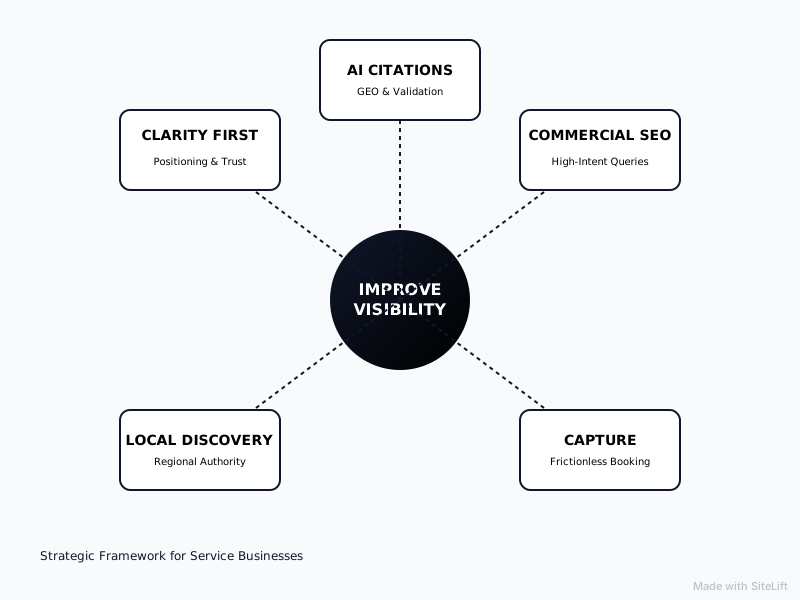
Key Takeaways
| Pillar | Focus Area | Primary Business Outcome |
|---|---|---|
| Clarity First | Clear positioning, trust proof, frictionless UX | Prevents immediate bounces; qualifies buyers instantly |
| Commercial SEO | High-intent queries, structured entity schema | Targets buyers ready to hire rather than students researching |
| AI Citations | Generative Engine Optimization (GEO), entity validation | Secures recommendations inside ChatGPT, Perplexity, and AI Overviews |
| Local Discovery | Optimized Google Business Profile, localized authority | Dominates regional searches and map packs |
| Capture Mechanics | Interactive assistants and low-friction booking | Turns after-hours search traffic into booked discovery calls |
What Does It Really Mean to Improve Website Visibility Today?
For service professionals, visibility has changed. It is no longer just a blue link sitting on page one of Google desktop search. Today, discovery happens across a multi-surface landscape that includes traditional search rankings, local map packs, and AI answer synthesizers like Perplexity and ChatGPT Search.
                    [ High-Intent Searcher ]
                               │
         ┌─────────────────────┼─────────────────────┐
         ▼                     ▼                     ▼
  [ Google Search ]    [ Local Map Pack ]    [ AI Answer Engines ]
  (Commercial SEO)     (GBP & Regional)      (GEO & Entity Data)
         │                     │                     │
         └─────────────────────┼─────────────────────┘
                               ▼
                   [ Clear, High-Trust Site ]
                               ▼
               [ Automated 24/7 Qualification ]
                               ▼
                    [ Booked Discovery Call ]
The Difference Between Vanity Traffic and High-Intent Discovery
I talk to service business owners every week who brag about their 20,000 monthly blog readers, yet their pipeline is bone dry. When we audit their analytics, we inevitably find that 95% of their traffic lands on generic how-to articles written for DIYers who have zero budget to hire an external firm.
Vanity traffic pads analytics dashboards; high-intent discovery fills sales calendars. When working to increase service business visibility, your goal is to be discovered by individuals experiencing an immediate commercial pain point. A commercial HVAC contractor does not need traffic for "how does an air conditioner work"; they need impressions for "emergency chiller replacement contractor."
Why Traditional Ranking Signals Are Sharing Space with AI Synthesizers
According to Backlinko's click-through rate analysis, the #1 organic result in Google receives an average CTR of 27.6%, while results below the fold experience sharp exponential drops. But even that top spot now shares visual screen space with Google AI Overviews and answer summaries.
When searchers ask complex, conversational questions, search engines increasingly summarize answers directly on the results page. If your site is only optimized for old-school keyword strings, you miss out on the growing cohort of buyers who rely on generative summaries to build their shortlists.
The Direct Line from Clear Positioning to Qualified Enquiries
Visibility without clarity is a recipe for high bounce rates. When a prospect clicks through to your website, you have roughly five seconds to answer three foundational questions:
- What specific problem do you solve?
- Are you qualified to solve it for someone in my industry?
- What is the single logical next step I should take?
If your site greets visitors with vague agency buzzwords ("We empower holistic transformation"), they will hit the back button. Search engines register this immediate exit as a signal of poor relevance, gradually depressing your search presence.
How Can Service Businesses Establish On-Page Clarity Before Chasing Rankings?
Throwing search traffic at a confusing website is like pouring water into a leaky bucket. Before you invest time or capital into content production or link building, you must ensure your core service pages are structurally sound.
Structuring Core Service Pages for Instant Human and Algorithmic Comprehension
Search engines and prospective clients want the exact same thing: rapid comprehension. When Google evaluates your page, it parses headings (H1, H2, H3), semantic relationships, and entity definitions. When a busy decision-maker lands on your page, their eyes scan those exact same elements.
To align both audiences, your service pages should follow a logical architecture:
- Above-the-Fold Hero Section: A plain-English value proposition explaining the core outcome you deliver.
- The Problem Context: An empathetic breakdown of the exact operational or financial pains your prospect is experiencing.
- The Proprietary Process: A 3-to-4 step overview illustrating how you deliver the service, reducing perceived risk.
- Verifiable Proof: Relevant case studies, client logos, and outcome-oriented testimonials positioned alongside your claims.
- Primary Conversion Point: A straightforward invitation to book a call, request an audit, or speak with an expert.
If your site architecture is scattered or bloated, understanding website structure optimization for service businesses will help you organize these pages into logical topical hubs that both search engines and buyers can easily navigate.
Eliminating Corporate Jargon in Favor of Problem-Solution Messaging
Jargon kills conversion rates. Phrases like "disruptive end-to-end solutions" tell prospective clients nothing about your day-to-day deliverables.
Instead, describe real-world outcomes. Replace "We deliver integrated synergy across enterprise workflows" with "We integrate your accounting software with your CRM so your sales team never double-enters an invoice."
Clear, declarative phrasing helps language models and search spiders categorize your business authority, which significantly improves your search visibility for services.
Embedding Proof Signals and Trust Architecture Above the Fold
Most service sites bury their best testimonials at the bottom of the page or relegate them to a forgotten "Testimonials" tab. High-intent searchers rarely dig that deep.
Position specific social proof markers immediately within the primary viewport. This includes industry accreditations, client review aggregates, or short, punchy quotes focusing on tangible outcomes (e.g., "Reduced our compliance turnaround by 40%"). Establishing this credibility upfront immediately reassures visitors arriving from organic search that you are an established, legitimate operation.
What SEO Tactics Genuinely Improve Website Visibility for Service Businesses?
Once on-page clarity is established, you can deploy targeted search engine optimization tactics designed specifically for service providers rather than generic e-commerce or publishing sites.
Infographic by SiteLift
Targeting Commercial Investigation Keywords Over Broad Industry Terms
The biggest mistake service firms make is chasing top-of-funnel keyword volume. Keywords with thousands of monthly searches are typically dominated by encyclopedic entries, software directories, or global aggregators.
Instead, map your content strategy around commercial investigation and transactional search intent.
| Broad/Informational Keyword (Low Conversion) | Commercial Investigation Keyword (High Value) |
|---|---|
| "What is cloud migration" | "Cloud migration consultant for healthcare" |
| "Commercial roof repair costs" | "Emergency flat roof repair contractor near me" |
| "Bookkeeping tips" | "Outsourced bookkeeping service for law firms" |
| "Architectural design styles" | "Commercial architect feasibility study firm" |
These high-intent keyword variations attract prospective clients who have already identified their problem and are actively evaluating third-party partners. For a deeper breakdown of matching search intent with site structure, review our guide on how to do SEO for your service website without jargon.
Implementing Comprehensive Schema Markup and Entity Associations
Search engines read code, not just visual design. To ensure your company is recognized as a specific entity with defined capabilities, you must implement structured data markup using Schema.org standards.
At a minimum, your service business website should incorporate:
OrganizationSchema: Identifies your legal name, founding date, leadership, contact points, and official social profiles.ServiceSchema: Explicitly states what services you offer, who they are for, and what geographic areas you cover.FAQPageSchema: Marks up helpful question-and-answer accordions, which helps earn rich snippet real estate directly within Google search results.
Following the structured data best practices outlined in the Google Search Central documentation ensures search spiders can index and extract your service offerings without misinterpreting your core capabilities.
Pro Tip: Use the hasOfferCatalog property inside your Service schema to map parent-child relationships between your overarching services and specialized sub-services. This helps search engines understand the full depth of your operational expertise.
Fixing Technical Friction Points That Harm Crawlability and UX
You do not need to tear down your entire website and build a new one to improve your organic performance. In fact, full redesigns often destroy historical search equity when URLs and redirects are mismanaged.
Focus on fixing the small technical issues that actually hinder search engines:
- Clean up 404 broken links: Ensure all legacy links point cleanly to their relevant current counterparts.
- Optimize Core Web Vitals: Compress oversized image banners and eliminate render-blocking scripts that delay initial text rendering.
- Streamline Mobile Navigation: Ensure menus, booking links, and phone click-to-calls display cleanly on smartphones.
If you are planning an update or refining an existing site, pairing technical hygiene with solid conversion principles is key—as outlined in our walkthrough on SEO web design for service businesses.
How Do You Optimize for AI Search Visibility and Engine Citations?
The rise of generative search platforms requires an evolution in how we publish information. Searchers are increasingly asking tools like ChatGPT, Claude, and Perplexity for vendor recommendations rather than clicking through pages of search listings.
Understanding Generative Engine Optimization (GEO) vs. Traditional SEO
Traditional SEO focuses on positioning a specific URL at the top of a static list of links for target keywords. Generative Engine Optimization (GEO) focuses on becoming a trusted data point that an AI model synthesizes and cites when responding to user prompts.
Large language models (LLMs) prioritize content that exhibits high informational density, objective factual phrasing, and clear entity relationships. To win AI search visibility, your content cannot simply be breezy marketing copy; it must directly answer questions with unambiguous authority.
Structuring Content to Win Direct Citations in ChatGPT, Perplexity, and AI Overviews
To increase the probability of your website being cited as an authoritative source in AI-generated answers:
- Lead with Direct Definitions: When addressing an industry process or solution, define it clearly in a concise 2-sentence paragraph before expanding into nuance.
- Use Markdown Tables for Comparisons: LLMs excel at parsing tabular data. Compare service tiers, materials, software frameworks, or timelines using structured tables.
- Write in an Objective, Factual Tone: Avoid hyperbole like "We are the absolute best choice." AI models favor objective, reference-grade language over sales pitches.
Building Brand Mention Footprints Across Unlinked Web Real Estate
AI models build confidence in a business by cross-referencing information across the wider web. They do not rely solely on traditional hyperlinks; they look for brand co-occurrences and unlinked mentions across industry directories, trade publications, forums, and local business registries.
If your firm is consistently mentioned alongside your primary service and geographic market across third-party industry publications, language models will naturally reference your business when users ask for recommendations.
How Does Local Service Visibility Connect Searchers Directly to Your Calendar?
For businesses that serve specific territories, local service visibility is the most direct bridge between search demand and new revenue.
According to the BrightLocal Local Consumer Review Survey, 98% of consumers use the internet to find information about local business services. If your business is practically invisible in localized map queries, you are surrendering inbound leads to competitors who have simply taken the time to claim their local digital footprint.
Optimizing Google Business Profiles for Service Area Accuracy
Your Google Business Profile (GBP) is often the very first interaction a local prospect has with your brand. Treat it with the same care as your primary homepage:
- Select the most accurate primary category (e.g., "Civil Engineering Firm" rather than a broad "Engineering Consultant").
- Explicitly define your service areas by postal codes or specific municipal boundaries.
- Maintain an active cadence of review generation, encouraging satisfied clients to mention specific services in their feedback.
To explore the latest research and benchmarks on local consumer review habits, review the data published by BrightLocal.
Creating Localized Service Hubs Without Thin-Content Pitfalls
Many agencies attempt to capture local market share by spinning up dozens of nearly identical city landing pages where only the city name changes. Search algorithms easily detect this as doorway content, and human visitors immediately bounce when they encounter generic pages.
Instead, build legitimate localized service hubs. If you serve multiple regions:
- Highlight specific case studies and client projects completed within that municipality.
- Mention local building codes, regional regulations, or local logistical conditions unique to that area.
- Provide direct contact details and photos of the local team serving that territory.
Using Interactive Assistants to Capture After-Hours Search Demand
Search traffic doesn't stop at 5:00 PM on Friday. High-value prospects frequently research commercial providers during evenings and weekends. If a prospective client visits your site outside business hours and only finds a generic "Contact Us" form, they will often bounce back to search results to find a competitor who provides an immediate answer.
Embedding an intelligent, conversational qualification assistant on your site bridges this gap. By greeting after-hours searchers, answering basic questions about your scope of work, and letting pre-qualified prospects book directly onto your calendar, you capture high-intent demand while your competitors sleep.
Pro Tip: Configure your conversational assistant to qualify prospects against your minimum project engagement size before booking a calendar slot. This protects your team's schedule while delivering a responsive, concierge experience to serious buyers.
How Should You Measure Website Visibility to Ensure Real Business Growth?
Improving your organic reach is only worthwhile if it translates to business growth. You need a simple, grounded measurement framework that bypasses vanity metrics and focuses directly on pipeline health.
Tracking Share of Search and Target Query Impressions
Instead of obsessing over daily ranking fluctuations for a single arbitrary keyword, monitor your aggregate impression growth across commercial query clusters in Google Search Console.
Are your impressions growing for queries containing your core service plus commercial qualifiers like "cost," "firm," "agency," or "specialist"? A steady upward trend in these clusters indicates that search engines recognize your entity's authority for your target offerings.
Monitoring AI Overview and Conversational Referral Citations
As conversational search grows, monitor your analytics for referral traffic from engines like Perplexity, ChatGPT (chatgpt.com), and Microsoft Copilot. While some conversational tools answer queries without sending an immediate click, users seeking complex B2B and professional services routinely click source links to review provider credentials and verify expertise.
Measuring Visibility-to-Enquiry Conversion Rates
The ultimate north star metric for any service firm is your cost-per-qualified-enquiry generated from organic discovery.
Track the full conversion funnel:
- Search Impressions on Commercial Queries
- Clicks to High-Intent Service Pages
- Qualified Enquiries Generated (form submissions, chat interactions, direct calls)
- Booked Discovery Calls
If impressions rise but qualified enquiries remain flat, you do not have a visibility problem; you have a messaging, trust, or conversion architecture problem.
Why Fixing What You Have Beats Rebuilding Every Two Years
I have watched far too many businesses burn months of runway and tens of thousands of dollars commissioning complete website redesigns because their organic reach stalled.
Nine times out of ten, their underlying services were exceptional. Their code was mostly fine. What they lacked was message clarity, deliberate technical entity signaling, and a conversion mechanism designed to capture high-intent searchers.
Tearing down your website every two years is a distraction from the unglamorous work of genuine business growth. The brands that win long-term search dominance do so by compounding their existing digital assets: clarifying their value proposition, targeting real commercial intent, and adopting modern technologies like AI citations and 24/7 lead qualification.
— growth-kings.com
Turn Search Discovery into Predictable Client Pipeline
Increasing your organic search presence shouldn't feel like a guessing game built on empty ranking promises and vanity traffic reports. At growth-kings.com, we help established service businesses optimize their websites for clarity, capture high-intent search and AI citations, and convert after-hours visitors into pre-qualified sales calls using automated conversion assistants.
If you are tired of traffic spikes that never show up in your pipeline, take a step back and audit your foundation. When you combine clear positioning with high-intent search architecture, your website stops being a passive digital brochure and becomes your most reliable enquiry engine.
Frequently Asked Questions
What is the fastest way to improve website visibility for a service company?
The fastest route is auditing your existing high-intent pages, optimizing your Google Business Profile, and targeting bottom-of-the-funnel commercial keywords. Improving on-page clarity and meta tags on core service pages typically yields faster ranking improvements and qualified enquiries than launching entirely new content campaigns from scratch.
How does AI search visibility differ from traditional Google SEO?
Traditional SEO focuses on earning high rankings for specific keywords in a list of web links. AI search visibility (Generative Engine Optimization) focuses on getting your business cited, synthesized, and recommended directly inside conversational answers provided by LLMs like ChatGPT, Perplexity, and Google AI Overviews.
Do I need to rebuild my entire website to increase search visibility?
No. In fact, full website rebuilds often introduce significant SEO risks, including broken redirects and loss of historical search equity. Most service websites achieve dramatic visibility and conversion improvements simply by fixing technical friction, implementing structured data, and refining on-page messaging.
What are AI citations, and how does my business get mentioned in ChatGPT or Perplexity?
AI citations occur when a generative search engine pulls information from your website and cites it as a reference source in its synthesized response. You can earn these citations by publishing clear definitions, structured comparison tables, schema markup, and establishing authoritative brand mentions across respected third-party platforms.
Why is my website getting impressions and traffic but no customer enquiries?
This disconnect usually points to a mismatch in search intent or an on-page clarity failure. You may be attracting informational visitors (people looking for free advice) rather than commercial buyers, or your landing pages may lack the clear value propositions, trust proof, and low-friction conversion paths required to turn visitors into enquiries.
Want this working on your own site?
Tell us what’s working, what’s stuck and what you want to improve. We will reply personally.