How AI Search Engines Evaluate Trust Signals: What Gets Service Firms Cited and Recommended
Discover how AI search engines evaluate trust signals to cite service firms. Learn how E-E-A-T, schema, and brand clarity drive AI Overviews citations.
By Growth Kings. Published , updated . 13 min read.

How AI Search Engines Evaluate Trust Signals: What Gets Service Firms Cited and Recommended
When a prospective enterprise client asks ChatGPT, Perplexity, or Google AI Overviews to recommend an executive search firm, a commercial law practice, or a specialized IT consultancy, the search engine no longer returns a standard list of ten blue links. Instead, it synthesizes a single, conversational answer that names specific firms and cites source material.
Understanding how ai search engines evaluate trust signals has quickly become the defining factor between being the recommended solution in your market or becoming invisible to high-value buyers.
Unlike traditional search engines that rely primarily on link volume and keyword positioning, generative engines rely on complex verification layers to decide which businesses are trustworthy enough to recommend. In this guide, we break down the exact mechanics behind AI citation algorithms and outline how established service firms can optimize their digital footprint without rebuilding their websites from scratch.
Key Takeaways: Traditional SEO vs. AI Search Evaluation
| Evaluation Factor | Traditional Search Engines | AI Search & Answer Engines |
|---|---|---|
| Core Mechanics | Crawls keywords & maps backlink authority | Retrieval-Augmented Generation (RAG) & entity resolution |
| Primary Trust Anchor | Domain Authority (DA) & anchor text match | Cross-web sentiment, entity consistency, & explicit E-E-A-T |
| Content Processing | Page-level text scanning for keyword density | Vector embeddings & semantic verification of original facts |
| Citation Source | Ranked search engine result page (SERP) positions | Direct extraction from verified high-trust nodes |
| Primary Risk | Dropping a few positions on page one | Complete exclusion from synthesized recommendations |
What Are AI Search Trust Signals and Why Do They Matter for Service Firms?
AI search trust signals are machine-readable proof points that demonstrate a business is legitimate, authoritative, highly regarded, and active. When large language models (LLMs) construct answers, they face a fundamental problem: hallucination risk. To prevent delivering inaccurate or harmful recommendations to users, models prioritize sources that demonstrate high confidence scores across their underlying knowledge graphs.
+-----------------------------------------------------------------------------------+
|                            RETRIEVAL-AUGMENTED GENERATION                         |
+-----------------------------------------------------------------------------------+
|                                                                                   |
|  [ User Prompt ]                                                                  |
|         │                                                                         |
|         ▼                                                                         |
|  [ LLM Query Vector ]                                                             |
|         │                                                                         |
|         ▼                                                                         |
|  [ External Data Retrieval ] ──► Cross-References Entity & Sentiment Data         |
|         │                                                                         |
|         ▼                                                                         |
|  [ Trust Evaluation Layer ]  ──► Filters out unverified or conflicting sources   |
|         │                                                                         |
|         ▼                                                                         |
|  [ Synthesized Response ]    ──► Cites only top-confidence service firms         |
|                                                                                   |
+-----------------------------------------------------------------------------------+
From Keyword Matching to Retrieval-Augmented Generation (RAG)
Traditional search engines work like index catalogs: you type in a phrase, and the engine finds web pages containing those keywords or related synonyms.
Modern answer engines use Retrieval-Augmented Generation (RAG). When a user submits a prompt, the system executes two distinct steps:
- It retrieves relevant documents from across the web.
- It passes those documents to an LLM to synthesize a coherent response.
If your service firm's content lacks clear, verifiable authority markers, the retrieval phase skips your domain entirely. You might rank on page one for a long-tail search term in classic Google SERPs, but if your site lacks explicit trust parameters, an AI engine will not use your content to construct its answer.
The Difference Between Google SERP Rankings and AI Engine Citations
Traditional SEO rewards keyword relevance, technical performance, and backlink metrics. While these factors still matter, AI search engines evaluate content through a semantic lens. They look for explicit claims backed by data, clear author credentials, structured business schemas, and consistent brand information across multiple platforms.
This shift is happening rapidly. According to research by Gartner, search engine volume is projected to drop 25% by 2026 due to the rapid consumer adoption of AI chatbots and conversational agents.
For B2B and professional service providers, losing visibility in conversational search means losing access to prospects who are ready to buy. For a deeper look at how answer engines operate, read our complete breakdown on AI search visibility.
How AI Search Engines Evaluate Trust Signals: Core Mechanics
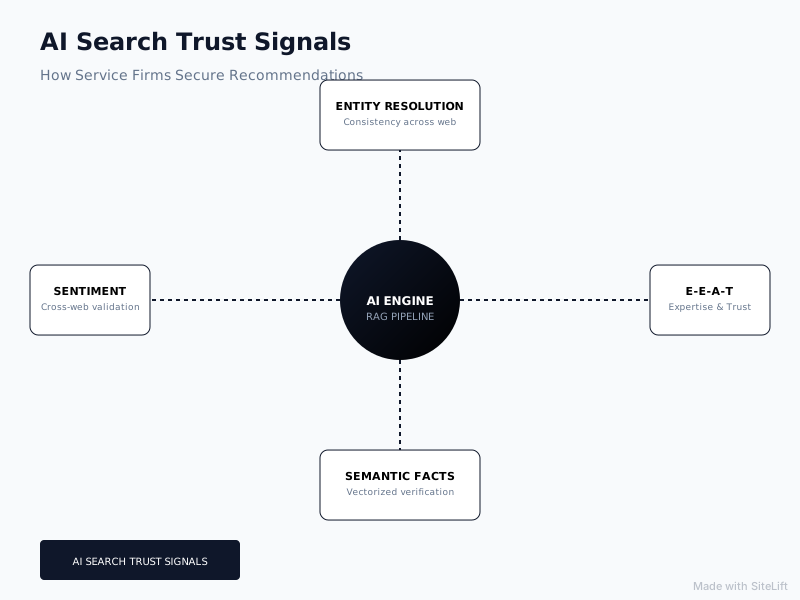
To win recommendations in platforms like Perplexity, Claude, and Google AI Overviews, service businesses must understand the three core mechanisms engines use to measure credibility.

Entity Verification and Digital Footprint Consistency
Before an AI model recommends your consulting firm or agency, it verifies your corporate identity. It does this by extracting entity data from your website and cross-referencing it against external sources.
The engine verifies:
- NAP Data: Name, Address, and Phone number consistency across local directories, government registries, and corporate filings.
- Entity Mapping: Connections between your firm, your founders, your core service categories, and your industry domain.
- Knowledge Graph Inclusion: Presence in established databases like Google Knowledge Graph, Wikidata, and Crunchbase.
If your firm is listed as "Growth Kings LLC" on one platform with an old office address, and "Growth Kings Digital" on another with a new address, the model's confidence score drops. Low confidence means the AI will pass over your business in favor of a competitor whose entity details match perfectly across the web.
Algorithmic E-E-A-T: Verifying First-Party Authority and Original Insights
Google introduced the E-E-A-T framework (Experience, Expertise, Authoritativeness, Trustworthiness) for human quality raters, but modern LLMs evaluate these same parameters algorithmically.
According to Google's Search Central documentation, clear author credentials, verified background information, and explicit first-party evidence are critical components evaluated by automated quality systems.
       ┌─────────────────────────────────────────────────────────┐
       │                ALGORITHMIC E-E-A-T EVALUATION          │
       └─────────────────────────────────────────────────────────┘
                                    │
         ┌──────────────────────────┼──────────────────────────┐
         ▼                          ▼                          ▼
┌──────────────────┐       ┌──────────────────┐       ┌──────────────────┐
│   EXPERIENCE     │       │    EXPERTISE     │       │ AUTHORITATIVE    │
│ First-hand data, │       │ Verified authors,│       │ Industry quotes, │
│ case studies, &  │       │ credentials, &   │       │ citations, &     │
│ project stats    │       │ specialized bios │       │ peer recognition │
└──────────────────┘       └──────────────────┘       └──────────────────┘
When evaluating your site content, AI indexers look for:
- Original Research & Proprietary Data: Unique metrics, benchmark reports, and documented project outcomes.
- Named Expert Authorship: Content attributed to verified professionals with links to their LinkedIn profiles, published work, and professional certifications.
- First-Hand Proof: Detailed descriptions of direct client engagements rather than broad, theoretical overviews.
Generic articles that state basic industry facts without original perspective signal to AI engines that your site is merely repeating existing web content rather than serving as an authoritative source.
Cross-Platform Sentiment Analysis and Brand Reputation Signals
AI models do not rely solely on what you say about yourself on your own website. They actively scrape public forums, review sites, and social channels to assess brand sentiment.
Recent research shows that 87% of consumers read online reviews for local service businesses—data points that modern LLMs scrape and digest to evaluate real-world brand reputation. Large language models process sentiment across review platforms like Trustpilot, Google Business Profile, Clutch, and G2, alongside discussions on platforms like Reddit and LinkedIn.
If your website claims elite service delivery but third-party review platforms reveal low ratings or unresolved customer disputes, the AI engine flags the contradiction. High sentiment scores across third-party sources directly increase the likelihood of your firm being cited as a top-tier recommendation.
Technical Trust Factors: How AI Indexers Process Your Website
Understanding structural signals helps ensure AI search indexers can parse, comprehend, and store your site's data without friction.
Infographic by SiteLift
Structured Data and Schema.org for LLM Parsing
Microdata and JSON-LD schema markups act as direct instructions for AI parsers. Instead of forcing an LLM to guess what your page represents, structured data explicitly tells the model your service scope, leadership structure, client reviews, and geographical reach.
To maximize website trust signals for AI systems, service firms should implement the following schema types defined on Schema.org:
OrganizationorCorporation: Defines your official business name, logo, social profiles, and corporate hierarchy.ProfessionalServiceorLocalBusiness: Clarifies service boundaries, physical locations, operating hours, and contact points.Service: Details specific service offerings, target audiences, and service areas.Person: Establishes author identities, credentials, job titles, and professional affiliations.ItemReviewed/AggregateRating: Connects verified client feedback directly to your service entities.
Clear Content Hierarchy and Transparent Proof Points
LLMs rely on predictable page structures to extract factual assertions. If your page hides details behind vague marketing copy, an AI crawler will fail to index concrete facts about your business.
Structure your service pages using simple hierarchy rules:
- Use standard header tags (
H2,H3) that state questions or topics clearly. - Place direct summary answers immediately following headings.
- Publish transparent operational details, including service scopes, typical project timelines, and engagement methodologies.
- Include clear, verifiable proof points (e.g., "We reduced server downtime by 42% for a mid-market logistics client within 90 days" instead of "We deliver industry-leading IT solutions").
On-Site Engagement Metrics and Interactive Experience
User experience signals indirectly feed into search engine quality evaluations. High bounce rates and short session durations often indicate to search engines that landing pages failed to satisfy the user's prompt.
Integrating interactive tools—such as intelligent qualification workflows or on-site assistants—helps visitors quickly find specific answers, increasing dwell time and engagement depth. When visitors engage deeply with your content, search engines recognize the domain as a high-utility destination, reinforcing its credibility index.
How to Optimize Your Service Firm's Website for AI Search Citations
Winning recommendations in AI search engines doesn't require scrapping your website or spending tens of thousands on a major redesign. Established service businesses can achieve substantial visibility improvements by systematically refining their existing web assets.
+-----------------------------------------------------------------------------------+
|               5-STEP AI CITATION OPTIMIZATION FRAMEWORK                           |
+-----------------------------------------------------------------------------------+
|                                                                                   |
|  [Step 1] Audit & Unify External Brand Entities Across Web Directories           |
|                                                                                   |
|  [Step 2] Add Structured Schema Markup (Organization, Service, Author)            |
|                                                                                   |
|  [Step 3] Re-architect Existing Content for Structural Clarity & Direct Answers   |
|                                                                                   |
|  [Step 4] Inject Proprietary Data, Case Metrics, & Named Credentials             |
|                                                                                   |
|  [Step 5] Implement Conversational Touchpoints to Capture & Validate Enquiries    |
|                                                                                   |
+-----------------------------------------------------------------------------------+
Step 1: Audit and Align Third-Party Mentions Across the Web
Run a comprehensive audit of your business presence across third-party platforms. Ensure that your firm's name, primary address, contact information, and primary service descriptions are identical across:
- Google Business Profile
- LinkedIn Company Page
- Clutch, G2, or UpCity profiles
- Industry-specific directories
- Crunchbase and corporate registration records
Fixing minor discrepancies eliminates identity confusion within LLM knowledge graphs, raising the system's baseline confidence score for your firm.
Step 2: Publish Original Data, Case Studies, and Named Expert Content
Review your existing blog posts and service landing pages. Upgrade generic material by adding first-person experience and concrete data points:
- Attribute Content: Add author bio boxes to key articles linking to verified expert profiles.
- Detail Client Outcomes: Replace anonymous testimonials with detailed, metric-rich case studies.
- Include Benchmarks: Share internal benchmark data or original industry surveys that other publications can cite.
To build an effective content engine tailored for modern search engines, explore our guide on generative engine optimization strategy.
Step 3: Enhance Existing Pages Without Demolishing Your Site Architecture
Rebuilding a functional site is rarely necessary. Incremental, targeted enhancements deliver faster gains with significantly less risk.
Focus your optimization efforts on high-impact areas:
- Update service page headers to match direct conversational prompts (e.g., change "Solutions" to "Commercial Litigation Services for Manufacturing Firms").
- Add structured FAQ sections to primary service pages using
FAQPageschema. - Embed direct proof points, certifications, and verified client outcomes directly above the fold.
If you are looking to audit your current search presence, our guide on how to improve website visibility provides actionable steps for structural upgrades.
Pro Tip: Never publish case studies without specific client metrics and named experts. AI models treat anonymous praise as generic marketing claims, whereas verifiable data points are far more likely to be extracted as direct citations.
Why Unverified Content Fails When AI Search Engines Evaluate Trust Signals
Understanding why content gets discarded by AI engines is just as critical as knowing what to build.
Over-Reliance on Generic, Unverified AI Content
Many agencies publish high volumes of unedited, AI-generated blog posts to fill out their websites. However, large language models are exceptional at recognizing their own output patterns.
Content that lacks original data, unique claims, or real-world experience is flagged as low-information density. When an AI search engine evaluates a site covered in generic, unverified text, it degrades the site's overall trust score, reducing the likelihood of citations across all service pages.
Conflicting Brand Details Across Digital Channels
Even established service firms frequently introduce entity conflicts during rebranding campaigns or office relocations.
If your website lists your business as an "Enterprise Management Consultancy" founded in 2012, but your Crunchbase entry lists you as an "IT Staffing Business" founded in 2014, an AI engine cannot confirm your primary category with certainty. When confidence drops below the required threshold, the engine defaults to competitors with clear, verified entity profiles.
Pragmatic Website Enhancement Over Costly Rebuilds
Many service business owners assume that adapting to AI search requires hiring an expensive agency to build a completely new website. In practice, full redesigns often disrupt existing search performance, break established URLs, and waste capital on design elements that do not impact search engine understanding.
At Growth Kings, our philosophy centers on practical, high-impact refinements. Winning recommendations in AI search engines comes down to clarity, structured authority, and conversion readiness—not visual gimmicks or trendy page layouts.
By auditing your entity consistency, implementing structured Schema markup, adding first-party proof to existing pages, and installing interactive tools that qualify inbound interest, you can position your service firm as a verified authority in AI search results.
For firms comparing specialized data management software to support their optimization efforts, see our detailed guide on selecting the best accurate data platform for AI search optimization.
— growth-kings.com
Frequently Asked Questions
How do AI search engines like Perplexity and Google AI Overviews decide which businesses to cite?
AI search engines use Retrieval-Augmented Generation (RAG) to select sources. They evaluate external data using entity resolution, schema markup, cross-web brand sentiment, and explicit E-E-A-T (Experience, Expertise, Authoritativeness, and Trustworthiness). Businesses with verified entity profiles, consistent NAP details, and unique first-party data are prioritized for direct citations.
What is the difference between traditional SEO trust factors and AI trust signals?
Traditional SEO trust factors focus heavily on domain authority, external backlink volume, and keyword matching within page titles and text. AI trust signals evaluate semantic meaning, structural schema validity, cross-channel entity consistency, third-party customer sentiment, and the presence of original, verifiable facts within the content.
Do service firms need a full website redesign to rank in AI search results?
No. Most established service firms do not need a complete website redesign. Updating existing service pages with structured JSON-LD schema, improving page hierarchy, clarifying core offerings, and adding verifiable client evidence delivers faster, more reliable AI search visibility improvements without the cost and risk of a full rebuild.
How does schema markup help AI engines evaluate business credibility?
Schema markup provides structured, machine-readable data that explicitly defines your business entity, team credentials, service parameters, and review ratings using standardized Schema.org vocabularies. This eliminates ambiguity during LLM parsing and raises the AI engine's confidence score when evaluating your business for recommendations.
Why does generic AI-generated content perform poorly in AI search citations?
Generic AI-generated content lacks original insights, primary research, verified expert attribution, and unique business metrics. Because large language models detect low-information content patterns easily, unedited AI text is filtered out during the retrieval phase of RAG in favor of first-hand expert sources.
Want this working on your own site?
Tell us what’s working, what’s stuck and what you want to improve. We will reply personally.