Beyond Google: How Local Service Brands Can Win the Generative Search Engine Race
Learn a generative engine optimization strategy to get cited by AI search. Practical GEO tactics for local services to win calls.
By Growth Kings. Published , updated . 15 min read.

Beyond Google: How Local Service Brands Can Win the Generative Search Engine Race
If you run an HVAC company, law firm, dental clinic, or home services brand, you’ve felt the shift. Customers aren’t just googling “plumber near me” anymore — they’re asking ChatGPT, Perplexity, and Google’s AI Overviews who they should trust. That’s why you need a clear generative engine optimization strategy built specifically for local services, not borrowed from SaaS playbooks.
I work with established service businesses every day, and here’s what I’m seeing: traditional rankings still matter, but AI answers are stealing the click. Gartner predicts search engine volume will drop 25% by 2026 as chatbots and virtual agents take over, according to Gartner’s forecast on the decline in traditional search volume. If your brand isn’t cited in those AI answers, you’re invisible at the exact moment a homeowner or client is ready to hire.
This guide breaks down how conversational engines choose local providers, and what GEO for local service businesses actually looks like in practice.
What Is a Generative Engine Optimization Strategy (GEO)?
A generative engine optimization strategy is the process of making your brand easy for AI-powered answer engines to find, trust, and cite.
Think ChatGPT, Perplexity, Claude, Microsoft Copilot, and Google Gemini / AI Overviews. Instead of returning ten blue links, they synthesize an answer. Your goal isn’t just position #1 — it’s being named and linked in the answer itself.
The Evolution from Traditional SEO to GEO
Traditional SEO matches keywords to pages. Generative engines match intent to consensus.
Google’s classic algorithm asked: does this page contain the keyword, have backlinks, and load fast? LLMs ask: what do many trusted sources agree is the best answer, and which brand has the clearest, most verifiable facts to support it?
That’s why Search Engine Land’s analysis of the shift to generative search frames GEO as citation optimization, not just ranking optimization. You win by being quotable, consistent, and corroborated elsewhere.
Here’s the core difference:
| Factor | Traditional SEO | Generative Engine Optimization (GEO) |
|---|---|---|
| Output | Ranked list of links | Single synthesized answer with 2-4 cited sources |
| Query style | Short keywords: “emergency dentist Austin” | Full questions: “Who’s the best emergency dentist in Austin open on Sundays?” |
| Trust signal | Backlinks + domain authority | Brand mentions, reviews, and cross-source consensus |
| Content winner | Comprehensive 2,000-word guide | Clear, direct answer with stats, citations, and structure |
| Success metric | Clicks and positions | Citations, AI share of voice, and qualified enquiries |
How Conversational Search Engines Process Local Queries
When someone asks Perplexity “Find a reliable mold remediation company in Miami that works with insurance,” the engine doesn’t just check your website.
It pulls from your Google Business Profile, Yelp and Trustpilot reviews, Angi or Houzz listings, local news mentions, Reddit threads, and your service pages — then looks for agreement. If five sources say you handle insurance claims, show up on time, and serve Miami-Dade, you get recommended.
For a deeper breakdown of that sourcing process, see our practical guide on how to get recommended by ChatGPT, AI Overviews and Perplexity.
Why Local Service Brands Must Adapt Immediately
Local is ground zero for zero-click search. When AI answers “What does drain cleaning cost in Chicago?” directly, the user may never visit a website unless they want to book.
That’s dangerous if you rely on after-hours emergency calls. But it’s also an opportunity. AI engines have to recommend a local provider — they can’t fulfill the service themselves. If you become the consensus pick, you get the call.
BrightLocal found that 87% of consumers used Google to evaluate local businesses in 2023, according to the BrightLocal Local Consumer Review Survey. AI models were trained on that same review ecosystem. They’ve inherited that trust in reviews — now they’re automating it.
Pro Tip: Don’t chase “AI rankings” in the abstract. Pick 10 money queries like “best estate planning lawyer for families in Denver” and test them weekly in ChatGPT, Gemini, and Perplexity. That’s your real local battleground.
How Do AI Search Engines Decide Which Local Services to Recommend?
Ranking in AI search results has less to do with clever prompts and more to do with digital proof. Here are the three filters every local brand has to pass.
The Power of Digital Consensus and Brand Mentions
LLMs don’t trust what you say about yourself. They trust what others consistently say about you.
Researchers from Princeton, Georgia Tech, and LMU Munich who coined Generative Engine Optimization found that adding authoritative citations and statistics can improve visibility in AI answers by up to 40%. The principle is the same for local: unlinked brand mentions on chambers of commerce sites, local news, industry associations, and niche directories act as votes.
You don’t need 500 links. You need 20-30 consistent mentions with the same name, address, phone, services, and service area. Inconsistency kills consensus. If your GBP says “Austin Plumbing Pros” but Yelp says “Austin Plumbing Pros LLC” and your site says “APP Plumbing,” the AI gets confused and picks a competitor with cleaner data.
Sentiment Analysis: How AI Evaluates Your Customer Reviews
AI doesn’t just count stars. It reads them.
Conversational engines summarize review sentiment at scale: Do customers mention punctuality? Transparent pricing? Clean work? Messy follow-up? A 4.8-star plumber with 200 reviews mentioning “arrived on time, explained cost upfront” will beat a 5.0-star competitor with 12 generic reviews.
This is why optimizing for conversational search engines starts with operations:
- Ask for reviews that mention the specific service and city (“furnace replacement in Columbus” beats “great job!”)
- Respond to every negative review with specifics, not templates
- Keep ratings above 4.5 on Google, Yelp, and your top vertical platform
AI will quote that sentiment verbatim: “Customers frequently praise X for same-day service.” Give it good material.
The Role of Structured Data as the AI Translation Layer
Schema markup is how you remove guesswork for machines.
Without it, an AI has to infer your hours, pricing, and service area from paragraph text. With it, you tell it explicitly. Use the official LocalBusiness schema documentation to mark up your name, geo-coordinates, opening hours, price range, services, and aggregate ratings.
At minimum, implement:
LocalBusiness(or subtype likePlumber,Dentist,Attorney)Servicewith areaServedReview/AggregateRatingFAQPagefor common pricing and process questionsBreadcrumbListfor site hierarchy
Pro Tip: Add sameAs links in your LocalBusiness schema pointing to your GBP, Yelp, BBB, Facebook, and LinkedIn profiles. It’s the fastest way to help AI connect your entity across the web.

What Does a Generative Engine Optimization Strategy Look Like for Local Service Businesses?
This is where most GEO advice fails local brands. It tells you to “create thought leadership.” You need booked jobs. Here’s a practical, local-first version.
Optimizing for Conversational and Natural Language Queries
Stop optimizing only for “HVAC repair Dallas.” Start answering how people actually talk to AI:
- “Who is the most reliable emergency plumber near me with 24/7 service?”
- “How much does it cost to replace a 3-ton AC unit in Phoenix including labor?”
- “Which divorce lawyer in Manchester offers fixed-fee initial consultations?”
Actions to take:
- Mine your call recordings, contact forms, and GBP Q&A for real phrasing.
- Build one service + city page per core offering — not 50 thin doorway pages, but 8-12 genuinely useful ones.
- Lead each page with a 40-60 word direct answer, then expand with pricing factors, process, timelines, and FAQs.
- Add comparison content: repair vs. replace, fixed fee vs. hourly, what’s included vs. extra.
If you want plain-English answers to common confusions here, our AI search visibility FAQ for service businesses is a good next read.
Building a Robust Off-Page Footprint for AI Validation
For local GEO, off-page is not link building — it’s entity validation.
Prioritize:
- Core aggregators: Google Business Profile, Apple Maps, Bing Places, Yelp, Facebook
- Vertical leaders: Avvo / FindLaw for legal, Healthgrades / Zocdoc for medical, Angi / Houzz / HomeAdvisor for home services, TripAdvisor for hospitality
- Local proof: Chamber of Commerce, city business awards, local sponsorships, neighborhood association mentions, local press
- Forums and Q&A: Reddit r/HomeImprovement, Nextdoor, Quora — not for spam, but for genuine helpful answers that get your name mentioned
Consistency matters more than volume. Same NAP, same services list, same business description everywhere.
Creating Direct-Answer, High-Utility Content Assets
AI loves content it can lift without rewriting. Structure for liftability.
Use the inverted pyramid: answer first, context second, details last.
Example structure for “How Much Does Water Heater Installation Cost in Denver?”:
- Direct answer: Most standard 50-gallon gas installations in Denver run $1,800–$3,200 including unit, permit, and haul-away. Tankless starts higher.
- What changes the price: gas vs. electric, venting, code upgrades, access
- Our process: same-day assessment, upfront flat quote, permit handling
- FAQs in schema: warranty, timeline, financing
Add original proof AI can’t get elsewhere: before/after photos with location tags, technician notes, permit numbers (redacted), real timelines, and service-area maps. That’s what gets cited.
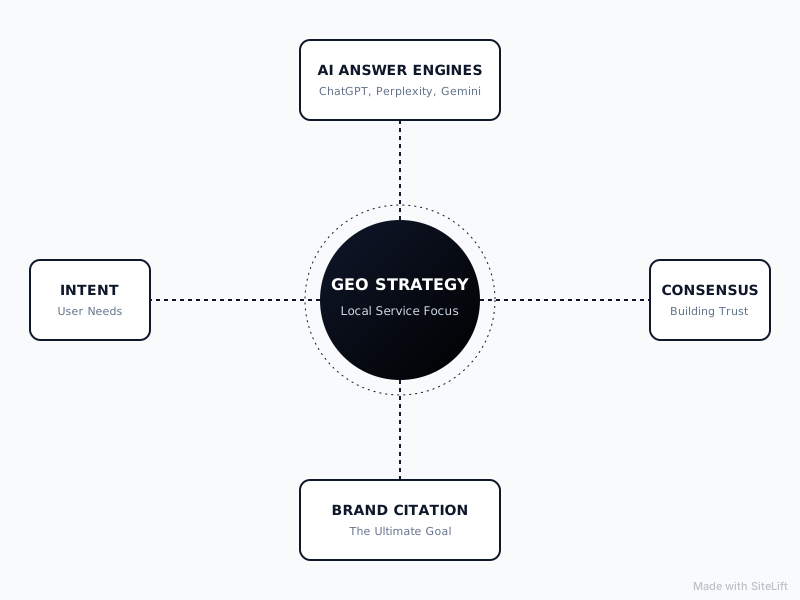
Infographic by SiteLift
Which Practical AI Visibility Tactics Can You Implement Today?
You don’t need a six-month rebrand. These AI visibility tactics move the needle in 30 days.
Deploying Advanced Schema and Entity Association
Go beyond basic LocalBusiness markup:
- Link services to places: Use
areaServedwith explicitCity+Stateentities, not just “serving the greater metro area.” - Define your founder and team with
Personschema linked viafounderoremployee— especially for law, medical, and financial services where E-E-A-T matters. - Mark up reviews correctly. Don’t fake aggregate ratings on your homepage if they live only on Google. Use
reviewsnippets from first-party reviews you actually collect. - Keep hours, holiday hours, and emergency availability in schema and visible text. Mismatches erode trust.
Test everything in Google’s Rich Results Test and Schema.org validator before pushing live.
Dominating Niche Directories and Local Aggregators
AI models lean heavily on structured third-party data because it’s cleaner than websites.
Claim, complete, and actively manage:
- For home services: Angi, Houzz, Thumbtack, HomeAdvisor, BBB
- For legal: Avvo, Justia, FindLaw, Martindale
- For health: Healthgrades, Zocdoc, WebMD Provider, Psychology Today
- For all local: Yelp, Trustpilot, Better Business Bureau, Nextdoor
Upload the same logo, same service list, same description, and 10+ geo-tagged photos. Get 5-10 new detailed reviews per month on one primary platform rather than one review on ten platforms.
Optimizing Your Website for Conversational AI Assistants
Here’s the irony: as AI search grows, the traffic you do get converts less patiently. Visitors arrive pre-educated by ChatGPT and want instant confirmation: Do you serve my area? What’s the price range? Are you available now?
That’s why on-site conversational assistants are becoming part of GEO. A well-trained AI assistant that answers pricing, availability, and service-area questions after hours doesn’t just improve conversion — it creates structured Q&A logs you can turn into new FAQ content AI engines love to cite.
Our team builds exactly that kind of foundation with search and AI visibility for established service businesses — clear service pages, technical cleanup, and credible proof, without pushing a full rebuild you don’t need.
How to Measure Success in the Age of Generative Search?
Forget tracking 200 keywords. Track whether AI recommends you, sends you qualified visitors, and drives calls.
Tracking Share of Voice (SoV) in AI Recommendations
Build a simple weekly audit sheet:
- List 15-20 high-intent prompts (“best emergency vet open late in Leeds,” “affordable loft conversion specialist in South London”).
- Run them in ChatGPT (with browsing), Perplexity, Google AI Overviews / AI Mode, and Copilot.
- Record: Are you mentioned? Cited with a link? What’s the sentiment? Who beat you?
- Screenshot and date it.
Tools for automated AI visibility tracking are emerging, but manual testing still catches nuance — like why a competitor was picked (“cited for transparent flat-rate pricing”).
Monitoring Referral Traffic from Conversational Engines
In GA4, go to Reports > Acquisition > Traffic Acquisition and filter Session source for:
chatgpt.comperplexity.aicopilot.microsoft.comgemini.google.comclaude.ai
Create a dedicated Exploration that isolates AI referrals, then look at engagement rate, key events, and call clicks — not just sessions. Early data shows AI referral volume is still small but intent is unusually high. Ten visitors who already asked AI to pre-qualify you beat 100 cold blog readers.
Evaluating Lead Quality and Conversion Metrics
GEO wins when the phone rings, not when a tool gives you a visibility score.
Track:
- Calls over 60 seconds from AI-referred pages
- Form submissions with service + postcode filled
- After-hours assistant conversations that turn into booked estimates
- Close rate by source (AI vs. organic vs. paid)
If AI mentions go up but enquiries don’t, your site is the leak — unclear pricing, no trust badges, slow mobile, or no instant contact option.
Key Takeaways
If you remember nothing else, remember this: AI doesn’t rank websites, it recommends businesses it can verify.
| Pillar | What to Do | Why It Wins in AI Search |
|---|---|---|
| Clarity | Direct answers + conversational FAQs on every service page | Easy for LLMs to quote verbatim |
| Consensus | Consistent NAP + mentions on GBP, Yelp, vertical directories | Builds cross-source trust |
| Sentiment | Detailed, service-specific reviews + thoughtful replies | AI summarizes sentiment when recommending |
| Structure | LocalBusiness, Service, Review, FAQ schema | Removes ambiguity for machines |
| Conversion | Fast site + AI assistant for after-hours qualification | Turns remaining clicks into enquiries |
Start with one service line in one city. Nail the answers, reviews, and schema there, then replicate.
My Honest Take: Why Local Brands Actually Have an Advantage in AI Search
I’ll be blunt: most GEO content annoys me. It’s written for SaaS marketing teams with 10 writers and talks about “optimizing for billions of queries.” That’s useless if you run a plumbing company with 14 vans.
Here’s what I actually believe after watching service sites adapt over the last 18 months: local businesses are better positioned for generative search than national brands.
Why? Because AI has a local fulfillment problem. It can write a poem or debug code, but it can’t unclog a drain in Tampa. It must hand that user to someone real, nearby, and trustworthy. Google understood this with Maps. ChatGPT and Perplexity are learning it now — and they’re hungry for verifiable local entities.
I’ve also seen the flip side. The firms losing fastest aren’t bad businesses; they’re vague ones. “We provide quality solutions for all your needs” gets ignored. “We install tankless water heaters in Fort Worth, permits included, same-week install, 4.9 stars from 340 neighbors” gets cited.
My advice? Don’t try to game the models. Be the business that’s easiest to recommend. Clear pricing ranges even when competitors hide them. Real photos of real techs. Reviews that mention towns you serve. Pages that answer the awkward questions — cost, mess, timeline, warranty — upfront.
Do that consistently for 90 days and you won’t just show up more in AI answers. You’ll close more of the calls you already get, because customers arrive pre-sold.
— growth-kings.com
How Growth Kings Helps Service Businesses Turn AI Visibility Into Enquiries
Visibility without enquiries is just vanity. At Growth Kings, we help established service businesses fix the whole chain: get found by Google and AI assistants, then turn those visits into qualified calls.
That usually means tightening your service pages for clarity and trust, cleaning up the technical foundations that block AI and search crawlers, and adding an AI enquiry assistant that answers pricing and availability questions when your office is closed.
If you’re already getting traffic but not enough quality leads — or you’re seeing competitors pop up in ChatGPT while you don’t — it’s worth a practical audit, not a full rebuild. Explore our resources on conversion, SEO, and AI assistants to see what good looks like before you spend a penny.
FAQ
What is the difference between traditional SEO and Generative Engine Optimization (GEO)?
Traditional SEO aims to rank your pages in a list of links for keywords. A generative engine optimization strategy aims to get your brand cited inside an AI-generated answer.
SEO rewards keywords, backlinks, and technical health. GEO rewards clear direct answers, consistent brand mentions across trusted directories, positive review sentiment, and structured data that AI can verify. You need both, but GEO adds citation-worthiness on top of rankings.
How do conversational search engines like ChatGPT and Perplexity find local businesses?
They synthesize multiple sources rather than crawling just your site. They check your website content and schema, your Google Business Profile, Yelp and vertical directories like Angi, Houzz, or Avvo, plus news, forums, and reviews.
Then they look for consensus: consistent business details, repeated positive sentiment around reliability and pricing, and clear service-area signals. Brands mentioned positively in several places win.
Does traditional local SEO still matter if generative search takes over?
Yes — it matters more. AI models rely heavily on the same local SEO foundations: optimized Google Business Profile, accurate citations, strong reviews, and location-specific service pages.
Think of local SEO as the data supply chain for AI. Without clean NAP data, reviews, and schema, generative engines have nothing trustworthy to cite. Keep doing local SEO, but write content in a more conversational, answer-first style.
How can I track if my local service business is being recommended by AI engines?
Create a list of 15-20 buying-intent prompts and manually test them weekly in ChatGPT, Perplexity, Gemini / AI Overviews, and Copilot. Note mentions, links, and competitors.
In GA4, also monitor referral traffic from chatgpt.com, perplexity.ai, copilot.microsoft.com, and gemini.google.com. Pair that with call tracking and form fills to see if AI mentions turn into real enquiries.
What types of schema markup are most important for GEO?
Start with LocalBusiness (or a specific subtype like Plumber, Dentist, or Attorney), Service with areaServed, AggregateRating and Review, FAQPage, and BreadcrumbList.
The key is accuracy and linkage: connect your entity to your locations, services, and third-party profiles with sameAs, and make sure visible page content matches your markup exactly.
Want this working on your own site?
Tell us what’s working, what’s stuck and what you want to improve. We will reply personally.