Best Accurate Data Platform for AI Search Optimization: 7 Picks That Help Service Firms Get Cited
Discover the best accurate data platform for AI search optimization. Compare 7 top tools that track citations and win recommendations across ChatGPT & Perplexity.
By Growth Kings. Published . 18 min read.

Best Accurate Data Platform for AI Search Optimization: 7 Picks That Help Service Firms Get Cited
Prospective clients rarely search the way they did three years ago. When an enterprise VP needs an executive search firm or a commercial real estate consultancy, they no longer wade through ten blue links and five sponsored ads. Instead, they prompt ChatGPT, Perplexity, or Google AI Overviews with nuanced, multi-part requirements: "Which commercial architecture firms in Chicago specialize in adaptive reuse with LEED Platinum certification?"
Finding the best accurate data platform for ai search optimization has become a critical operational requirement for service businesses. If an answer engine hallucinates your pricing, misses your primary practice areas, or recommends a direct competitor because their digital entity graph is clearer, you lose qualified pipeline before the prospect ever visits your site.
To help you protect your brand authority and capture high-intent buyers, we put the leading generative search intelligence tools through their paces. Here is an honest, head-to-head evaluation of the seven top platforms service firms use to track citations, verify factual accuracy, and win recommendations across large language models (LLMs).
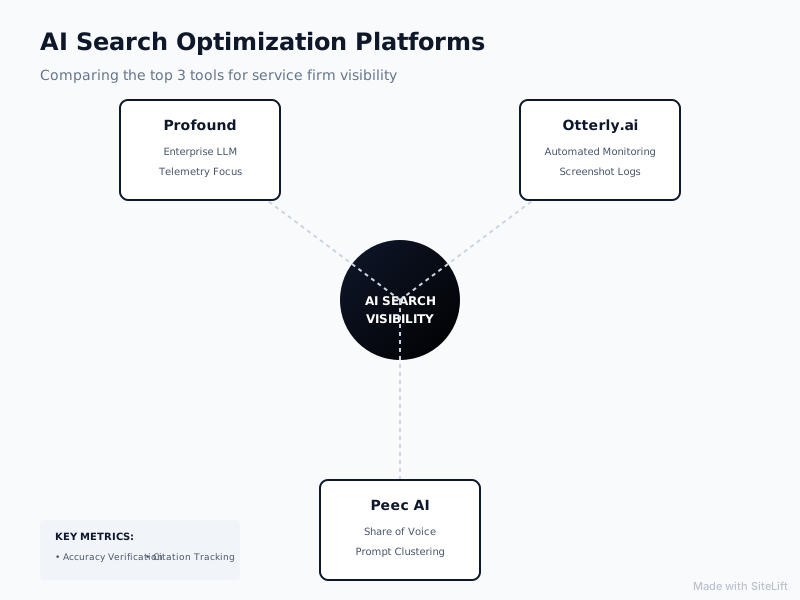
At a Glance: Top AI Search Visibility Tracking Platforms
| Platform | Best For | Engines Tracked | Verification Method | Knowledge Graph Sync | Pricing Model |
|---|---|---|---|---|---|
| Profound | Enterprise multi-model LLM intelligence | ChatGPT, Perplexity, Copilot, Gemini | API response parsing & prompt telemetry | No (Monitoring only) | Custom enterprise |
| Otterly.ai | Fast automated brand monitoring | ChatGPT, Perplexity, Google AI Overviews | Synthetic user queries & screenshot logs | No (Monitoring only) | Starter to mid-market |
| Peec AI | Brand share of voice & prompt clustering | ChatGPT, Perplexity, Claude | Dynamic prompt cluster evaluation | No (Monitoring only) | Tiered SaaS |
| Yext | Grounding AI citations with clean entity data | Feeds knowledge graphs for all major LLMs | Centralized multi-directory schema engine | Yes (Native core engine) | Custom / Mid-to-Enterprise |
| BrightEdge | Enterprise search & AI Overviews tracking | Google AI Overviews, classic search engines | Real-time SERP parser & historical log | Partial (Entity schema guidance) | Enterprise annual contract |
| Semrush | Unified organic SEO & AI Overview monitoring | Google AI Overviews, classic search | Position Tracking SERP feature filters | Partial (Via listing management) | Self-serve tiered SaaS |
| SE Ranking | Cost-effective citation & AI Overview tracking | Google AI Overviews, classic SERPs | SERP snapshot extraction & link analysis | No (Traditional SEO focus) | Budget-friendly tiered SaaS |
Infographic by SiteLift
What Makes the Best Accurate Data Platform for AI Search Optimization?
Traditional rank trackers cannot solve this problem. Legacy SEO tools check static ranking positions for fixed keywords like "IT consulting Dallas" on a single search engine results page. Conversational engines, however, generate probabilistic text answers synthesized from disparate sources on the fly.
According to research by Gartner, search engine volume is projected to drop by 25% by 2026 due to the rapid consumer adoption of conversational AI assistants and generative answer engines. For high-ticket service firms, winning in this new environment requires purpose-built generative engine optimization platforms that measure presence differently.
To separate enterprise-grade tracking platforms from fragile web scrapers, we evaluate platforms against four core criteria:
- Multi-LLM Breadth: The platform must track brand mentions across the models your buyers actually use: OpenAI’s ChatGPT Search, Perplexity AI, Google AI Overviews, Microsoft Copilot, and Anthropic’s Claude.
- Prompt Variation Depth: A human rarely types the exact same phrase into Perplexity twice. The software must run multi-turn prompt simulations, testing conversational pivots, regional filters, and buyer intents.
- Citation & Source Verification: The platform cannot merely report that your brand was named. It must log the underlying web resources the LLM retrieved (your website, a digital PR mention, a directory, or an authoritative industry study) to assemble its answer.
- Entity Accuracy Validation: Generative models hallucinate. For professional services, an engine stating that you charge contingency fees when you work strictly on retainer directly damages pipeline trust. The platform must flag factual errors in how LLMs describe your core offerings.
A study by Authoritas analyzing Google AI Overviews found that cited sources matched the top organic ranking URL in fewer than 50% of generative answer responses. If your attribution strategy relies solely on classic rankings, you are flying blind. Learning how businesses get cited by AI search starts with tracking the actual sources feeding generative answers.
1. Profound: Best Accurate Data Platform for AI Search Optimization at Enterprise Scale
┌─────────────────────────────────────────────────────────────┐
│                    PROFOUND ARCHITECTURE                    │
│                                                             │
│  [Prompt Clustering] ──► [Multi-LLM Execution Engine]       │
│                                  │                          │
│         ┌────────────────────────┼────────────────────────┐ │
│         ▼                        ▼                        ▼ │
│    [ChatGPT-4o]            [Perplexity]               [Copilot] │
│         │                        │                        │ │
│         └────────────────────────┼────────────────────────┘ │
│                                  ▼                          │
│                     [Citation & Sentiment Engine]           │
│                                  │                          │
│                     [Executive Visibility Dashboard]        │
└─────────────────────────────────────────────────────────────┘
Profound has quickly emerged as the enterprise gold standard for multi-model LLM visibility and analytics. While legacy tools retrofit existing crawlers to spot AI snapshots on Google, Profound was built from the ground up to query conversational models directly via enterprise APIs and headless browser simulations.
Core Capabilities & Citation Tracking Mechanics
Profound tracks your brand across ChatGPT Search, Microsoft Copilot, Perplexity, and Google Gemini. Its primary strength lies in prompt intelligence: instead of tracking static keywords, it allows service firms to input complex buyer journeys.
For instance, a mid-sized accounting firm can simulate prompts like "Compare top fractional CFO agencies for SaaS companies scaling past $10M ARR." Profound executes the prompt, records whether your brand was recommended, measures sentiment (positive, neutral, negative), and maps out the exact URLs cited as footnotes in the AI's response.
Strengths & Limitations for Service Firms
- Pros: Unmatched prompt-level analytics; clear visibility into competitor share of voice inside conversational responses; precise sentiment analysis that alerts you when an LLM misrepresents your firm's market tier.
- Cons: High enterprise pricing entry point; does not directly remediate hallucinated data (it monitors, but does not publish data to the web).
- Best-Fit Scenario: National or global professional service firms (legal, consulting, engineering, enterprise IT) that need granular executive reporting on brand narrative control across conversational search engines.
2. Otterly.ai: Best Dedicated Tool for Emerging AI Search Visibility Tracking
Otterly.ai addresses a direct pain point for modern marketing teams: automated monitoring of how generative search engines perceive and cite their business day after day. It avoids legacy SEO bloat and concentrates entirely on conversational interfaces.
Automated AI Monitoring and Prompt Simulation
Otterly runs scheduled, automated prompt queries across ChatGPT, Perplexity, and Google AI Overviews. The platform captures full visual screenshots alongside raw text responses, giving your marketing team visual proof of how your firm appears to users.
For service firms, Otterly's standout feature is its citation gap analysis. When an AI engine recommends a rival consulting practice instead of yours, Otterly highlights the specific third-party publications, review portals, or trade journals that the LLM pulled into its retrieval-augmented generation (RAG) context window.
Strengths & Limitations for Mid-Market Service Providers
- Pros: Clean, intuitive user interface; rapid setup with zero onboarding friction; visual screenshot history that makes reporting to leadership effortless.
- Cons: Limited integration with classic search telemetry; smaller prompt volume limits on lower pricing tiers.
- Best-Fit Scenario: Growing boutique agencies and regional service providers that need dependable ai citation monitoring for service businesses without signing a five-figure annual contract.
3. Peec AI: Best for Real-Time Brand Share of Voice in Conversational Search

Peec AI tackles the conversational visibility challenge through the lens of market share. In traditional search, you measure market share by top-three organic rankings. In conversational engines, you measure it by inclusion rate: out of 100 relevant prompts asked by potential buyers, how many times did the engine recommend your firm?
Prompt Clustering and Competitor Benchmarking Features
Peec AI organizes prompts into semantic clusters based on user intent. For a boutique law firm, it categorizes prompts into commercial litigation, intellectual property defense, and regulatory compliance.
The software repeatedly queries models like ChatGPT and Claude to reveal your firm's mention rate against direct competitors. It also tracks the order of recommendation: being the first agency cited in a Perplexity summary yields significantly higher referral traffic than being listed fourth in an appended bulleted list.
Implementation and Usability for Niche Service Consultancies
- Pros: Exceptional comparative metrics; clear share-of-voice data visualization; helpful alerts when an engine abruptly drops your domain from its citations.
- Cons: Still building out historical reporting depth; lacks structured data tools to help you fix incorrect underlying entity profiles.
- Best-Fit Scenario: Specialized consultancies competing in crowded regional or vertical niches that need to prove market dominance against specific local rivals.
Pro Tip: When analyzing share-of-voice drops in Peec AI, examine the newly cited competitor URLs. More often than not, the rival recently published an authoritative case study or appeared in a niche trade publication that the LLM's crawler prioritized for freshness.
4. Yext: Best Knowledge Graph Platform for Grounding AI Citations
Yext approaches the AI search challenge from a fundamentally different angle than pure monitoring tools. Instead of merely watching where your firm gets cited, Yext acts as the foundational data source that prevents LLMs from hallucinating in the first place.
Entity Architecture and Knowledge Graph Synchronization
Conversational engines rely on knowledge graphs and authoritative structured data to verify facts. Yext lets you build a unified, machine-readable digital knowledge graph of your firm: your partners, office locations, service specialties, published whitepapers, accreditations, and exact fee frameworks.
Through its extensive publisher network and automated schema markup engines, Yext syncs this clean entity data across hundreds of digital endpoints, knowledge bases, and directories. When web-crawling LLMs crawl the public web, Yext ensures they hit a wall of unambiguous, verifiable facts about your business.
┌─────────────────────────────────────────────────────────────┐
│                    YEXT ENTITY ECOSYSTEM                    │
│                                                             │
│       [Firm Central Truth Graph (Yext Content Engine)]       │
│                               │                             │
│         ┌─────────────────────┼─────────────────────┐       │
│         ▼                     ▼                     ▼       │
│   [Schema Markup]    [Direct API Feeds]    [Publisher Sync] │
│         │                     │                     │       │
│         └─────────────────────┼─────────────────────┘       │
│                               ▼                             │
│               [LLM RAG & Web Crawlers Intake]               │
│             (ChatGPT, Perplexity, Gemini, Bing)             │
│                               │                             │
│                               ▼                             │
│           [Factual, Hallucination-Free Citations]           │
└─────────────────────────────────────────────────────────────┘
Feeding Clean Fact Data Directly to LLM Crawlers
- Pros: Directly addresses the root cause of AI hallucinations; ensures uniform business data across global search directories; strong enterprise governance controls.
- Cons: High total cost of ownership; complex setup requiring dedicated internal ownership; lacks conversational prompt share-of-voice tracking.
- Best-Fit Scenario: Multi-location service operations (healthcare networks, financial advisories, multi-office legal practices) where publishing inaccurate practice details carries legal or compliance risk.
5. BrightEdge (Generative Parser & Copilot): Best Enterprise GEO Suite
As one of the historic giants of enterprise organic search intelligence, BrightEdge invested heavily in tracking generative shifts as soon as Google rolled out Search Generative Experience (SGE).
Deep Google AI Overviews and SGE Historical Analysis
Research published by BrightEdge revealed that over 84% of queries across specific commercial verticals now trigger some variation of generative AI-powered summaries. To help organizations navigate this shift, BrightEdge developed its proprietary Generative Parser.
The tool tracks how Google AI Overviews expand, contract, and change URL citations across millions of search queries. It maps the exact relationship between traditional organic rank positions and generative citation inclusion, helping enterprise teams discover why their page-one ranking page might be completely absent from the AI Overview box above it.
Enterprise-Grade Intent Mapping and Search Engine Integration
- Pros: Enterprise-scale data infrastructure; historical longitudinal tracking dating back to early AI Overview experiments; blends classic SEO metrics with generative attribution.
- Cons: Prohibitive pricing for smaller service firms; complex interface with a steep learning curve; primarily focused on Google rather than conversational hubs like ChatGPT.
- Best-Fit Scenario: Large corporate marketing teams managing multiple regional service domains who need enterprise-grade security and consolidated organic reporting.
6. Semrush (AI Overview Tracking & SERP Toolkit): Best All-in-One Organic & AI Suite
For many established agencies, adding another specialized $500/month tool to the marketing stack is out of the question. Semrush solves this by baking generative search tracking directly into its existing Position Tracking infrastructure.
Position Tracking with AI Overview Filtering
Within the Semrush Position Tracking tool, users can apply a dedicated AI Overview filter. This reveals:
- Which of your target keywords generate an AI Overview.
- Whether your website's URL is cited inside that overview.
- Which competitor URLs are featured when your site is missing.
This setup makes it easy to integrate AI search monitoring into existing reporting cadences. If you are already running organic campaigns to generate inquiries, you can monitor both classic rankings and generative citations within the same project view.
Content Optimization Strategies for Getting Sourced
- Pros: Highly cost-effective if you already subscribe to Semrush; clean interface; robust keyword research capabilities that pinpoint informational questions buyers ask before hiring a provider.
- Cons: Does not monitor conversational chat platforms like ChatGPT, Claude, or Perplexity; limited to Google’s implementation of generative search.
- Best-Fit Scenario: Mid-sized service agencies that want to optimize for Google AI Overviews without increasing their current software overhead.
7. SE Ranking: Best Value AI Overview and Citation Tracker for Growing Agencies
SE Ranking has built a reputation for offering reliable, agency-grade search tracking at a price point that does not punish growing businesses. Its recent updates bring dedicated generative search tracking to teams operating on leaner budgets.
Granular AI Overview SERP Feature Analysis
SE Ranking treats Google AI Overviews as a primary SERP feature. Its tracking module records the exact state of the SERP: whether an AI Overview was present, whether it was auto-expanded or collapsed, and every domain linked within the generated text.
The platform logs historical shifts, alerting you when an algorithm update swaps out your domain's authoritative guide for a competitor's whitepaper. This gives your content team clear marching orders on which service pages require structural updates or refreshed citations.
Affordable Citation Tracking Workflow
- Pros: Exceptional value for money; intuitive client-facing reporting tools; flexible subscription tiers based on keyword volume and check frequency.
- Cons: Tracks only Google AI Overviews, leaving out dedicated conversational LLMs; prompt variation testing requires manual keyword input.
- Best-Fit Scenario: Independent consultancies, local service firms, and boutique digital agencies that need to deliver clean, transparent AI Overview reports to stakeholders on a budget.
Pro Tip: In SE Ranking, set up a custom alert for any high-value commercial keyword where your firm loses an AI Overview citation. Re-evaluating your schema markup and refreshing your primary service definitions within 48 hours can often help you recapture the citation on the next crawl.
Head-to-Head Comparison: The 7 Platforms Evaluated
Choosing the right platform comes down to whether your primary concern is monitoring conversational model outputs (ChatGPT, Perplexity), auditing Google's generative SERP (AI Overviews), or correcting underlying business facts (Knowledge Graphs).
┌─────────────────────────────────────────────────────────────┐
│                 GEO TOOL CATEGORIZATION                     │
│                                                             │
│  [Conversational Trackers]      [Traditional SEO Suites]    │
│  • Profound                     • Semrush                   │
│  • Otterly.ai                   • BrightEdge                │
│  • Peec AI                      • SE Ranking                │
│                                                             │
│              [Data Grounding & Entity Engines]              │
│              • Yext                                         │
└─────────────────────────────────────────────────────────────┘
Side-by-Side Evaluation Matrix
| Platform | Primary Focus | Best For Service Firms When... | Key Limitation |
|---|---|---|---|
| Profound | Conversational LLM Intelligence | You need deep conversational analytics across all major LLMs | High enterprise minimum pricing |
| Otterly.ai | AI Search Monitoring | You want automated screenshot tracking and citation mapping | Does not offer content schema engines |
| Peec AI | Brand Share of Voice | You need to benchmark inclusion rates directly against rivals | Focused strictly on prompt monitoring |
| Yext | Knowledge Graph Sync | Inaccurate business data is corrupting your AI mentions | Expensive and complex to implement |
| BrightEdge | Enterprise Search & GEO | You require massive-scale Google AI Overview telemetry | Requires annual enterprise commitment |
| Semrush | Unified SEO & AI SERP | You want to track Google AI Overviews inside an existing SEO workflow | No native ChatGPT or Perplexity tracking |
| SE Ranking | Cost-Effective AI SERP | You need reliable AI Overview tracking on an agency-friendly budget | Limited to Google's search ecosystem |
If you want a deeper look into practical steps to get recommended by these platforms, read our guide on how to get recommended by AI search.
Why Entity Grounding Is Underrated in Generative Search Optimization
Most discussions around generative engine optimization (GEO) focus heavily on tracking prompts and writing longer FAQ sections. In our experience, this approach addresses symptoms rather than the root cause.
Conversational engines like ChatGPT and Perplexity do not recommend professional service firms simply because a website repeated a keyword five times. They recommend firms when their retrieval engines encounter unambiguous, mathematically verifiable facts supported by a network of trusted nodes across the web.
If your website describes your firm as a "premier solutions partner," an LLM has no idea what that means. If your structured entity schema, corporate registry, industry directories, and case studies state that your firm is an "ISO 27001-certified managed IT provider serving dental practices in Ohio," the model can instantly match your firm to relevant user queries.
Tracking tools show you where your brand is falling short. However, unless you pair that tracking with a clean, machine-readable digital foundation, your citation rates will fluctuate wildly every time an LLM updates its training weights or retrieval parameters. Implementing an actionable generative engine optimization strategy means fixing the factual data layer first, then measuring results with the right monitoring platform.
How Established Service Firms Should Choose Their AI Optimization Stack
Your selection depends on your firm’s size, transaction volume, and the complexity of your client acquisition funnel.
Scenario A: Multi-Location and Enterprise B2B Practices
- The Stack: Yext (for entity data management) + Profound (for multi-LLM citation intelligence).
- The Strategy: High-ticket consulting firms, legal practices, and regional accounting networks cannot afford hallucinations. Use Yext to distribute verified entity facts across the global knowledge ecosystem. Then, use Profound to monitor executive brand perception, evaluate multi-turn buyer prompts, and benchmark your share of voice against Tier-1 competitors.
Scenario B: Boutiques and Mid-Sized Agencies Focusing on Pipeline Conversion
- The Stack: Otterly.ai or Peec AI (for conversational AI tracking) + Semrush or SE Ranking (for Google AI Overviews).
- The Strategy: If your business development relies on steady inbound inquiries, keep your overhead low. Use Semrush or SE Ranking to monitor whether your high-intent commercial keywords trigger Google AI Overviews and secure cited links. Supplement this with Otterly.ai to keep tabs on brand recommendations inside ChatGPT and Perplexity.
Turning Citations Into Inbound Enquiries
Securing citations across AI search engines is only half the battle. If a prospective client prompts ChatGPT, sees your consulting firm recommended, and clicks through to your website, what happens next?
Too many service firms spend thousands optimizing for visibility, only to direct qualified traffic to vague websites with confusing messaging, buried service definitions, and passive contact forms that go unanswered for days. When buyers arrive from conversational search, they expect immediate clarity and fast answers.
At growth-kings.com, we help established service businesses turn website traffic into qualified enquiries. Instead of pushing unnecessary site redesigns or making empty ranking promises, we focus on practical, high-impact improvements: sharpening your value proposition so buyers instantly understand why you are different, structuring your technical foundations so search engines and LLMs cite your expertise, and deploying conversational AI assistants that handle after-hours inquiries and qualify leads in real time.
Winning the generative search race is meaningless if your website cannot convert the trust that conversational engines hand you on a silver platter. — growth-kings.com
Frequently Asked Questions About AI Search Visibility Tracking
What is the difference between traditional rank tracking and AI search visibility tracking?
Traditional rank tracking measures static URLs appearing on fixed, numbered positions (e.g., position 1, 4, or 10) on a standard search results page for exact keywords. AI search visibility tracking measures whether your brand or website is referenced, summarized, or hyperlinked within probabilistically generated answers produced by conversational models like ChatGPT, Claude, Perplexity, and Google AI Overviews across varying conversational prompts.
How do generative search engines like Perplexity and ChatGPT decide which service firms to cite?
Conversational engines rely on Retrieval-Augmented Generation (RAG). When a user submits a prompt, the system queries its index or the live web for authoritative sources matching the user's intent. It selects sources that demonstrate high factual clarity, strong brand entity authority, consistent digital citations, and structured markup. The model synthesizes facts from these top-retrieved documents into its final conversational answer.
Can small-to-mid-sized service firms influence AI search citations without enterprise budgets?
Yes. Smaller firms can punch above their weight by dominating specific niches and geographic locations. By clarifying their core service pages, implementing robust JSON-LD schema markup, earning coverage in reputable trade publications, and keeping directory citations consistent, boutique firms frequently get cited over larger corporate rivals whose service definitions are vague.
How often should an agency monitor its brand citations across LLM platforms?
For professional service firms, weekly automated tracking is typically ideal. Conversational search engines pull fresh web data regularly, and their internal model weights update continuously. Tracking your prompts weekly or bi-weekly allows you to spot drops in citation frequency and correct factual errors before they impact your inbound pipeline.
What is the role of structured data and entity schema in generative engine optimization?
Structured data (such as Schema.org JSON-LD) provides search crawlers and LLMs with clear, machine-readable facts about your business. It explicitly defines your organization's legal name, services, primary personnel, service areas, and customer reviews. This structured layer reduces ambiguity, helping AI crawlers understand your capabilities and cite your firm accurately without hallucinating details.
Want this working on your own site?
Tell us what’s working, what’s stuck and what you want to improve. We will reply personally.