Generative Engine Optimization vs Traditional SEO: What Service Businesses Must Do Differently Now
Generative Engine Optimization vs Traditional SEO: Discover what service businesses must change now to maintain visibility and win leads in AI search.
By Growth Kings. Published , updated . 18 min read.

Generative Engine Optimization vs Traditional SEO: What Service Businesses Must Do Differently Now
If you run an established service firm, you have likely noticed a puzzling shift over the past twelve months. Your search engine rankings appear stable, your technical health audits look clean, and yet qualified inbound enquiries are flattening out or quietly dipping. You are not imagining this disconnect. The friction lies directly in the collision between generative engine optimization vs traditional seo.
For two decades, service marketing followed an unbroken law: rank on page one of Google, capture organic clicks, direct prospects to a service page, and convert them via a booking form or phone call. Today, that linear path is fragmenting. Search engines are no longer acting merely as catalog librarians that point users to external websites; they are functioning as answer engines that synthesize solutions directly inside the interface.
Traditional Search Engine Pipeline:
[User Query] ──► [Search Index / Crawl] ──► [Ranked Blue Links] ──► [User Visits Website] ──► [On-Site Lead Conversion]

Generative Search Engine Pipeline (RAG):
[Conversational Prompt] ──► [Entity & Citation Retrieval] ──► [LLM Synthesized Answer] ──► [Zero-Click Answer OR Direct Referral]
When someone asks a conversational engine like ChatGPT, Perplexity, or Google AI Overviews for the best commercial HVAC contractor for a complex data center retrofit, they do not get ten blue links. They get a curated, synthesized recommendation. Deciding how to allocate your marketing capital across generative engine optimization vs traditional seo is no longer a theoretical debate—it determines whether your service business is visible at the critical moment of customer intent, or rendered invisible by AI synthesis.
Generative Engine Optimization vs Traditional SEO: At a Glance
Before we break down the operational mechanics, here is how the two approaches compare across core operational metrics:
| Strategic Dimension | Traditional SEO | Generative Engine Optimization (GEO) |
|---|---|---|
| Primary Destination | The browser-rendered Search Engine Results Page (SERP) | AI Overviews, Perplexity spaces, ChatGPT responses |
| Mechanics of Discovery | Algorithmic indexing of HTML documents based on PageRank and keywords | Retrieval-Augmented Generation (RAG) extracting semantic entity data |
| Target KPIs | Keyword positions (Top 3), Organic CTR, Organic Impressions, Sessions | Citation Frequency, Share of Model Voice (SoV), Synthesized Brand Sentiment |
| Content Structure | Long-form landing pages, targeted keyword variations, topical hubs | High-fact density snippets, extractable data points, quotable authoritative answers |
| Authority Signals | External backlink quantity/quality, domain age, anchor text matching | Cross-platform consensus, digital PR citations, structured schema markup |
| Conversion Pathway | Click-through to custom landing page $\rightarrow$ manual lead capture | Zero-click answer retention $\rightarrow$ highly qualified direct referral or direct brand search |
| Investment Profile | Predictable monthly retainer, technical maintenance, long ramp (4–9 months) | Agile structural data injections, entity alignment, rapid citation updates |
Core Evaluation Criteria: How to Measure Search Visibility in 2025 and Beyond
To assess how traditional search techniques hold up against modern generative search models, we need a consistent set of operational criteria. When evaluating an AI search optimization service firm or planning your own internal strategy, measure your digital footprint against these four foundational pillars:
1. Information Retrieval & Crawling vs LLM Ingestion
Traditional search relies on web crawlers (like Googlebot) discovering URLs, parsing HTML elements, rendering JavaScript, and storing pages in an inverted index. In contrast, generative engines rely on Large Language Models (LLMs) and Retrieval-Augmented Generation (RAG). RAG pulls authoritative context from trusted repositories in real time to substantiate an answer. The question here is: Is your content easily parsed as raw factual knowledge, or is it buried beneath layout scripts and fluffy marketing prose?
2. Keyword Targeting vs Entity Authority & Semantic Co-occurrence
Traditional SEO relies on matching strings of text—short-tail and long-tail keywords—across page titles, headers, and body copy. Generative engines ignore simple keyword repetition in favor of entity-based understanding. They look at how closely your brand entity associates with specific problems, geographic areas, industry accreditations, and positive consensus across third-party sources.
3. Click-Through Traffic vs Multi-Source Citation Share
For decades, organic performance was measured purely by clicks. However, data published by SparkToro indicates that nearly 60% of Google searches now result in zero clicks—a trend accelerated by AI-generated summaries at the top of the screen. Under this criterion, we evaluate whether an approach merely fights for a diminishing pool of page visits or establishes your brand as the primary cited authority within the synthesized answer itself.
4. Lead Capture & Conversion Pathways
Getting seen is only half the battle; service businesses live or die by qualified consultations and pipeline value. In traditional search, you control the user experience from the moment someone clicks your blue link. In generative search, the prospect has already had their basic objections answered by an AI before they ever touch your site. The criterion focuses on how seamlessly each methodology drives high-intent prospects into your booking calendar.
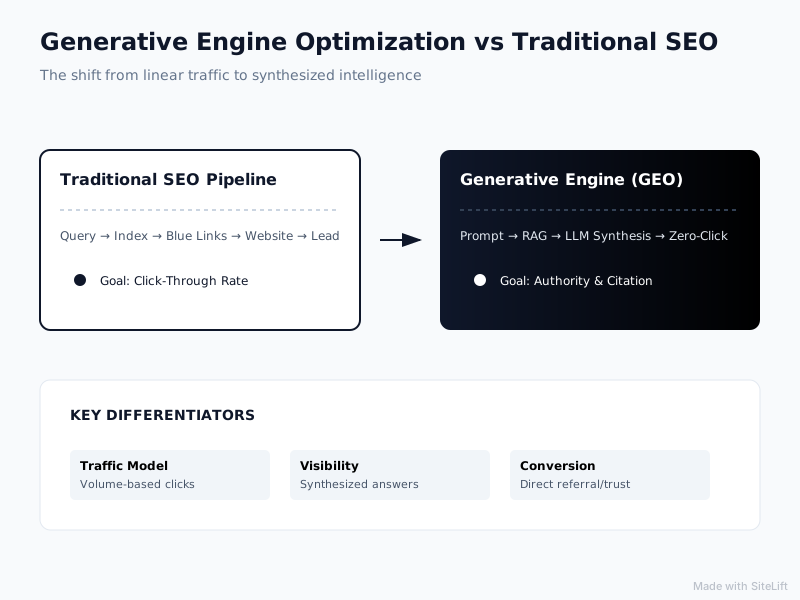
Infographic by SiteLift
Evaluating Traditional SEO: The Bedrock of Search Engine Discovery
Traditional SEO has served as the backbone of online lead acquisition for more than two decades. For professional service firms—such as engineering consultants, boutique law practices, and regional commercial contractors—it provided a reliable, measurable playbook.
How Traditional SEO Performs Under the Evaluation Criteria
- Information Retrieval: Excellent for standard web environments. Search engines understand XML sitemaps, canonical tags, and page hierarchies effortlessly.
- Targeting Model: Built on exact- and partial-match search queries. It maps commercial-intent keywords (e.g., "commercial roofing contractor Dallas") directly to dedicated service pages.
- Traffic Delivery: Relies on users scrolling past sponsored placements and clicking through to an organic link.
- Lead Conversion: Maximizes control. Once visitors land on your site, custom layouts, client testimonials, and direct forms guide them toward inquiry.
Key Strengths: Direct Traffic Control, Proven ROI, and High Intent
The greatest asset of traditional SEO remains its predictability. When executed well, technical site hygiene combined with structured localized pages captures prospects who know precisely what they want. If a facility manager searches for an emergency commercial plumber, they rarely pause to read a conversational essay from an AI; they scan for a local phone number, a verified address, and a credible Google Business Profile.
Furthermore, traditional on-page SEO gives you complete command of your conversion funnel. You control the narrative, the visual social proof, and the specific calls to action. For firms seeking to understand basic website visibility without unnecessary agency jargon, our foundational guide on how to do search engine optimization for your website covers these mechanical cornerstones in detail.
Core Limitations: Vulnerability to Zero-Click Layouts and SERP Saturation
Despite its enduring utility, traditional SEO faces severe structural headwinds. First, search engine results pages are aggressively monetized. Between Local Services Ads (LSAs), Google Ads carousels, and map packs, organic listings are pushed significantly below the fold.
Second, applying purely traditional SEO for AI Overviews leaves service firms open to sudden traffic drops. If your entire strategy relies on capturing informational search queries (e.g., "how often should commercial chillers be serviced?"), Google's AI Overview will now answer that query directly inside the search results. Your organic ranking may remain at position #1, but your organic traffic for that query can plummet overnight.
Evaluating Generative Engine Optimization (GEO): The Next Frontier of Answer Visibility
Generative Engine Optimization (GEO) does not aim to secure a position in a list of blue links. Instead, it positions your company's intellectual property, service parameters, and reputation to be retrieved, cited, and recommended by AI models responding to conversational prompts.
How GEO Operates Under the Evaluation Criteria
- Information Retrieval: Uses dynamic Retrieval-Augmented Generation (RAG). The LLM searches live web fragments, authoritative databases, and entity maps to construct responses.
- Targeting Model: Focuses on semantic concepts, contextual relevance, and factual co-occurrence rather than repetitive keywords.
- Traffic Delivery: Operates primarily via source citations, linked footnotes, and zero-click brand impressions.
- Lead Conversion: Generates lower volumes of site visits, but yields visitors who are already deeply educated and possess significantly higher commercial intent.
How AI Engines Choose What to Cite:
[User Prompt]
       │
       ▼
[Query Expansion & Intent Parsing]
       │
       ▼
[RAG Retrieval: Pulling High-Authority Fact Snippets & Entity Graphs]
       │
       ▼
[LLM Evaluates Consensus Across Multiple Trusted Sources]
       │
       ▼
[Final Synthesis: Recommendations Generated with Authoritative Citations]
Key Strengths: Pre-Qualified Brand Recommendation and Cross-Platform Synthesis
The distinct advantage of GEO is the implied endorsement of the answering engine. When an AI system presents three recommended firms to a corporate buyer, those firms bypass the buyer's initial skepticism. The buyer does not feel targeted by an advertisement; they believe they are reviewing an objective synthesis of the market's best options.
Furthermore, empirical academic evidence confirms that websites can actively influence these models. Research conducted by Princeton University, Georgia Tech, and the Allen Institute for AI demonstrated that implementing targeted GEO adjustments—specifically adding authoritative citations, statistical proof, and quotation-ready data points—can boost a brand's visibility in generative search responses by up to 30% to 40%.
If you want to dive deeper into practical entity setup for local brands, explore our tactical guide on generative engine optimization strategy for local services.
Core Limitations: Attribution Opacity and Volatile AI Retrieval Models
GEO is not without drawbacks. The most glaring challenge is reporting clarity. Unlike traditional search platforms that provide clean impression and click metrics inside Google Search Console, platforms like ChatGPT, Claude, and Perplexity offer limited attribution data.
To benchmark your performance across these conversational tools, service firms must use modern platforms designed for LLM citation tracking. You can review our comparative analysis of the best accurate data platform for AI search optimization to see how industry leaders quantify citations across generative engines.

Head-to-Head Comparison: GEO vs SEO Strategy
When planning an effective GEO vs SEO strategy, you are not choosing between two opposing philosophies. You are choosing how to balance structural visibility with synthetic authority.
| Strategic Element | Traditional SEO Approach | Generative Search (GEO) Approach |
|---|---|---|
| Content Objective | Comprehensive topical coverage optimized for specific keyword strings | Information-dense, quotable data points structured for machine extraction |
| Site Architecture | Deep folder trees, siloed service categories, internal keyword links | Flat semantic entity architecture, structured schema, machine-readable facts |
| External Authority | Backlinks from high Domain Rating (DR) websites | Third-party consensus mentions, industry directories, peer-reviewed data |
| User Journey Stage | Captures early-to-mid funnel research and explicit transactional searches | Captures complex comparative prompts, multi-variable requests, and advisory inquiries |
| Conversion Focus | On-page conversion rate optimization (CRO), lead magnets, form fills | Instant answer clarity, validation of brand credentials, friction-free booking |
| Risk Factor | Vulnerable to ongoing SERP real estate compression by ad units | Volatility in LLM training runs and sudden RAG retrieval updates |
Pro Tip: Never strip down an established, well-ranking traditional SEO page just to make it "AI-friendly." Instead, enhance your existing high-performing URLs by embedding concise factual summaries, clear schema definitions, and direct question-and-answer modules right at the top of the content.
Why the "Total Website Rebuild" for AI Search is Overrated
A worrying trend has emerged across the agency world: web development shops are telling established service firms that their current websites are obsolete, urging them to spend tens of thousands of dollars on complete rebuilds to make them "AI-ready."
In our view, this advice is largely self-serving and counterproductive.
Generative engines do not evaluate how trendy your web framework is or whether your site uses an expensive modern headless CMS. In fact, complex single-page JavaScript applications often make it harder for RAG bots to pull clean contextual text. What conversational models actually care about is straightforward: factual clarity, semantic authority, and computational trust.
You do not need to tear down a high-performing, established domain that has spent a decade accumulating domain equity. Instead, you can achieve far better visibility by making surgical, high-impact improvements:
- Cleaning up entity references so search engines understand precisely who you are and what you do.
- Embedding structured JSON-LD schema across your service offerings.
- Adding authoritative data points that AI scrapers can easily cite.
- Installing intelligent conversion tools to capture the visitors who do click through.
Ripping out a functional site destroys historical URL equity and creates unnecessary indexing issues. Upgrading your content architecture and conversion pathways gives you the benefits of GEO without the risks of starting from scratch.
"The winners in generative search won't be the companies that build the flashiest websites. They will be the service businesses that turn their existing domains into the most factual, verifiable, and authoritative sources of truth in their industry." — growth-kings.com
Strategic Scenarios: When to Lean Into SEO vs Generative Search
Neither channel works in a vacuum. A high-performing service business generative search program knows when to prioritize traditional organic positioning and when to focus on generative engine citations.
Where Your Strategy Should Focus:

Commercial Intent: Low Complexity / Immediate Need
[Emergency Service Call / Basic Local Search]
       │
       ▼
LEAN HEAVILY INTO TRADITIONAL & LOCAL SEO
(Google Business Profile, Local Map Pack, Transactional Landing Pages)

Commercial Intent: High Complexity / High-Trust Advisory
[Corporate Restructuring / Large-Scale Commercial Engineering / Enterprise B2B]
       │
       ▼
LEAN HEAVILY INTO GENERATIVE ENGINE OPTIMIZATION (GEO)
(Cross-Platform Consensus, Citation Anchoring, Entity Authority, Structured Data)
1. High-Intent Commercial Searches: Why Traditional Local SEO Still Dominates
If your revenue depends on immediate, single-variable localized searches—such as a broken water main, an urgent roof leak, or a standard corporate tax filing—traditional search and local map packs remain essential.
When buyers need help immediately, they rarely engage in exploratory conversational prompts. They open a browser, type a localized query, and click the first phone number or verified business listing they see. In this environment, maintaining your Google Business Profile, accumulating verified client reviews, and retaining local page optimization remains foundational.
2. Complex Advisory and Research Queries: Where GEO Drives Decision-Making
Conversely, when corporate buyers make high-stakes, multi-faceted business decisions, they increasingly rely on AI interfaces to parse their options.
Consider an enterprise director searching for an executive search firm to handle a sensitive, highly regulated leadership transition. Instead of browsing ten separate agency websites, they are likely to submit a nuanced prompt to Perplexity or ChatGPT:
"Compare the top three boutique executive search firms specializing in life sciences and regulatory affairs across Europe, highlighting their placement success rates and fee structures."
If your firm has only optimized for the keyword phrase "executive search firm," you will not appear in that synthesized answer. The AI will bypass your website in favor of competitors whose digital footprint includes structured data, published placement metrics, and third-party mentions across industry publications.
3. The Hybrid Model: Combining Established Visibility with AI Ingestion
The most profitable approach for established service businesses is a unified, hybrid model. Traditional SEO secures your baseline organic visibility and defends your branded search territory. Concurrently, GEO strategies structure your insights, methodologies, and case studies so that conversational engines readily ingest and reference them during complex buyer evaluations.
According to long-term tech forecasts from Gartner, traditional search engine query volume is projected to drop by 25% by 2026 as users shift toward conversational generative engines. Service businesses that cling exclusively to legacy keyword targeting risk losing a quarter of their potential discovery pipeline over the coming years.
What Service Businesses Must Do Differently Now: A Practical Action Plan
To adapt your current marketing infrastructure for both discovery engines, your team should execute three practical operational shifts:
Shift 1: Move from Keyword Density to Fact Density and Quotable Data
AI engines do not care how many times you repeat a phrase on a service page. They look for distinct, verifiable factual statements that can be extracted cleanly to answer a user's prompt.
- Audit Your Service Pages: Remove generic marketing jargon (e.g., "We offer world-class, dynamic solutions for industry leaders"). Replace it with direct, declarative statements (e.g., "Our firm manages HVAC infrastructure for over 2,500,000 square feet of commercial cold-storage facilities across the Midwest").
- Publish Proprietary Benchmarks: Release proprietary pricing guides, project timelines, and process frameworks. When your site provides hard numbers, conversational engines cite your data as the industry benchmark.
- Format for Extraction: Use clear bullet points, definition headers, and concise summary tables that RAG systems can ingest without parsing complex page designs.
Shift 2: Anchor Digital Brand Identity with Structured Schema and Entity Profiles
If conversational engines cannot confidently confirm who you are, they will not risk recommending your business. You must help machines understand your company's digital identity across every platform.
- Deploy Advanced JSON-LD Schema: Move beyond basic Organization schema. Implement deep semantic schema, including
ProfessionalService,areaServed,hasOfferCatalog,knowsAbout, andsameAsmarkup that points directly to your verified third-party profiles. - Standardize Your Digital Footprint: Ensure your business name, executive bios, accreditations, and primary physical locations are identical across LinkedIn, Wikipedia (if applicable), Crunchbase, state licensing portals, and tier-one industry directories.
- Track Generative Mentions: As highlighted in Search Engine Land's enterprise search coverage, keeping tabs on where your brand surfaces in AI Overviews is becoming as important as monitoring organic keyword positions.
Shift 3: Modernize On-Site Conversion Paths for AI-Educated Visitors
The traffic you do receive from generative engines will behave differently from traditional search visitors. These users have already read an AI-generated summary of your business; they do not need a soft introduction. They land on your site looking to validate credentials, understand next steps, and book a consultation immediately.
- Create Clear, Immediate Trust Signals: Place case studies, regulatory licenses, security certifications, and high-profile client logos directly on the entry page above the fold.
- Implement Conversational Capture Mechanisms: A static PDF download or an unmonitored contact form is no longer enough. Visitors accustomed to conversational AI appreciate interactive website assistants that can answer immediate questions, confirm geographic availability, and pre-qualify inquiries after standard business hours.

At growth-kings.com, we focus on helping established service firms bridge this exact gap. Rather than pitching costly, disruptive website rebuilds, our approach centers on pragmatic improvements: enhancing your site's trust signals, refining your search visibility across both traditional and generative engines, and deploying conversational AI assistants that turn visitors into qualified sales pipeline.
The Final Verdict
When comparing generative engine optimization vs traditional seo, the question is not which system will defeat the other. Traditional SEO remains the foundation of discovery, local intent, and conversion infrastructure. However, Generative Engine Optimization represents the primary layer of authority, recommendation, and executive decision-making moving forward.
If your service firm relies entirely on legacy keyword tracking, you are marketing to a search environment that is quickly slipping away. By structuring your content around verifiable facts, establishing clear entity authority across the web, and optimizing your site for high-intent visitors, you protect your current client acquisition channels while positioning your brand to lead in the age of conversational search.
FAQ
What is the fundamental difference between Generative Engine Optimization (GEO) and traditional SEO?
Traditional SEO focuses on optimizing web pages to rank in search engine results pages (SERPs) for specific keywords, driving traffic through organic blue links. Generative Engine Optimization (GEO) focuses on structuring content, data, and brand authority so that conversational AI models (such as ChatGPT, Perplexity, and Google AI Overviews) ingest, cite, and recommend the business within synthesized answers.
Does Generative Engine Optimization mean traditional SEO is obsolete?
No. Traditional SEO is not obsolete; it serves as the foundation upon which GEO operates. Generative engines use Retrieval-Augmented Generation (RAG) to scan and extract data from high-ranking, technically sound, and well-indexed web properties. Without solid technical SEO, structured schema, and indexed pages, an AI engine cannot easily discover or validate your company's data.
How do AI engines decide which service firms to recommend?
AI engines select service firms based on entity authority, cross-platform consensus, and information density. The model looks for clear third-party verification of your expertise (such as reviews, directory profiles, and media citations), authoritative structured schema markup, and content that provides direct, factual answers to the user's specific conversational prompt.
Can mid-sized service businesses realistically compete with major national brands in generative search?
Yes. Unlike traditional search, where massive enterprise domains can dominate organic search positions purely through sheer backlink volume, generative engines prioritize semantic relevance, niche expertise, and factual accuracy. A regional or mid-sized service business that publishes precise data points, detailed case studies, and clear structured schema can easily out-cite a large competitor that relies on generic, shallow marketing copy.
How can a service firm track ROI and lead attribution from generative search?
While conversational engines do not offer the granular click data found in traditional search tools, service firms can track performance using three practical methods:
- Adding a structured "How did you first hear about us?" field on intake forms with dedicated AI options (e.g., ChatGPT, Perplexity).
- Monitoring brand referral traffic and custom UTM tags in web analytics platforms from generative domains (such as
chatgpt.comorperplexity.ai). - Using dedicated AI visibility tracking platforms to measure shifts in brand citation frequency and share of voice across generative prompts over time.
Want this working on your own site?
Tell us what’s working, what’s stuck and what you want to improve. We will reply personally.