Entity Optimization for AI Search Visibility: Make Your Service Brand Unmistakable to AI
Master entity optimization for AI search visibility. Learn how to optimize your brand for knowledge graphs, Google AI Overviews, and AI citations.
By Growth Kings. Published , updated . 18 min read.

Entity Optimization for AI Search Visibility: Make Your Service Brand Unmistakable to AI
When a potential client opens ChatGPT, Perplexity, or Google to ask for the best commercial HVAC engineer, boutique corporate law firm, or specialized consultancy, your website is no longer competing against a list of blue links. You are competing for the model's confidence. Winning that confidence requires entity optimization for ai search visibility—the practice of establishing your business as an unambiguous, verified semantic concept that generative engines can safely recommend.
If an AI engine is even 5% unsure about who you are, what services you provide, or which geographical regions you operate in, it simply omits you. It cannot risk recommending an entity it cannot verify.
Here is the reality facing service businesses: traditional keyword strategies are falling behind. Generative artificial intelligence systems do not parse the web as collections of isolated strings. They navigate a web of connected entities—real-world things, places, organizations, and concepts defined by their relationships to one another.
What Is Entity Optimization for AI Search Visibility?
To understand how modern search works, you have to leave keywords behind. For two decades, search engines functioned primarily on string matching: a user typed "industrial roofing contractor Chicago," and the algorithm hunted for documents containing those exact words or close synonyms.
Entity-based search flips this paradigm on its head.
[Traditional SEO]  Searcher --> Strings ("HVAC Dallas") --> Web Pages with matching text
[AI / Semantic]    Searcher --> Intent & Concepts       --> Knowledge Graph (Nodes & Edges) --> AI Answer / Citations
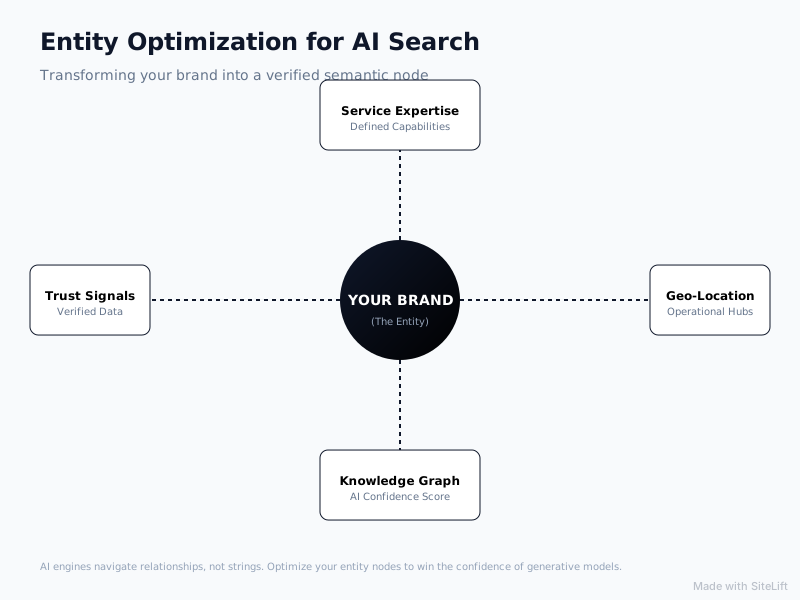
An entity is a uniquely identifiable concept or thing that is distinct, independent, and well-defined. Think of it as a specific node in a massive network. Your brand is an entity. The specific service you provide is an entity. The city you operate in is an entity. The founder of your firm is an entity.
Entity optimization is the systematic process of defining these nodes and strengthening the connective tissue—known in computer science as edges—between your brand and the exact problems you solve. When executed properly, entity optimization for ai search visibility transforms your service business from an obscure web page into an unmistakable, authoritative entry in the global knowledge graph.
From Keywords to Entities: How AI Search Understands Service Brands
Large Language Models (LLMs) and modern retrieval-augmented generation (RAG) systems do not read your website like a human, nor do they scan it like a legacy web crawler. They convert unstructured text into vector embeddings—mathematical representations of meaning in high-dimensional space.
When an AI engine processes your service pages, it evaluates:
- Entity Identity: Is this business distinct from other businesses with similar names?
- Topical Authority: Does the web consistently associate this entity with this specific industry niche?
- Relationship Mapping: Who owns this entity, where is it headquartered, what awards has it won, and what certifications does it hold?
If your website merely sprinkles keywords like "best IT consulting" across a generic homepage, an LLM perceives high entropy (uncertainty). But when your digital footprint explicitly links your organization to verified external reference points, the engine gains mathematical certainty about your brand.
The Role of Knowledge Graphs in Google AI Overviews and SearchGPT
AI search engines rely heavily on knowledge graphs to ground their answers in truth and prevent embarrassing hallucinations. Google’s Knowledge Graph, for instance, contains billions of entities and hundreds of billions of facts about them.
According to BrightEdge research, Google AI Overviews appear for over 80% of informational search queries in key service and B2B categories. When an AI Overview forms, the system does not dynamically crawl thirty websites from scratch. Instead, it queries its internal semantic index, pulls trusted entity nodes, cross-references recent web consensus, and synthesizes an answer with specific citations.
If your company does not exist as an established node in this semantic ecosystem, you are fundamentally excluded from the selection pool. You are invisible to the model.
Why Traditional SEO Alone Leaves Service Brands Invisible to LLMs
Traditional SEO rewarded document-level tactics: tweaking meta tags, packing subheadings with secondary phrases, and securing high volumes of low-context backlinks. While these fundamentals still offer baseline value, they fail to address how generative systems construct responses.
Consider the shift in user behavior. According to Gartner, traditional search engine volume is projected to drop by 25% by 2026 due to AI chatbots and virtual agents.
When users stop clicking through multiple search results and instead trust an AI engine's synthesized recommendation, ranking #4 for a keyword yields virtually zero traffic. You are either the cited entity in the recommendation, or you do not exist. Traditional SEO optimizes documents for pages; entity optimization optimizes identities for machines.
Why Is Brand Entity SEO Critical for Modern AI Search Citations?
When an enterprise client or affluent homeowner asks an AI engine for a service recommendation, the engine is putting its own perceived reliability on the line. It favors sources that demonstrate clear entity consensus across multiple independent channels.

How LLMs Filter and Select Brand Citations for Service Queries
Large language models follow specific heuristic paths when selecting external brand citations:
- Entity Extraction: The model extracts the core entities from the prompt (e.g., "commercial litigation firm," "London," "regulatory compliance").
- Contextual Retrieval: The engine queries its vector database or search index for entities possessing strong contextual relevance to those exact parameters.
- Consensus Validation: The engine checks whether external, trusted platforms confirm these service claims.
- Citation Output: The system synthesizes the final response, linking to the most authoritative source URLs to substantiate its claims.
A groundbreaking study from Princeton University on Generative Engine Optimization (GEO) demonstrated that adding relevant domain citations and authoritative quotes can increase a brand's visibility in AI search responses by up to 40%. The models systematically bias toward content that presents structured, verifiable factual evidence over generalized marketing puffery.
The Cost of Entity Ambiguity: Hallucinations and Missed Recommendations
Entity ambiguity is the silent killer of service brand visibility. Consider a mid-tier accounting practice named "Apex Advisory." There might be thousands of companies worldwide operating under variations of that name—financial planners, IT consultants, recruitment agencies, and real estate brokers.
If an AI engine cannot definitively determine whether your Apex Advisory provides cross-border tax restructuring or executive coaching, it will avoid citing you altogether. Worse, it may hallucinate attributes belonging to another business, associating your firm with services you do not offer or locations you do not serve.
Ambiguity kills algorithmic trust. Clarity creates citations.
Converting AI Search Recommendations into High-Intent Leads
Traffic originating from an AI engine recommendation behaves differently than legacy organic search visitors. When someone reads an AI Overview or a Perplexity answer that singles out your firm as a premier provider, their intent has already progressed past basic evaluation.
[Legacy Search Traffic]
Impression -> Skim 5 Blue Links -> Land on Page -> Bounce or Browse -> Low Conversion

[AI-Referred Entity Traffic]
Query -> Algorithmic Synthesis -> Brand Singled Out as Trusted Expert -> Direct Qualified Enquiry
These visitors have already seen the machine validate your expertise. If your website preserves that clarity and provides immediate pathways to engage, those visitors convert at significantly higher rates into qualified inquiries.
How Do You Build an Unmistakable Brand Entity Profile for AI Engines?
Building an undeniable brand entity requires coordinating your on-page technical architecture with your off-page digital footprint. The goal is simple: make it impossible for any crawler or LLM to misunderstand who you are, what you do, and why you are qualified.
Structuring On-Page Data with Advanced Schema Markup and SameAs References
On-page entity optimization begins with clean, rigorous structured data. The vocabulary provided by Schema.org serves as the primary standardized language through which webmasters communicate directly with machine algorithms.
Rather than relying on basic automated plugins that output fragmented schema snippets, service brands require nested JSON-LD that explicitly defines relationships.
Here is an architectural blueprint of what your core Organization schema should convey:
{
  "@context": "https://schema.org",
  "@graph": [
    {
      "@type": "Organization",
      "@id": "https://growth-kings.com/#organization",
      "name": "Growth Kings",
      "url": "https://growth-kings.com",
      "logo": "https://growth-kings.com/logo.png",
      "sameAs": [
        "https://www.linkedin.com/company/growth-kings",
        "https://twitter.com/growthkings",
        "https://www.wikidata.org/wiki/Q00000000"
      ],
      "knowsAbout": [
        "Entity Optimization",
        "Generative Engine Optimization",
        "Conversion Rate Optimization"
      ],
      "hasOfferCatalog": {
        "@type": "OfferCatalog",
        "name": "Digital Growth Services",
        "itemListElement": [
          {
            "@type": "Offer",
            "itemOffered": {
              "@type": "Service",
              "name": "Website Optimization for Clarity and Trust",
              "description": "Practical website enhancements that clarify brand positioning and maximize inquiry conversions."
            }
          }
        ]
      }
    }
  ]
}
Google provides comprehensive technical guidelines on how these items interact in their Search Central Guide to Structured Data.
The sameAs array is perhaps the most critical attribute in your schema. It functions as an explicit declaration: "This entity hosted on our domain is identical to the entity represented by these specific third-party profiles." This removes guesswork for machine learning models trying to connect your site to external knowledge bases.
Pro Tip: Never include dead social links or unverified directories in your sameAs arrays. Every single URL in that attribute should be an active, verified node that reinforces identical business details.
Establishing Off-Page Authority via Wikidata, Directories, and Niche Databases
Machines do not take your website's word for it. To validate an entity, AI systems cross-reference secondary and tertiary sources.
- Wikidata: Operating as the structured database behind Wikipedia, Wikidata.org is one of the most heavily ingested training sources for search knowledge graphs. If your business has achieved notable press coverage or industry significance, establishing a properly sourced Wikidata item can anchor your entity globally.
- Specialized Industry Registries: General directories carry little weight, but niche-specific authority hubs matter immensely. For medical services, this means state licensing databases and health boards; for legal, bar associations and Martindale-Hubbell; for consultancies, trusted industry indexes.
- Corporate Registries: Official government records (such as Companies House in the UK or state business registries in the US) provide ground-truth verification that algorithms rely on to verify corporate existence.
Leveraging Digital PR to Earn High-Consensus Brand Citations
In the world of generative AI, brand citations act as semantic votes of confidence. You do not just need backlink juice; you need contextual co-occurrence.
When respected industry publications analyze your sector and repeatedly mention your brand name in close proximity to concepts like "enterprise security auditing" or "high-end architectural restoration," an LLM's neural network physically strengthens the weights between those concepts.
According to ongoing industry analyses documented by Search Engine Land, the frequency and sentiment of brand mentions across authoritative third-party news sources directly correlate with recommendation frequency within generative search engines.
What Is the Role of Entity Consistency Across the Digital Ecosystem?
If your website claims you serve "Mid-Market Manufacturing Firms in North America," but your LinkedIn page says you are a "Global Tech Agency," and an old directory lists you as a "Local IT Repair Shop," you trigger algorithmic uncertainty.
When data points collide, AI systems step back. They hedge their bets by recommending a competitor whose digital footprint is consistent across the web.
Infographic by SiteLift
The Entity Audit: Tracking Core Properties Across Platforms
Maintaining entity consistency requires an audit of every digital footprint your company controls or influences.
| Platform / Node | Core Properties to Verify | AI Engine Significance |
|---|---|---|
| Official Website | Canonical brand name, exact service catalog, schema markup | Primary source of truth for services and direct claims |
| Google Business Profile | Exact NAP (Name, Address, Phone), categories, primary service areas | Primary training data for local AI Overviews & Gemini |
| LinkedIn Company Page | Industry categorization, corporate size, headquarters, executive team | Critical B2B entity verification for LLM grounding |
| Industry Associations | Accredited certifications, official business registrations | Highest-tier trust signal for factual verification |
| Digital PR & Media | Contextual brand mentions alongside core service keywords | Core driver of vector association and consensus scores |
Eliminating Contradictory Data That Confuses Machine Learning Models
Inconsistent data often builds up quietly over years of company growth:
- Legacy Phone Numbers: Old office lines scattered across retired directories.
- Discontinued Services: Forgotten landing pages describing service packages you phased out in 2021.
- Former Office Addresses: Historical corporate locations remaining on secondary profiles.
Every piece of legacy noise degrades the machine's confidence in your entity. Performing regular content cleanups—retiring outdated landing pages with proper 301 redirects to active service equivalents—is fundamental to maintaining entity clarity. For a deeper breakdown of this approach, explore our guide on how to improve website visibility through clarity and AI citations.
Tracking and Monitoring Your Brand's Presence in AI-Generated Responses
You cannot optimize what you do not evaluate. You need to systematically test how AI search engines interpret your business.
Pro Tip: Set aside time each month to query Perplexity, ChatGPT (with web search active), Google Gemini, and Copilot with non-branded, high-intent queries your prospective clients use. Analyze whether your brand is cited, how your capabilities are summarized, and what sources the engine uses to support its recommendations.
If an engine describes your services incorrectly, inspect the sources it cited. You will often uncover an outdated directory listing or an obsolete third-party press release feeding the model bad information. Correct that source, and the model's output will adapt.
Key Takeaways: Brand Entity SEO for AI
Before looking at how to roll this out without rebuilding your site, review these core tenets of entity optimization:
| Strategic Pillar | Core Focus | Direct Benefit to Service Brands |
|---|---|---|
| Semantic Clarity | Moving from string matching to structured entities | Makes your specific capabilities machine-readable for LLMs |
| Structured Data | Advanced nested JSON-LD schema with sameAs links |
Explicitly connects your website to verified knowledge graphs |
| Consensus Building | Digital PR and authoritative third-party mentions | Establishes statistical confidence across AI training datasets |
| Entity Consistency | Auditing and aligning corporate details across the web | Eliminates data conflicts that cause AI hallucinations or omissions |
| Clarity-First Design | On-page positioning focused on human & machine trust | Converts high-intent AI search traffic into qualified enquiries |
The Editorial Take: Why Entity Clarity Beats Content Volume Every Single Time
For the past decade, service businesses were sold an expensive lie: to win organic search, you must publish thousands of blog posts.
Agencies churned out endless 800-word articles explaining basic questions that any decent chatbot can answer in three seconds. That strategy is dead. Flooding your domain with hundreds of thin, keyword-focused articles does not make you an authority to an AI engine; it introduces semantic bloat. It dilutes your entity profile.
When an LLM scans a domain with 400 mediocre blog posts covering every tangential subject under the sun, your core entity vector gets fuzzy. Are you a top-tier management consultancy, or are you an amateur lifestyle blog talking about office productivity tips?
True authority is tight, precise, and unambiguous. We would rather see a service business publish ten deeply authoritative, perfectly structured service pages—supported by robust nested schema, verified external citations, and clear thought leadership—than five hundred disposable blog posts.
Stop trying to out-write the machines. You cannot out-publish an LLM that generates 100 tokens per second. Instead, make your brand's real-world expertise impossible for that LLM to ignore. Entity clarity beats raw content volume every single day.
How to Execute Entity Optimization for AI Search Visibility Without a Full Site Rebuild?
One of the biggest misconceptions among service business owners is that modernizing for AI search requires throwing away their current website and starting over.
That is completely unnecessary.
Entity optimization is primarily a layer of structural clarity, precise technical markup, and contextual alignment added to your existing foundation. You do not need an expensive digital redesign; you need targeted, surgical enhancements. If you want to understand how this fits into broader search evolutions, study our blueprint for a generative engine optimization strategy for local services.
Optimizing High-Intent Service Landing Pages for Clarity and Trust
Start with your revenue-generating core: your individual service pages. Most service websites suffer from creative ambiguity—clever headlines that say nothing practical about what the company actually delivers.
Revamp these pages with absolute semantic clarity:
- Explicit Service Definitions: State clearly within the first two sentences what the service is, who it is for, and where it is delivered.
- Standardized Subsections: Use clear headings outlining deliverables, methodology, certifications, and verified case studies.
- Structured Schema Integration: Embed clean, specific
ServiceandOfferschema on each dedicated URL, nesting it within your primaryOrganizationidentity.
This structure allows web crawlers and RAG systems to parse your exact value proposition in milliseconds, matching user queries straight to your operational strengths.
Integrating Conversational AI Assistants to Capture Entity-Qualified Traffic
Winning citations across AI search engines is only half the battle. When a qualified prospect arrives at your website via an AI Overview or Perplexity recommendation, their expectations are already shaped by conversational technology. They want direct answers, not hunting through confusing menus.
This is where integrating purpose-built conversational AI assistants pays massive dividends.
AI Search Citation -> Visitor Lands on Service Page -> Conversational Assistant Engages Instantly -> Answers Technical Nuances -> Collects Qualified Enquiry Details
Rather than forcing prospective clients to submit a generic contact form and wait 48 hours for a reply, an on-site conversational assistant—trained specifically on your company's verified entity data—can:
- Answer complex questions about your specific methodologies and project timelines.
- Triage inquiries after hours to ensure no high-value corporate lead slips away.
- Qualify the lead against your ideal client profile before booking a call directly on your team's calendar.
By pairing front-end entity optimization (which drives AI citations) with on-site conversational qualification, you close the loop between discovery and revenue.
Measuring AI Visibility and Citation Growth Over Time
Because entity-driven AI visibility operates differently than classic rank tracking, your measurement framework must evolve as well. For a detailed review of the tracking tools available today, read our evaluation of the best accurate data platform for AI search optimization.
Focus on tracking these core KPIs:
- AI Search Citation Frequency: How often your brand URL or brand name appears as a linked source in generative answers across target service queries.
- Branded Search Query Volume: An increase in users searching for your brand by name is the direct byproduct of being cited repeatedly in AI answers.
- Direct Referral Quality: The conversion rate and average deal size of visitors landing on your site via AI engine source links.
Turn Your Service Business Into an Unmistakable Industry Entity
At Growth Kings, we believe established service businesses should not have to waste money on endless website redesigns or empty SEO ranking promises that fail to generate revenue.
Our focus is practical and results-driven:
- Website Optimization for Clarity and Trust: We audit your existing web architecture, stripping away confusing jargon and implementing advanced, entity-rich schema that makes your services unmistakable to search algorithms and human clients alike.
- Search and AI Visibility Enhancement: We refine your on-page and off-page semantic connections, securing the critical entity consensus required to win citations across Google AI Overviews, SearchGPT, and Perplexity.
- Conversational AI Lead Capture: We deploy intelligent, custom-trained conversational assistants that work 24/7 on your website—turning the high-intent traffic earned through AI visibility into vetted, qualified phone calls and sales inquiries.
You do not need to rebuild your digital presence from scratch. You simply need to make your real-world expertise readable to the modern web.
— growth-kings.com
FAQ
What is the difference between traditional SEO and entity optimization for AI search?
Traditional SEO focuses largely on matching search keywords to specific web documents through keyword density, metadata, and backlink volume. Entity optimization focuses on establishing your brand as a recognized, verified concept (an entity) within knowledge graphs. It emphasizes relationships, facts, semantic structured data, and third-party consensus, allowing AI systems like ChatGPT and Google AI Overviews to cite your business with high confidence.
How do Google AI Overviews and Perplexity decide which service brands to cite?
Generative engines evaluate entities based on semantic relevance, source authority, and web consensus. Rather than pulling pages at random, they retrieve information from authoritative nodes in their knowledge bases, cross-reference verified sources using retrieval-augmented generation (RAG), and cite brands that have unambiguous, corroborated data across independent platforms.
Does my service business need a Wikipedia or Wikidata entry for entity SEO?
A Wikipedia page is not mandatory—and attempting to create one without meeting strict notability guidelines often results in deletion. However, establishing a clean, properly referenced entry on Wikidata is highly beneficial. Wikidata acts as an open, structured database heavily utilized by machine learning systems to disambiguate businesses, understand corporate relationships, and map service entities.
How long does it take for AI search engines to recognize an updated brand entity?
While traditional search crawlers can index on-page schema changes within days, broader AI recognition depends on model refresh cycles and retrieval-augmented indexes. Typically, when structured data and off-page entity alignment are executed simultaneously, businesses begin seeing shifts in AI citations and overview summaries within 4 to 12 weeks.
Can entity optimization be implemented without completely redesigning my website?
Yes. Entity optimization does not require a visual redesign or platform migration. It involves technical enhancements to your page architecture, implementing advanced JSON-LD structured data, clarifying the written copy on key service pages, and aligning off-page directory and digital PR profiles. These updates can be applied directly to your existing website infrastructure.
Want this working on your own site?
Tell us what’s working, what’s stuck and what you want to improve. We will reply personally.