Conversion Rate Optimization Specialist: When Service Firms Should Hire One
Learn when service firms should hire a conversion rate optimization specialist to turn stagnant web traffic into qualified, high-ticket client inquiries.
By Growth Kings. Published , updated . 15 min read.

Conversion Rate Optimization Specialist: When Service Firms Should Hire One
Most service firms treat low website inquiries as a traffic problem. They pour budget into Google Ads, hire SEO agencies, and churn out LinkedIn thought leadership, assuming that more clicks will inevitably yield more client consultations. Yet the pipeline remains stubbornly flat. If visitors land on your site, look around, and leave without booking a call, more traffic only burns through your capital faster. This is precisely where a conversion rate optimization specialist steps in to diagnose cognitive friction, repair broken buyer journeys, and turn passive pageviews into qualified inbound revenue.
Unlike high-volume ecommerce stores selling low-ticket retail items, professional service businesses—such as consultancies, commercial trade firms, legal practices, and agencies—deal with high-consideration decisions. Your visitors aren't making impulse purchases; they are assessing risk, competence, and trust.
Below is an executive summary of what a dedicated specialist brings to service operations, followed by an in-depth operational guide on identifying when, why, and how to hire one.
Key Takeaways: Hiring a CRO Specialist for Professional Services
| Metric / Decision Point | Generalist Web Agency | Conversion Rate Optimization Specialist |
|---|---|---|
| Primary Objective | Visual aesthetics and brand alignment | Inbound qualified inquiry volume and pipeline velocity |
| Methodology | Subjective design trends and client preferences | Behavioral analytics, heuristic evaluations, user research |
| Handling Low Traffic | Requests more ad spend or redesigns the whole site | Qualitative friction mapping and high-impact messaging fixes |
| Lead Quality Focus | Form fill volume (often unvetted inquiries) | Lead qualification and sales calendar fit |
| Typical Investment | Lump-sum upfront project fee ($15k–$50k+) | Iterative sprints or monthly performance retainer |
What Does a Conversion Rate Optimization Specialist Actually Do for Service Businesses?
A conversion rate optimization specialist is a behavioral analyst, user researcher, and data-driven strategist rolled into one. Their mandate is not to create an artistic masterpiece, but to remove every point of friction that prevents a qualified prospect from reaching out to your firm.
Beyond Button Colors: Qualitative User Research and Behavior Mapping
Pop-marketing lore suggests conversion optimization is about changing call-to-action buttons from green to orange. In the world of high-ticket services, visual cosmetic tweaks rarely move the needle.
A seasoned CRO expert spends the vast majority of their time conducting qualitative research. According to digital experimentation frameworks taught by institutes like CXL, true conversion gains come from discovering why people hesitate. For a service firm, this involves:
- Heuristic analysis: Systematically evaluating every page against clarity, relevancy, distraction, and urgency criteria.
- Heatmapping and scroll tracking: Identifying where high-intent prospects abandon service pages and which critical trust signals they bypass entirely.
- Session replay analysis: Watching recorded user sessions to uncover hidden UI bugs, confusing navigation paths, or clunky form interactions.
- Prospect interview synthesis: Translating the exact language, anxieties, and criteria buyers use during sales calls into on-page value propositions.
Conversion Audit Specialist vs. Full-Cycle CRO Consultant
When evaluating external help, you will typically encounter two primary operational models:
- The Conversion Audit Specialist: This professional performs a time-bound, forensic investigation of your current digital footprint. They deliver an exhaustive teardown highlighting UX dead ends, messaging ambiguity, and missed conversion opportunities. For firms with competent internal designers and developers, a standalone conversion audit provides the exact roadmap needed to execute high-impact fixes internally.
- The Full-Cycle CRO Consultant: This expert handles end-to-end execution. They conduct the audit, construct the conversion hypothesis, rewrite UX copy, wireframe improved layouts, and oversee technical implementation. If your team lacks specialized conversion copywriting and UX bandwidth, an ongoing engagement ensures systematic improvements over time.
To understand the core mechanics of how these diagnostic reviews work in practice, explore our detailed conversion optimization definition tailored specifically for service inquiry growth.
Addressing the Unique Dynamics of High-Trust Service Funnels
Ecommerce conversion optimization relies on split-testing micro-conversions across hundreds of thousands of transactions. A 0.2% lift on a shopping cart can represent millions of dollars for an online retailer.
Service firms, however, operate in high-friction, relationship-driven environments. Prospective clients are committing to contracts worth thousands—or tens of thousands—of dollars. They are asking serious internal questions: Do these people understand my specific problem? Can I trust them with my business? What happens after I fill out this form?
A dedicated cro consultant for lead generation optimizes for psychological safety, perceived competence, and clarity of engagement rather than impulse clicks.
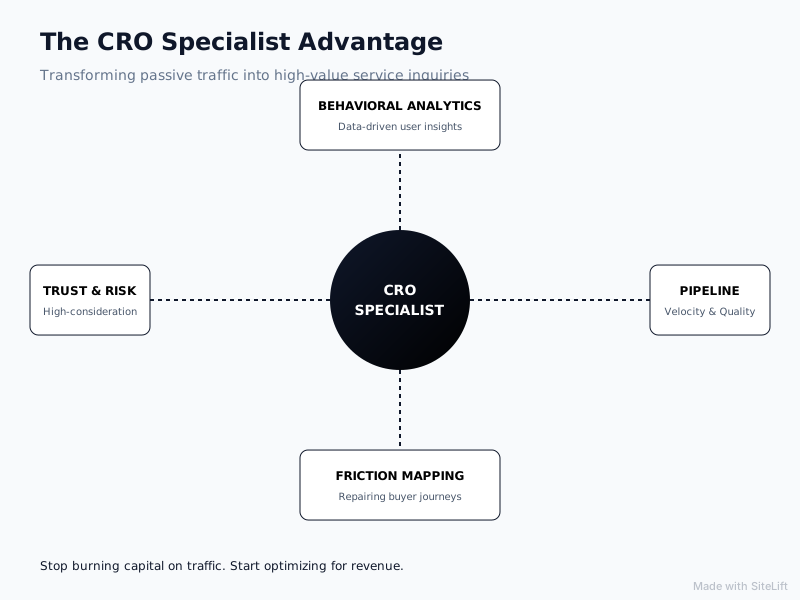
Infographic by SiteLift
CRO vs Website Optimization Services: What Is the Difference?
Service business leaders often conflate conversion rate optimization with general website optimization services. While complementary, they address fundamentally different layers of your digital performance.
+-----------------------------------------------------------+
|               Website Optimization Services               |
|  (Core Web Vitals, Page Speed, Hosting, Basic Technical)   |
+-----------------------------+-----------------------------+
                              |
                              v
+-----------------------------------------------------------+
|         Conversion Rate Optimization Specialist           |
| (Visitor Psychology, Messaging, Trust Signals, Lead Flow) |
+-----------------------------------------------------------+
Tactical Technical Fixes vs. Data-Driven Behavioral Science
Standard website optimization services concentrate almost exclusively on technical hygiene: server response times, caching, image compression, Core Web Vitals, and structural on-page SEO. These tasks ensure your site functions reliably and loads quickly.
CRO, by contrast, operates at the intersection of human psychology and behavioral economics. Once a visitor lands on a fast-loading page, technical optimization has done its job. The CRO specialist must now convince that visitor that your firm is the best choice to solve their problem. Technical optimization gets people to the front door; CRO invites them in, demonstrates expertise, and closes the conversation.
The Redesign Trap: Why Complete Website Overhauls Often Fail to Fix Conversions
When inquiries drop, the default instinct of many leadership teams is to order a complete website redesign. Months are spent debating color palettes, aesthetic typography, and slick animations.
Yet, when the new site launches, conversion numbers frequently stay flat—or drop. Why? Because redesigns treat visual styling as a proxy for messaging clarity. If your value proposition is vague, your proof points are buried, and your contact flow feels like a tax audit, wrapping it in a sleek new WordPress theme fixes none of the underlying issues.
A conversion specialist isolates what is broken before changing code. They prevent you from discarding the parts of your site that are already working, saving you tens of thousands of dollars in unnecessary agency redesign fees.
How CRO Complements SEO and Paid Traffic Acquisition
Data published by Invesp indicates that companies spend approximately $92 acquiring traffic for every $1 spent on converting that traffic. This massive imbalance creates an expensive leak in your acquisition model.
If you spend $8,000 monthly on Google Ads with a 1.5% conversion rate, doubling your budget to hit revenue goals doubles your customer acquisition costs (CAC). By contrast, working with a specialist to systematically improve that landing page conversion rate from 1.5% to 3.0% effectively doubles your inbound leads at your existing ad spend.
If you are mapping out your acquisition channels, reviewing a rigorous conversion funnel optimization framework reveals how small friction reductions compound down the entire pipeline.

When Should a Service Business Hire a CRO Expert?
Not every service business needs a conversion specialist immediately. If you launched your website last month and receive 100 visits a week, your issue is brand awareness and distribution, not conversion bottlenecks.
However, established firms reach a clear inflection point where conversion optimization becomes the highest-leverage growth activity available.
Sign 1: Healthy Website Traffic with Stagnant Lead Flow
If your Google Search Console shows consistent organic impressions and your analytics displays healthy, steady engagement, yet your sales inbox remains quiet, you have an on-page conversion failure.
According to HubSpot research, average website conversion rates for B2B and professional services typically hover between 2% and 4%. If your site draws 3,000 to 10,000 qualified visitors a month but converts under 1%, you do not need more content marketing—you need a forensic evaluation of your user journey.
Pro Tip: If traffic is rising but form submissions are flat, do not rewrite your blogs. Examine your service landing pages. Look at how many clicks occur above the fold versus how many people ever scroll to your contact button.
Sign 2: Skyrocketing Customer Acquisition Costs (CAC) on Paid Channels
Pay-per-click (PPC) costs on competitive commercial keywords (such as corporate legal work, IT consulting, or commercial contracting) rise every quarter. As platform bids inflate, your margins compress.
When paid traffic ceases to be profitable, most founders pull back on ad spend. A smarter approach is to hire a cro expert for your service business to optimize campaign-specific landing pages. A specialist ensures every dollar spent lands on a high-converting, relevance-matched page designed specifically for high-intent decision-makers.
Sign 3: Sales Teams Wasting Time on Unqualified Inquiries
Conversion optimization is not purely about driving higher lead volumes; it is equally about lead qualification. If your sales engineers or account executives spend half their workweek fielding calls from tire-kickers who cannot afford your retainers, your website is failing to set expectations.
A conversion audit specialist analyzes your entry points and implements strategic self-selection mechanisms. By introducing smart qualifying questions, transparent operational boundaries, and tiered contact flows, a CRO expert screens out bad-fit prospects while accelerating high-value deals directly into your calendar.
How a CRO Consultant for Lead Generation Transforms Service Websites
When a seasoned conversion professional tackles a service business site, they follow an architectural framework engineered for trust, clarity, and low cognitive effort.
Establishing Clarity and Trust Above the Fold
Research from the Nielsen Norman Group shows that web users often decide within the first 10 to 20 seconds whether to stay on a page or leave. Within those critical moments, a prospective client must understand three foundational things:
- What you do: Clear, plain-English service definition without corporate buzzwords.
- Who you do it for: Specific industry, company size, or situational positioning.
- Why they should believe you: Verifiable proof, such as client logos, industry certifications, or measurable case studies.
A conversion specialist eliminates poetic, ambiguous hero headlines (e.g., "Empowering Tomorrow's Enterprise Agility") and replaces them with direct, value-first propositions (e.g., "We Architect Enterprise Cloud Infrastructure for FinTech Firms with Zero Downtime").
Friction Reduction in Forms, Booking Flows, and Multi-Step Inquiries
The contact form is where most service conversions quietly die. Common mistakes include asking for phone numbers too early, using vague submit buttons like "Submit," and presenting massive walls of input fields that feel like homework.
To turn this around, experts deploy high-conversion patterns:
- Multi-step forms: Breaking detailed onboarding questions into two or three low-friction steps, using psychological commitment principles.
- Direct calendar integration: Allowing qualified prospects to skip email tag and book consultations directly on sales calendars.
- Microcopy reassurance: Adding explicit statements regarding response times and privacy directly below form buttons (e.g., "We review inquiries within 4 business hours. No unsolicited sales calls.").
For an exhaustive audit of your own lead generation forms, step through our 21-point conversion rate optimization audit checklist to identify where prospects are dropping off.
Capturing High-Intent Demand with Real-Time Conversational Interfaces
A substantial portion of service website traffic arrives outside of standard business hours—often late in the evening when business owners finally have time to research vendors. If your only call to action is a static contact form that promises a reply "within 24-48 business hours," you risk losing that prospect to a competitor who responds faster.
Modern CRO strategies bridge this gap using real-time conversational assistants. Rather than passive, annoying pop-up chatbots, these are structured, AI-powered qualifying flows that:
- Acknowledge the visitor's specific challenge immediately.
- Answer common preliminary questions regarding scope, service boundaries, and timelines.
- Collect essential qualifying details and book a meeting directly on your calendar while interest is at its peak.
Why the Obsession with Full Redesigns Is Burning Service Firms
In my years auditing B2B and professional service sites, the single most destructive habit I see leadership teams fall into is the "two-year redesign cycle."
A firm notices inquiries have dried up. Frustrated, they bring in a design agency that knows nothing about their sales conversations. The agency spends four months producing stunning Figma mockups and another three months developing a custom theme. By month eight, the new site launches. It looks gorgeous, the executive team is thrilled, and everyone waits for the flood of new client calls.
Nothing happens. In fact, qualified inbound calls drop because the agency stripped out the detailed technical service descriptions that were driving organic search intent, replacing them with minimalist cards and generic marketing jargon.
True conversion optimization is unglamorous. It is reading 200 transcripts of sales calls, analyzing user heatmaps at 2 AM, and realizing that your prospective clients leave because they can't figure out if you serve their geographical market. Stop rebuilding your website from scratch. Fix the friction points that are already costing you money.
Pro Tip: Before greenlighting an expensive, multi-month website rebuild, hire a specialist to run a 30-day conversion audit. In nine out of ten cases, the fixes required to double your lead flow live in your copy, your social proof placement, and your intake forms—not your visual layout.
How to Choose and Hire the Right CRO Specialist for Your Firm
Hiring the wrong conversion partner can lead to wasted budget and degraded user trust. Use this evaluation framework to vet candidates thoroughly.
Core Competencies: Analytics, Psychology, and UX Copywriting
A true conversion expert must possess cross-disciplinary competence:
- Data Literacy: Deep fluency with Google Analytics 4, Tag Manager, heatmapping tools (Hotjar, Microsoft Clarity), and event tracking.
- Behavioral Psychology: An intuitive grasp of cognitive biases, friction analysis, and decision fatigue.
- Direct-Response Copywriting: The ability to write persuasive, benefit-driven headlines and value propositions. Design supports the copy—copy drives the conversion.
Crucial Questions to Ask Before Signing a Contract
When vetting an independent consultant or specialized agency, look past polished pitch decks and ask these diagnostic questions:
- "Our site receives 3,000 visits per month. How will you optimize our pages without the sample size required for traditional A/B split testing?"
Good answer: They should explain heuristic analysis, qualitative user testing, customer interviews, and scroll-map observation. Anyone who promises to run 15 concurrent A/B tests on a low-traffic service site does not understand statistical significance. - "How do you ensure the inquiries we get are actually qualified?"
Good answer: They should discuss intent filtering, multi-step intake fields, transparent expectation-setting, and sales team feedback loops. - "Can you show me an example of how you improved lead volume on an existing site without a full redesign?"
Good answer: They should present a case study showing targeted interventions: revamped above-the-fold value propositions, restructured service landing pages, and simplified inquiry pathways.
Realistic Timelines, Milestones, and Measuring ROI
Conversion rate optimization is an iterative discipline, not an overnight switch.
- Month 1 (Discovery & Audit): Setup of analytics, event tracking, heatmap monitoring, qualitative interviews, and delivery of a prioritized roadmap.
- Month 2 (Initial Interventions): Deployment of high-priority fixes: value proposition clarification, form redesigns, mobile usability enhancements, and conversational lead capture tools.
- Month 3 and Beyond (Refinement & Compounding): Review of behavioral data, expansion to secondary service pages, deeper qualification mechanisms, and continuous pipeline monitoring.
If your agency relies heavily on tailored campaign pages, consult our conversion rate optimization landing page playbook to see how individual service destinations should be engineered for maximum pipeline yield.
Turning Digital Traffic into Predictable Client Inquiries
If your established service business has plateaued despite consistent marketing spend, your website doesn't need another expensive aesthetic facelift. It needs strategic, evidence-based conversion engineering.
At Growth Kings, we partner with established service firms to identify conversion leaks, clarify complex offerings, and deploy conversational lead capture systems that engage qualified prospects around the clock. By focusing on practical, high-impact refinements rather than risky, costly redesigns, we turn your current traffic into an active source of high-intent sales conversations.
— growth-kings.com
Frequently Asked Questions
How much website traffic does a service firm need before hiring a CRO specialist?
While high-volume ecommerce stores need tens of thousands of monthly transactions to run statistically valid A/B split tests, service firms can benefit from a CRO specialist with as few as 1,000 to 3,000 monthly visitors. At this volume, the specialist relies on qualitative research, heuristic usability evaluations, session replay diagnostics, and customer feedback loops to identify and remove conversion barriers.
What is the difference between a CRO consultant for lead generation and an ecommerce CRO expert?
An ecommerce CRO expert focuses on reducing friction in high-volume, low-consideration transactions—optimizing add-to-cart rates, cross-sells, checkout flows, and payment gateway options. A CRO consultant for lead generation specializes in high-trust, extended-consideration cycles. Their work centers on value proposition clarity, multi-touch attribution, overcoming client risk aversion, qualifying lead criteria, and optimizing consultation booking pathways.
Can a conversion audit specialist improve lead generation without a full website redesign?
Yes. In fact, most conversion improvements are achieved through targeted, modular interventions rather than complete overhauls. A conversion audit specialist typically adjusts headline copy, restructures proof points, repositions trust signals, simplifies intake forms, and fixes layout bugs on existing pages. This delivers faster results at a fraction of the cost of a full rebuild.
How long does it typically take to see measurable results from conversion rate optimization?
Initial diagnostic audits typically take two to four weeks. Once foundational fixes—such as updated messaging, streamlined forms, and conversational capture tools—are implemented, service firms often begin seeing qualitative improvements in inquiry quality within 30 to 60 days. Because conversion optimization compounds over time, the full revenue impact becomes increasingly pronounced across quarters as sales cycles close.
Want this working on your own site?
Tell us what’s working, what’s stuck and what you want to improve. We will reply personally.