How to Structure Content for AI Citations: Headings, Facts and FAQs That Get Quoted
Learn how to structure content for AI citations. Master semantic headings, inverted-pyramid answer blocks, tables, and FAQ schema to get quoted by LLMs.
By Growth Kings. Published , updated . 14 min read.

How to Structure Content for AI Citations: Headings, Facts and FAQs That Get Quoted
If your content is written only for traditional search engine crawlers, you are already losing traffic to answer engines like Perplexity, ChatGPT, and Google AI Overviews. Learning how to structure content for ai citations is now just as critical as targeting keywords was a decade ago.
Generative engines do not read your pages like human beings, nor do they rank links based solely on backlink counts. Instead, they ingest text, split it into chunks, calculate vector embeddings, and retrieve the most semantically relevant, factually dense snippets to synthesize direct answers. According to Gartner, traditional search engine volume will drop by 25% by 2026 as users migrate to conversational search assistants. If your site lacks an AI-friendly content optimization framework, your brand simply will not be part of that conversation.
Here is a step-by-step masterclass on how to format your text, build clean semantic hierarchies, and turn your expertise into machine-readable citations.
Prerequisites: What You Need Before Formatting for Generative Engines
Optimizing for Retrieval-Augmented Generation (RAG) models requires a solid foundation before you start rewriting sentences. You cannot format thin or generic content into an authoritative citation.
Time, Tools, and Technical Requirements
- Time Required: 2 to 4 hours per long-form guide or core service page.
- Tools Needed: A clean code/text editor, a schema generator or JSON-LD validator (such as Google’s Rich Results Test), and server-level access to verify your
robots.txtconfiguration. - Core Skills: Basic semantic HTML markup, technical copywriting, and conceptual understanding of document chunking.
Establishing Core Entity Clarity
Before writing a single heading, you must establish clear entity relationships. Large language models (LLMs) connect concepts through knowledge graphs. If your business provides specialized commercial HVAC engineering, your page must clearly define the primary entity (your service), the parent entity (your company), and the topical domain (mechanical engineering).
When entities are ambiguous, retrieval models discount the source to avoid hallucinating facts. For a deeper breakdown of building these connections, explore our complete guide to entity optimization for AI search visibility.
Auditing Existing Content for Quotable Authority
Review your baseline copy for factual substance. Generative engines discard filler, rhetorical questions, and speculative claims.
Make sure your site also allows LLM crawlers to access your assets. Check your server’s robots.txt file to ensure you are not accidentally blocking user agents such as GPTBot, PerplexityBot, and Google-Extended. If an engine cannot fetch your raw HTML, no amount of semantic optimization will help.
Step 1: How to Structure Content for AI Citations Using Semantic Headings
Traditional SEO encouraged clever, catchy headings designed to trigger clicks. In contrast, generative engines rely on semantic predictability. Vector search algorithms chunk content at heading breaks; if a heading fails to label the chunk beneath it accurately, the model misjudges its relevance.
Using Direct Question-Based H2s and H3s
Frame subheadings around explicit, natural-language queries. LLMs retrieve text by measuring the cosine similarity between a user's prompt and your document chunks. Matching the grammatical structure of search prompts maximizes this similarity score.
- Avoid: Heading 2: Making It Happen
- Use Instead: Heading 2: How Do Commercial Heat Pumps Operate in Sub-Zero Climates?
Using interrogative words (how, what, why, which) directly signals that the subsequent paragraph contains an answer block.
Maintaining Strict Conceptual Nesting
Never skip heading levels for aesthetic reasons. An H1 sets the overarching entity for the page, H2 tags delineate distinct parent subtopics, and H3 tags divide those subtopics into granular attributes.
H1: Commercial Roof Maintenance Guide
  ├── H2: Preventative Inspection Checklists
  │     ├── H3: Spring Bi-Annual Roof Inspection Tasks
  │     └── H3: Post-Storm Drainage Assessment Steps
  └── H2: Commercial Membrane Replacement Costs
        ├── H3: EPDM Roofing Material Expenses
        └── H3: TPO Roofing Installation Labor Rates
- Action: Rewrite your page headings into clear, descriptive questions and nested topics.
- Expected Result: RAG pipelines cleanly divide your page into standalone semantic chunks without losing conceptual context.
- Mistake to Avoid: Do not use stylistic CSS classes as heading replacements (e.g., using a
<p class="big-bold-text">instead of a semantic<h2>tag).
Step 2: How to Structure Content for AI Citations with Fact-Dense Summaries
Once a generative crawler identifies a relevant heading, it parses the first 40 to 60 words for a definitive answer. This is where content formatting for AI search relies heavily on the classic journalism framework: the Inverted Pyramid.
The 40-to-60 Word Definitive Answer Block
Generative engines prioritize Bottom Line Up Front (BLUF) formatting. The sentence immediately following your H2 or H3 must state the core answer directly without prelude, storytelling, or rhetorical padding.
### What is the lifespan of an industrial air scrubber?
An industrial air scrubber typically lasts between 10 and 15 years with routine maintenance. Lifespan depends on daily operating hours, ambient particulate density, and filter change frequency. Units operating in corrosive chemical environments require blower and motor replacements every 5 to 7 years.
Notice the density of that answer. It provides the exact timeframe in the first sentence, lists the controlling variables in the second, and specifies edge-case limits in the third. It is instantly extractable as a standalone quote.
Subject-Predicate-Object Sentence Clarity
To make text frictionless for Natural Language Processing (NLP) token extraction, write in active voice using direct Subject-Predicate-Object (SPO) grammar.
- Weak Syntax (Passive/Ambiguous): "When considering project timelines, delays are frequently observed to be caused by late supply deliveries."
- Strong Syntax (SPO/Direct): "Supply chain bottlenecks cause 45% of commercial construction delays."
Pro Tip: Treat the first sentence under every heading as if it were the only paragraph an AI model will read. If that single sentence cannot stand alone in an AI Overview with full attribution, rewrite it until it can.
- Action: Place a 40-to-60 word definitive summary block directly beneath every informational heading.
- Expected Result: LLM extractors can lift your summary intact as a featured definition or direct citation snippet.
- Mistake to Avoid: Never begin an answer block with conversational throat-clearing such as "To understand this question, we must first look at the history of..."

Step 3: Format Data Blocks with Tables and Ordered Numerical Lists
Generative algorithms favor structured visual summaries because they eliminate syntactic ambiguity. If an AI agent needs to compare options or extract a sequential process, it favors an HTML table or numbered list over dense narrative prose.
According to research from Authoritas, Google AI Overviews appear for up to 84% of search queries across specific technical, product, and commercial service categories. In many of these overviews, the generated summary lifts data directly from well-formatted comparative tables.
Structuring Tabular Data for Machine Ingestion
Avoid complex nested tables or multi-span cells that confuse web scrapers. Use native HTML markup (<table>, <thead>, <tbody>, <th>, <tr>, <td>) rather than CSS-based flexbox columns or graphic images of charts.
| Optimization Layer | Traditional SEO Focus | AI Citation (GEO) Focus | Primary Machine Metric |
|---|---|---|---|
| Heading Structure | Keyword inclusion, CTR hooks | Unambiguous semantic questions | Cosine similarity in vector search |
| Paragraph Flow | Reader dwell time, engagement | Bottom Line Up Front (BLUF) | Information density per token |
| Data Presentation | Graphic infographics, slide decks | Native HTML <table> markup |
Clean tabular entity extraction |
| Schema Markup | Basic Organization/Article | Granular FAQPage & About/Mentions |
Explicit knowledge graph triples |
Step-by-Step Procedural Formatting
When explaining a process, use strict ordered lists (<ol>). AI agents look for numbered sequences to answer "how-to" prompts.
- Anchor the list with an introductory scope sentence: State the outcome and the exact number of steps (e.g., "Executing a commercial safety audit involves five mandatory phases:").
- Bold the action verb in each step: Make the sequence skimmable for both human readers and tokenizers.
- Include clear parameters: Mention tools, timelines, and measurable criteria inside each list item.
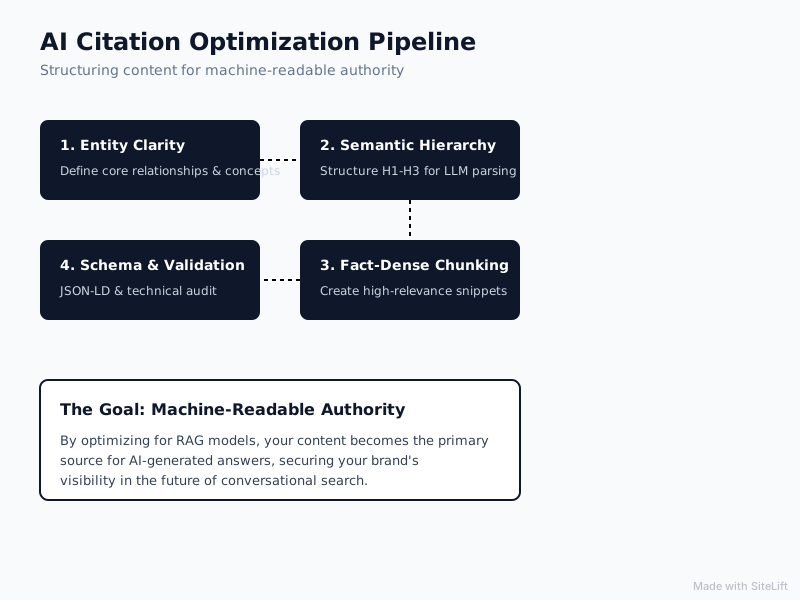
Infographic by SiteLift
- Action: Convert descriptive product or service comparisons into clean HTML tables, and write all workflows as numbered steps.
- Expected Result: Answer engines will extract your tables and lists directly into their synthesized comparative summaries.
- Mistake to Avoid: Never embed data inside an image or an unsearchable PDF file if you expect generative search models to quote it.
Step 4: Deploy FAQ Schema and Self-Contained Q&A Units
A properly architected FAQ section serves as a direct training and retrieval ground for conversational interfaces. This is where FAQ schema for AI citations provides an unmistakable signal to crawlers.
Designing Atomized Answer Units
Every Q&A pair must function as an atomized, standalone informational unit. A reader—or an LLM retrieval algorithm—should be able to understand the answer without reading the rest of the page.
- Do not use relative pronouns like "As mentioned above" or "This service".
- Re-state the primary entity explicitly: "Growth Kings provides technical search visibility audits..." rather than "We provide these audits...".
Implementing Valid FAQPage JSON-LD Markup
While semantic HTML tells the browser how to render text, JSON-LD structured data communicates directly with the search engine’s semantic index. Reference the documentation on Schema.org and Google Search Central to ensure your implementation strictly adheres to current structured data standards.
Here is a template for an atomized FAQ block:
<script type="application/ld+json">
{
  "@context": "https://schema.org",
  "@type": "FAQPage",
  "mainEntity": [
    {
      "@type": "Question",
      "name": "How does content formatting affect AI citations?",
      "acceptedAnswer": {
        "@type": "Answer",
        "text": "Content formatting directly dictates how RAG systems parse and chunk documents. Using semantic H2 and H3 tags, self-contained BLUF answer blocks, and HTML tables allows vector search models to extract accurate text snippets without losing semantic context."
      }
    },
    {
      "@type": "Question",
      "name": "What is the best schema markup for AI answer retrieval?",
      "acceptedAnswer": {
        "@type": "Answer",
        "text": "The most effective schemas for AI retrieval are FAQPage, HowTo, and ItemList, combined with distinct Organization and About/Mentions entity definitions. This markup gives generative engines explicit machine-readable context."
      }
    }
  ]
}
</script>
- Action: Add 3 to 5 atomized Q&As with valid
FAQPageJSON-LD to every core informational page. - Expected Result: Generative engines identify pre-packaged answers mapped directly to high-probability conversational prompts.
- Mistake to Avoid: Do not include questions in your schema that are missing from the visible on-page copy; search engines flag this as deceptive structured data.
Step 5: Anchor Claims with Direct Citations and Machine-Readable Attribution
LLMs are built to minimize hallucination risk. When answering high-stakes commercial, financial, or technical queries, retrieval algorithms look for content backed by primary sources.
Explicit Source Attribution Syntax
A groundbreaking joint study by Princeton University, Georgia Tech, and the Allen Institute for AI (published on arXiv.org) evaluated Generative Engine Optimization (GEO). The researchers found that adding authoritative citations and technical domain terminology can increase visibility in generative engine responses by up to 40%.
Generative engines favor language that makes the attribution obvious:
- "According to data published by [Organization]..."
- "Standard specifications established by [Industry Body] require..."
- "As documented in the 2024 benchmark report by [Primary Source]..."
Linking Out to High-Trust Root Entities
Do not hoard outbound links. When you state a statistic or reference an industry standard, link directly to the primary research domain using descriptive anchor text.
Linking out to trusted nodes within your topical cluster signals to retrieval systems that your content belongs to an authoritative network of information. This is essential for building a quotable service content structure that answer engines trust enough to cite.
Why Technical Citation Syntax Is Underrated
Many marketing teams still worry that linking to external sources bleeds "PageRank" or pushes visitors off their site. That perspective is stuck in 2012.
Generative models rely on cross-referencing and verification pipelines. When you cite recognized authorities, you give the LLM an easy way to verify your facts against its broader training data. In our experience, pages with clean, verifiable citations consistently earn more mentions in Perplexity and ChatGPT than pages that claim authority without naming sources.
Pro Tip: Always anchor outbound links to the specific entity name (e.g., "[National Institute of Standards and Technology]") rather than generic phrases like "[source study]" or "[click here]". This helps the LLM establish the entity relationship during parsing.
- Action: Audit all unsupported assertions across your article and append explicit attributions pointing to primary sources.
- Expected Result: Retrieval engines assign a higher confidence score to your text chunks during RAG verification.
- Mistake to Avoid: Avoid citing secondary aggregator blogs; always trace statistics back to the root research organization.
Troubleshooting Common Pitfalls: Why Generative Search Skips Your Content
If you have made these updates but AI engines are still skipping your site, your pages likely suffer from one of these structural bottlenecks:
1. Conversational Fluff and Narrative Drag
Generative models calculate an "information gain" score for document chunks. If a chunk contains 200 words but only delivers 20 words of factual substance, the model discards it in favor of denser sources. Strip away lengthy personal anecdotes, rhetorical flourishes, and generic introductions.
2. Conflicting Claims Across Different Pages
If your "Pricing" page lists your baseline service at $5,000, but an older blog post from three years ago lists it at $3,500, generative search engines face an entity-state conflict. When faced with contradictions on the same domain, LLMs often drop the citation altogether rather than risk outputting inaccurate data. Regularly audit your legacy content to align key facts.
3. Syntax Errors in Microdata
A missing bracket or unescaped quotation mark in your JSON-LD script renders your schema unreadable to machine parsers. Run every updated page through Google’s Rich Results Test and Schema.org’s Validator to confirm your structured data parses cleanly.
For practical answers to common stumbling blocks, review our breakdown of AI search visibility FAQs.
The Expected Outcome: How to Track Citations Across Search Assistants
Once you implement this structure, your search footprint will begin to shift from standard blue-link queries to synthesized AI citations. To understand the broader impact on your commercial pipeline, review our guide on how to improve website visibility and convert inbound traffic.
Monitoring Referral Footprints from Perplexity, ChatGPT, and Copilot
Keep a close eye on your analytics platform for referral traffic from generative engines:
perplexity.aiandroid-app://com.openai.chatorchatgpt.comcopilot.microsoft.com
Users who click citations in generative engines have already consumed an AI-synthesized answer. They land on your page looking for deeper verification or execution, making them exceptionally qualified commercial leads.
Benchmarking Inclusion in Google AI Overviews
Track your core commercial queries inside ranking tools that monitor SERP features. Note whether your domain is cited in the carousel above the fold, within the text footnotes, or absent entirely. When your headings, inverted-pyramid paragraphs, and FAQ schema align, you will see your domain surface as a cited source even for competitive head terms.
If restructuring your site architecture for this new search paradigm feels overwhelming, you do not need to tear down your website and rebuild it from scratch. At growth-kings.com, we specialize in pragmatic, high-impact refinements. We audit your existing service content, establish technical entity clarity, and build the machine-readable architectures needed to turn search visibility into qualified inbound enquiries.
— growth-kings.com
FAQ
What is content structuring for AI citations?
Content structuring for AI citations is the practice of formatting web pages using semantic HTML headings, inverted-pyramid answer blocks, clean data tables, and JSON-LD schema so Retrieval-Augmented Generation (RAG) models can parse, verify, and quote the content accurately in generative answers.
How do generative search engines decide which sources to cite?
Generative search engines select citations based on semantic relevance, information density, and entity authority. They match user queries against document chunks using vector embeddings, verify the factual claims against trusted knowledge graphs, and pull snippets from pages that answer the query directly and concisely.
Does using FAQ schema guarantee inclusion in AI Overviews or Perplexity answers?
No markup guarantees inclusion. However, valid FAQPage schema ensures that machine parsers ingest your questions and definitive answers without ambiguity. It removes the guesswork for the crawler, giving your content a distinct advantage over unformatted competitor pages.
What is the ideal word count for an answer block to get quoted by LLMs?
The ideal word count for an answer block is between 40 and 60 words. This length gives an LLM enough context to extract a complete, accurate fact while remaining concise enough to fit directly into a synthesized answer snippet.
How does writing for AI citations differ from traditional SEO copywriting?
Traditional SEO copywriting often relies on keyword repetition, long narrative intros, and formatting designed to maximize time on page. Writing for AI citations prioritizes information density, active Subject-Predicate-Object sentences, structured data tables, and immediate answers placed directly beneath descriptive headings.
Want this working on your own site?
Tell us what’s working, what’s stuck and what you want to improve. We will reply personally.