How to Get Cited in AI Answers: A Practical Playbook for Service Businesses
Learn how to get cited in AI answers across ChatGPT, Perplexity, and Google AI Overviews with this practical, actionable playbook for service businesses.
By Growth Kings. Published , updated . 18 min read.

How to Get Cited in AI Answers: A Practical Playbook for Service Businesses
Potential clients used to scroll through ten blue links, browse three agency websites, and submit an enquiry form. Today, high-intent buyers are opening ChatGPT, Perplexity, or Google and asking: "Who are the most reliable commercial HVAC maintenance firms in Bristol?" or "Which boutique marketing agency has the best track record for B2B tech onboarding?"
If your company is absent from those generated summaries, you do not exist to that prospective client.
Learning how to get cited in ai answers is not about chasing algorithmic tricks or stuffing articles with hidden text. It is about restructuring your business’s digital footprint so large language models (LLMs) treat your company as a verified, unassailable entity.
Research from Gartner projects that traditional search engine volume will drop 25% by 2026 as consumers and corporate decision-makers migrate toward AI chatbots and conversational interfaces. Meanwhile, a study by the Pew Research Center found that a rapidly growing share of internet users turn to generative AI tools for research, daily decisions, and service recommendations.
If you run a service business, waiting to see what happens is a dangerous operational choice. This practical, step-by-step playbook explains how Generative Engine Optimization (GEO) works and how to establish the digital authority required to secure consistent citations across ChatGPT, Perplexity, and Google AI Overviews.
Prerequisites: What Service Businesses Need Before Optimising for AI Citations
Before you touch your site copy or deploy code, you need to establish whether your business has the baseline authority required for machine citation. Unlike classic SEO, where an aggressive backlink campaign could temporarily push a mediocre site to page one, LLMs rely on corroborated facts and consensus.
AI Entity Trust Framework
┌────────────────────────────────────────────────────────┐
│  Web-Wide Consensus (Directories, Press, Reddit)       │
├────────────────────────────────────────────────────────┤
│  Machine-Readable Infrastructure (JSON-LD, sameAs)     │
├────────────────────────────────────────────────────────┤
│  Direct Information Gain (Original Data, Crisp Q&A)    │
└────────────────────────────────────────────────────────┘
Auditing Your Current Digital Entity & Brand Authority
LLMs do not read web pages like humans; they parse tokens and map concepts within multidimensional vector spaces. When an engine like Perplexity or ChatGPT evaluates your company, it asks three foundational questions:
- Is this entity clearly identified as an operating service business?
- Do independent, reputable third parties confirm what this entity claims to do?
- Is there cross-web consensus regarding the entity's location, leadership, and expertise?
To audit this, run a simple query across Perplexity and ChatGPT:
"What does [Your Business Name] do, who operates it, and what are their primary service specialisations?"
If the AI hallucinates, mixes you up with a company in another country, or returns a blank refusal, your brand lacks entity resolution. You cannot skip straight to citation tactics if the underlying machine does not recognize you exist. For an in-depth breakdown of how machines organize these concepts, review our guide to entity optimization for AI search visibility.
Essential Assets: Clean NAP Data, Structured Profiles, and Niche Authority
Make sure you have these operational assets verified before moving forward:
- Uniform NAP (Name, Address, Phone): Discrepancies between your site footer, your Google Business Profile, and Companies House/registry listings will fracture your entity confidence score.
- Direct Proof of Leadership: Clear author bios, executive summaries, and direct links to active LinkedIn profiles. LLMs lean heavily on verified persons to evaluate organizational competence.
- Specialised Content Architecture: A site architecture that groups related topics together rather than scattered, shallow 500-word blog posts that mimic competitor content.
Step 1: Ground Your Entity Across Web-Wide Knowledge Repositories
Answer engines retrieve data via Retrieval-Augmented Generation (RAG). Before an AI generates an answer, it pulls real-time information from a retrieval index. To earn citations, your brand must be established in the core sources those retrievers crawl.
Optimizing for Perplexity Brand Mentions and Wikipedia/Wikidata Context
Perplexity is particularly aggressive about pulling from open-web knowledge bases and encyclopedic databases. While earning a Wikipedia page is notoriously difficult for mid-market service firms (and attempting to manipulate Wikipedia will get your domain blacklisted), Wikidata is accessible and structured.
- Create or Claim Your Wikidata Entry: Navigate to Wikidata and set up a structured item for your business. Include properties like
instance of(Business or Enterprise),official website,inception,headquarters location, andfounder. - Anchor Your Social Proof: Ensure your Wikidata entry references authoritative sources, such as public corporate registries, major news coverage, or established industry trade boards.
- Seed Contextual Cohorts: If you operate in legal accounting, commercial architecture, or specialized consulting, ensure your brand is cited alongside known regional players in trade papers. LLMs build association vectors; when your brand repeatedly co-occurs with recognized leaders in your niche, the model treats you as a peer entity.
Leveraging High-Authority Industry Directories and Review Platforms
Generic directory submissions provide little value in traditional SEO today, but for LLM entity grounding, verified platforms are foundational.
Focus on platforms that search bots crawl continuously for consensus:
- B2B Service Platforms: Clutch, GoodFirms, G2, Trustpilot, and the Better Business Bureau.
- Professional Bodies: Industry-specific registers (e.g., RIBA for UK architects, Bar associations for legal services, ISO accreditation registries).
- Local Hubs: Google Business Profile, Apple Business Connect, and Bing Places.
Claim Profile -> Unify Service Naming -> Standardize Address -> Link Social URLs -> Acquire Verified Reviews
Common Mistake to Avoid: Listing your service titles inconsistently. If your website calls your primary service "Commercial Facility Maintenance," your Clutch profile calls it "Building Operations & Janitorial," and your LinkedIn page calls it "HVAC & Property Care," an LLM may fail to merge these into a single high-confidence capability profile.

Step 2: How to Get Cited in AI Answers Through Content Structuring
If your brand entity is grounded, the next step is reformatting your on-site content so retrieval models can lift, parse, and cite it without computational friction.
Data published by BrightEdge indicates that Google AI Overviews appear on a substantial portion of complex, multi-intent search queries. This fundamentally shifts organic click share away from basic listings and toward synthesis boxes. To claim space inside those summaries, your on-page text must be designed for extraction.
Formatting for Google AI Overviews Citation Strategy
Google's AI Overviews favor text that delivers high information gain—content that provides clear, direct answers accompanied by unique perspectives, proprietary data, or concrete technical details that generic scrapers lack.
To build an effective AI Overviews citation strategy, adopt the Inverted Pyramid for Answer Engines:
- Target Header: State the exact service, problem, or decision criteria in a descriptive H2 or H3 (e.g.,
### How Much Does Commercial Solar Installation Cost for Warehouses?). - The Direct Answer Capsule (40–60 words): The very first sentence beneath the header must answer the question plainly, without throat-clearing fluff. Use complete grammatical sentences with subject-verb-object clarity.
- The Data or Methodology Proof: Follow the direct answer with a structured table, bulleted criteria, or empirical benchmarks that explain why that answer is accurate.
- Context and Nuance: Expand on edge cases, regional variations, or operational hurdles.
Implementing the Question-Answer-Proof Model
When search bots scrape pages to answer multi-hop conversational queries, they search for high-density information nodes.
Here is how different search engines extract content based on formatting:
| Content Element | Traditional Google Organic | Perplexity.ai | Google AI Overviews | ChatGPT Search |
|---|---|---|---|---|
| Direct Answer Paragraph | Helps win Featured Snippets | Primary retrieval target for synthesis | Core snippet source in synthesis boxes | Informs direct response generation |
| Structured Comparison Tables | Ranked for secondary keywords | Scraped directly into tabular answers | Prioritised for commercial queries | Converted into bulleted summaries |
| Original Case Study Data | Passive backlink generator | Linked directly as reference source | Yields high information-gain score | Cited as consensus proof point |
| Author / Expert Credentials | Evaluated via general E-E-A-T | Ignored unless mentioned on web | Verified against Knowledge Graph | Used to confirm source authority |
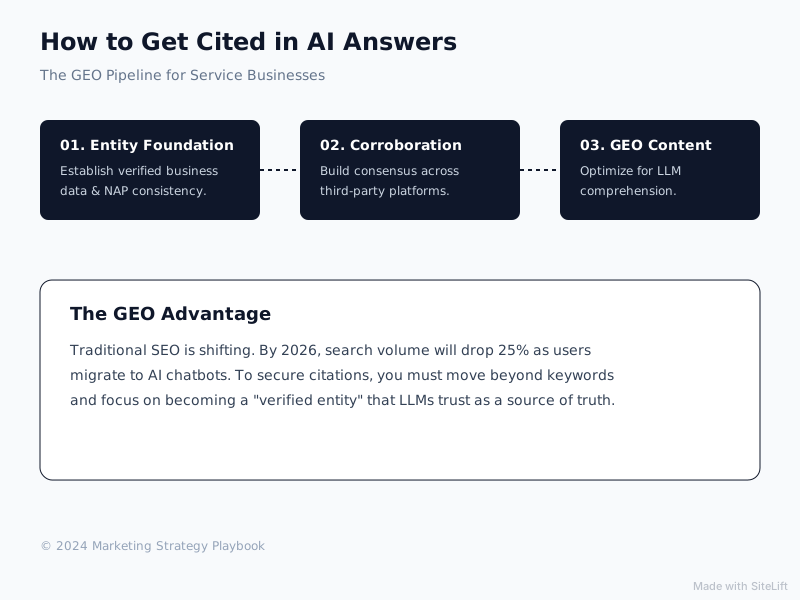
Infographic by SiteLift
Pro Tip: Never start an informational section with "It depends," "When considering this question," or "In order to understand..." State the definitive benchmark first (e.g., "Commercial solar installations for mid-sized warehouses typically range between £45,000 and £120,000, depending on roof structural integrity and peak kWh load"). Then explain the variables.
Step 3: Secure Strategic Third-Party Citations and Digital PR
Your own website is inherently biased. Large language models are trained to cross-reference multiple independent nodes across the web before presenting an entity as a trustworthy recommendation.
If you want to improve website visibility and dominate generative engine results, you must look outside your own domain.
Getting Featured in Consensus Sources (Reddit, Quora, and Niche Forums)
One of the most radical developments in search behaviour over the past two years is the massive weight engines like Google and Perplexity place on forum discussions. When a user asks an AI for an authentic recommendation, the system frequently accesses Reddit threads to determine actual consumer sentiment.
Identify Active Niche Subreddits
  └─ Find Unbiased Service Inquiries
       └─ Provide Comprehensive, Non-Promotional Technical Answers
            └─ Establish Brand Authority in Scraped Discussion Threads
To leverage this safely:
- Monitor Relevant Communities: Track subreddits and professional forums where business owners and operational managers ask for software or service recommendations.
- Deliver Value First: Never use spam accounts to drop naked links to your homepage. Provide thorough, technical breakdowns of how problems are solved. Mention your agency or service firm only as context where directly relevant.
- Seed Real Case Histories: Transparent explanations of past projects (what went wrong, what it cost, how it was resolved) are indexed by retrieval models as reliable user consensus.
Earned Media Tactics That Teach LLMs About Your Expertise
Why digital PR is underrated for AI search: LLMs do not simply count the PageRank passing through an editorial hyperlink. They ingest the unlinked brand mentions, the contextual adjectives surrounding your company name, and the co-occurrence of your brand with your specific industry vertical.
Instead of writing standard press releases about new hires or office moves, pitch original industry data to niche trade publications:
- Conduct a survey of 100 operations managers within your target sector.
- Publish an anonymised pricing or performance index based on your client portfolio.
- Pitch the findings to respected trade journals with unique data tables.
When an industry trade site publishes, "According to a study by [Your Firm], 64% of engineering firms struggle with regulatory tracking," an LLM updates its internal weights. It now understands your firm as a verified authority on engineering compliance.
Step 4: Implement Advanced Schema Markup to Help AI Bots Parse Meaning
Semantic search engines rely on structured code to bridge the gap between human language and relational databases. The official documentation provided by Google Search Central makes it clear that structured data helps search engines understand the explicit intent and entities present on a page.
If you leave your site's structure to machine interpretation alone, you risk misclassification.
                    ┌─────────────────────────┐
                    │   schema.org/LocalBusiness │
                    │   or Organization       │
                    └────────────┬────────────┘
                                 │
         ┌───────────────────────┴───────────────────────┐
         ▼                                               ▼
┌──────────────────┐                           ┌──────────────────┐
│  hasOfferCatalog │                           │     sameAs       │
│  (Service Schema)│                           │  (Wikidata/Clutch│
└──────────────────┘                           └──────────────────┘
Connecting Entities with Organization, Service, and Person Schema
By using vocabulary defined at Schema.org, you can connect your website directly to your recognized external profiles using the sameAs array.
Below is an example of an Organization JSON-LD payload tailored to help AI crawlers disambiguate a professional service business:
{
  "@context": "https://schema.org",
  "@type": "ProfessionalService",
  "name": "Apex Structural Engineering",
  "url": "https://www.apex-structural-example.com",
  "logo": "https://www.apex-structural-example.com/assets/logo.png",
  "description": "Specialised structural and civil engineering consultancy for commercial adaptive reuse projects.",
  "address": {
    "@type": "PostalAddress",
    "streetAddress": "45 St Mary Axe",
    "addressLocality": "London",
    "postalCode": "EC3A 8AA",
    "addressCountry": "GB"
  },
  "sameAs": [
    "https://www.wikidata.org/wiki/Q00000000",
    "https://www.linkedin.com/company/apex-structural",
    "https://clutch.co/profile/apex-structural",
    "https://find-and-update.company-information.service.gov.uk/company/00000000"
  ],
  "hasOfferCatalog": {
    "@type": "OfferCatalog",
    "name": "Core Engineering Capabilities",
    "itemListElement": [
      {
        "@type": "Offer",
        "itemOffered": {
          "@type": "Service",
          "name": "Commercial Building Structural Surveys",
          "description": "Comprehensive structural integrity audits and load calculations for historical renovation projects."
        }
      }
    ]
  }
}
Structuring FAQPage and AboutPage Code for Machine Readability
Your AboutPage and service-level FAQPage schema should leave zero ambiguity regarding who you are, what problems you solve, and what credentials your leadership holds.
- Use
Personschema for founders and practice leads, linking their author nodes to personal LinkedIn profiles, published books, patents, or industry speaking portfolios. - Ensure every entry in your
FAQPageschema contains a complete, self-contained answer that does not require the user (or bot) to click through to another page to understand the context. - Validate every script using Google’s Rich Results Test and the official Schema.org Validator before deploying to production.
Step 5: Audit, Monitor, and Refine Your AI Answer Visibility
Tracking classic keyword ranks tells you very little about your performance in answer engines. A keyword tracking tool might tell you that your site is sitting at position #4 on Google, while an AI Overview above that result is recommending three of your direct competitors and completely ignoring you.
Prompt-Testing Protocols Across ChatGPT, Perplexity, and Gemini
Establish a monthly testing matrix focused on buyer intent. Do not simply search for your own brand name; test queries that simulate a prospect conducting preliminary vendor due diligence:
- Category Recommendation Prompts: "What are the top three specialist consultancies for [Niche Service] in [Region]?"
- Comparison Prompts: "Compare [Your Business] with [Competitor Business] for enterprise integration."
- Problem-Solving Prompts: "What are the best methods to handle [Specific Technical Problem], and which firms specialize in this implementation?"
Document the outputs inside a simple spreadsheet tracking:
- Did the engine mention your firm?
- Was your domain cited as a clickable reference link?
- Was the sentiment positive, neutral, or outdated?
- Which competitor URLs were cited instead?
Tracking Referral Traffic and Conversion Rates from AI Engines
AI search traffic behaves differently than traditional organic search traffic. When a user clicks a citation inside Perplexity, ChatGPT Search, or an AI Overview, they have typically already read a synthetic summary of your service capabilities. They are pre-qualified and sit much closer to a buying decision.
Set up custom segments inside your analytics platform (such as Google Analytics 4) to monitor referral traffic from:
chatgpt.com/android-app://com.openai.chatperplexity.aigemini.google.comcopilot.microsoft.com
Look closely at engagement time and conversion paths. Visitors arriving through AI citations should show significantly higher average session duration and conversion intent than standard programmatic display or broad social traffic.
Troubleshooting: How to Get Cited in AI Answers When Your Business Is Overlooked
If you have implemented structural changes and updated your profiles, but answer engines continue to cite competitors while ignoring your business, you are likely hitting one of three operational roadblocks.
Diagnosing Low Topical Authority and Information Duplication
The single biggest obstacle for service businesses is what I call the echo chamber penalty.
If your website consists of 20 blog posts explaining generic concepts—such as "Why Your Business Needs Digital Marketing" or "5 Benefits of Hiring a Commercial Architect"—LLMs will skip your domain entirely. Why would a model cite your page when that exact text exists on 10,000 other sites with higher domain authority?
The Fix: Transition to an information-gain editorial model. Stop writing generic definitions. Publish:
- Transparent pricing guides with real cost brackets.
- Breakdown teardowns of difficult projects, including mistakes and material costs.
- Original workflow diagrams and proprietary methodologies.
Fixing Brand Disambiguation and Inconsistent Online Footprints
If an AI model has conflicting information about your business, it will omit you out of safety. Language models are tuned to avoid hallucinations; when data points collide, confidence scores plummet.
The Fix:
- Search for old office addresses, abandoned phone numbers, and outdated trading names across historical directories.
- Update your corporate filings, BBB profiles, and local chamber of commerce pages so that details match your primary domain down to the punctuation mark.
- If your company shares a name with a business in another industry or region, deliberately add explicit geo-qualifiers and sector descriptions across your primary title tags and home page copy.
Technical Bot Access Issues
Ensure your server is not blocking the automated web crawlers that power modern generative engines. Inspect your robots.txt file and server access logs.
Make sure you are not accidentally restricting user-agents such as:
GPTBot(OpenAI training and indexing)OAI-SearchBot(OpenAI real-time search engine)PerplexityBot(Perplexity search and real-time retrieval)Google-Extended(Google Gemini training; keep in mind that blocking this may affect experimental visibility)
Ensure your hosting infrastructure responds with clean 200 HTTP status codes to these crawlers without serving aggressive Cloudflare captchas or rate-limiting challenges that prevent their headless scrapers from parsing your HTML.
Expected Outcomes: Converting AI Citations into Qualified Service Enquiries
Ranking in an AI answer is a marketing metric; turning that citation into a booked client consultation is a business outcome. Because visitors referred by answer engines arrive with high context, their on-page expectations are distinct.
AI Citation Click ──► High-Clarity Landing Page ──► Instant Conversational Capture ──► Booked Discovery Call
Optimizing Landing Pages for AI-Driven Visitors
When an executive clicks a link inside a ChatGPT answer to explore your service, they do not want to be greeted by an aggressive pop-up modal, a slow-loading corporate hero video, or three paragraphs of self-congratulatory mission statements.
They expect clarity and confirmation:
- Immediate Headline Alignment: Ensure the top section of the destination page explicitly confirms the specific service or expertise cited by the AI.
- Visible Proof Markers: Display client case studies, accreditation badges, and clear team credentials immediately above the fold.
- Transparent Commercial Scope: State plainly who your services are for, who they are not for, and how your project engagements work.
Deploying Conversational Assistants to Capture Warm AI Referrals
At growth-kings.com, we focus on helping established service businesses turn website visits into qualified enquiries. Getting cited in answer engines creates high-intent inbound opportunities, but driving that traffic to a static, unmonitored contact form often leads to wasted opportunities.
Decision-makers who use generative AI tools to find service partners are already accustomed to conversational interfaces. If an operations director visits your site at 8:30 PM after reading a citation on Perplexity, they are unlikely to fill out a slow contact form and wait 48 hours for a callback.
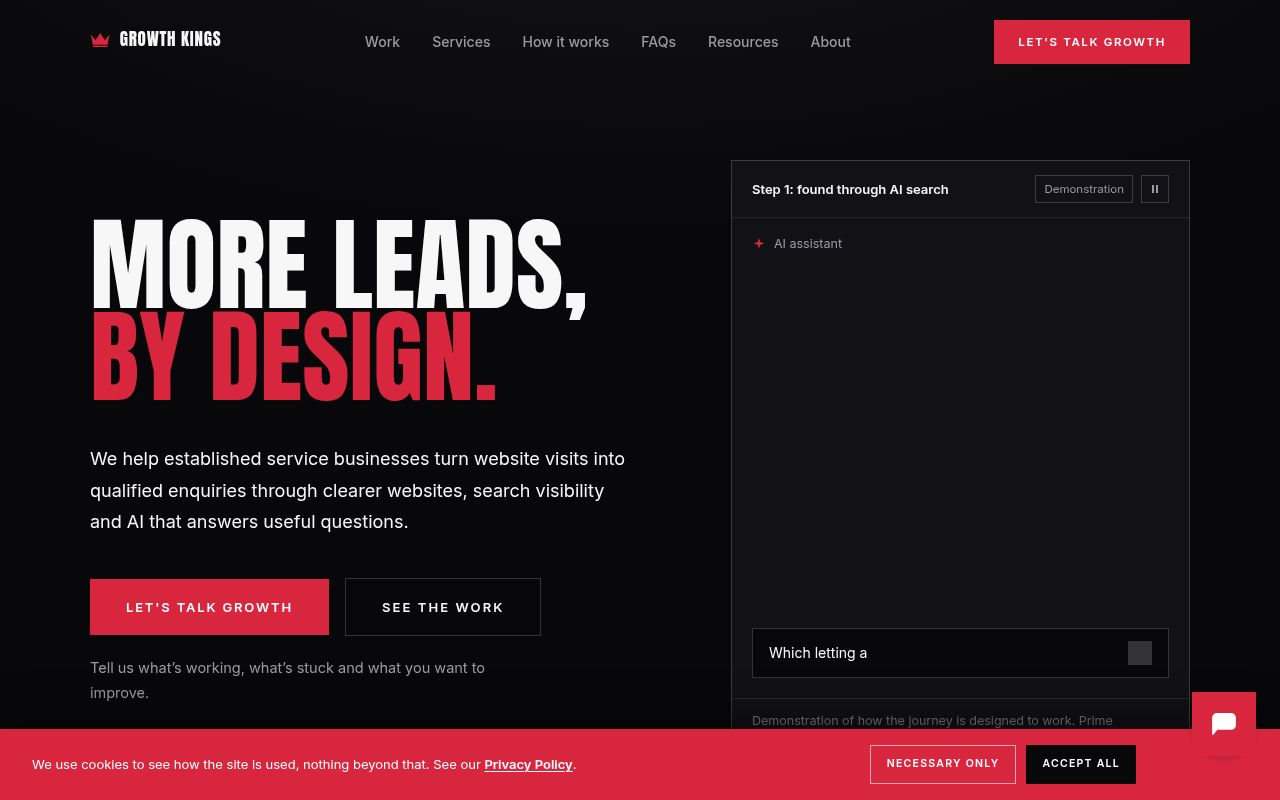
By implementing intelligent conversational assistants that can answer nuanced technical questions, verify operational fit, and book discovery calls directly onto your team's calendar after hours, you complete the journey from AI search visibility to closed revenue.
You do not need to blow up your existing website or spend tens of thousands of pounds on an unnecessary enterprise rebuild to take advantage of this shift. Making structural improvements to entity clarity, structuring answers for machine retrieval, and capturing traffic with responsive digital infrastructure will ensure your business wins modern search recommendations.
— growth-kings.com
FAQ
How do AI search engines like ChatGPT and Perplexity choose which sources to cite?
AI search engines rely on a combination of entity grounding, semantic relevance, and independent consensus. When a user submits a query, the system retrieves top-ranking web documents from search indexes, evaluates those documents for high information gain (unique, factual, and direct answers), and cross-references the findings against recognized industry sources. Platforms prioritize domains that feature clear, machine-readable structured data, verifiable author credentials, and consistent mentions across reputable third-party platforms like directories, industry publications, and community forums.
Can you pay search engines to be cited in Google AI Overviews or ChatGPT answers?
No. Currently, you cannot buy direct organic citations inside Google AI Overviews, Perplexity answers, or ChatGPT Search responses. While Google and other search platforms test conventional sponsored ads adjacent to or below generative summaries, the synthesis citations themselves are algorithmically selected based on retrieval relevance, data accuracy, and entity trust. Any platform claiming to offer guaranteed paid placement directly inside generative answers is misleading you.
How long does it take for a service business to start appearing in AI answers?
For real-time retrieval engines like Perplexity.ai and ChatGPT Search, changes can reflect relatively quickly. If you publish high-gain content, secure a prominent third-party review, or fix technical crawler access issues, citations can appear within three to six weeks as retrieval indexes refresh. However, influencing the underlying model weights and building broad cross-web consensus for Google AI Overviews typically takes three to six months of steady digital PR, structured data deployment, and authoritative content development.
Does getting cited in AI answers require changing your existing SEO strategy?
It does not require abandoning classic SEO fundamentals, but it does require expanding your approach beyond traditional keyword targets. Technical site health, fast loading speeds, logical site architecture, and authoritative backlink profiles remain essential because AI retrievers rely on standard search indexes to pull sources. However, your content creation strategy must evolve: you must move away from generic, long-form filler written solely for keyword frequency and focus on high-density direct answers, unique business data, entity disambiguation, and cross-web brand validation.
How can you track website visits that originate from AI search citations?
You can track AI referral traffic by monitoring specific referral sources inside your web analytics platform. Filter your referral traffic for domains such as chatgpt.com, perplexity.ai, copilot.microsoft.com, and gemini.google.com. In addition, create dedicated campaign links or track direct traffic increases to pages that answer engines frequently cite. Because AI visitors often copy-paste URLs or use specific citation links containing clean query parameters, tracking these unique entry patterns helps you isolate conversions driven by answer engines.
Want this working on your own site?
Tell us what’s working, what’s stuck and what you want to improve. We will reply personally.