Conversion Rate Calculator for Your Website: Measure Leaks and Forecast More Enquiries
Learn how to use a conversion rate calculator for your website to spot traffic leaks, calculate enquiry metrics, and accurately forecast service business growth.
By Growth Kings. Published , updated . 13 min read.

Conversion Rate Calculator for Your Website: Measure Leaks and Forecast More Enquiries
Most online calculators are built for e-commerce stores tracking shopping carts and checkout funnels. If you run a professional service business, consulting firm, or B2B company, those tools completely miss the mark. You do not care about average order value or cart abandonment; you care about qualified phone calls, consultation bookings, and high-value form submissions. Using a generic conversion rate calculator website template designed for retail leaves you with misleading data and zero visibility into your actual sales pipeline.
When you measure your enquiry rates accurately, you stop guessing why website traffic fails to generate revenue. This guide walks you through the math, benchmarks, and diagnostic steps needed to plug traffic leaks and turn passive page visitors into commercial opportunities.
Key Takeaways
| Metric / Concept | What It Measures | Target for Service Sites | Primary Action |
|---|---|---|---|
| Enquiry Conversion Rate | Percentage of unique visitors who submit an enquiry | 2.5% – 5.0% | Audit high-drop-off pages |
| Micro vs. Macro Action | Engagement (scrolls, clicks) vs. intent (calls, forms) | Focus tracking on Macro | Tag commercial forms in GA4 |
| Form Friction Impact | Form completion drop-off due to excess fields | 3-field baseline | Remove non-essential fields |
| After-Hours Capture | Leads generated outside standard 9-to-5 hours | 30%+ of total leads | Deploy 24/7 interactive capture |
| Pipeline Uplift Multiplier | Revenue gain from conversion rate lift vs. ad spend | 2x pipeline from same traffic | Fix messaging before buying ads |
What Is a Website Conversion Rate Calculator and Why Does It Matter?
At its simplest, a conversion rate tool determines the efficiency of your website by comparing the volume of people who land on your pages against those who take a meaningful action. In a lead generation context, that action is a qualified commercial enquiry.
Understanding Conversion Rates in a Lead Generation Context
Service businesses do not process transactions online. A conversion occurs when a prospective client raises their hand to request information, book a discovery call, or ask for a proposal. Tracking these touchpoints requires looking beyond raw traffic numbers.
If your website pulls in 10,000 visitors a month but yields only five contact form submissions, your website is essentially a digital brochure with a leaky floor. A dedicated calculation gives you an objective baseline to evaluate whether your messaging, layout, and trust factors are doing their jobs.
Micro-Conversions vs. Macro-Enquiries
One common trap is blurring the line between vanity engagement and actual business leads:
- Micro-Conversions: Downloading an un-gated whitepaper, viewing a case study, clicking an FAQ accordion, or watching a video.
- Macro-Enquiries: Submitting a detailed project brief, booking a meeting via a calendar embed, calling the main office line, or completing a "request a quote" form.
Micro-conversions indicate interest, but macro-enquiries keep your business running. If your reporting treats a PDF download the same as an inbound meeting request, your metrics look artificially healthy while your calendar stays empty.
The Real Cost of Untracked Traffic Leaks
Every visitor who bounces from your site represents money left on the table—particularly if you paid for that visit through Google Ads or social campaigns. When you do not calculate your conversion baseline, you cannot tell if a dip in monthly revenue stems from poor traffic quality or friction on your landing pages. Measuring leaks lets you identify precisely where prospects decide that reaching out is simply too difficult.
How Do You Calculate Your Website Enquiry Conversion Rate with a Conversion Rate Calculator Website Formula?
The mathematics behind conversion tracking are straightforward, but the inputs must be clean to get actionable insights.
The Standard Website Conversion Rate Formula
To find your baseline, use the following website conversion rate formula:
$$\text{Conversion Rate (%)} = \left( \frac{\text{Total Qualified Enquiries}}{\text{Total Unique Visitors}} \right) \times 100$$
For example, if your service firm receives 4,000 unique visitors in a month and generates 80 qualified enquiries, your calculation looks like this:
$$(80 / 4,000) \times 100 = 2.0%$$

Step-by-Step Calculation for Service Businesses
To implement this manually or build it into a tracking sheet, follow these steps:
- Define the Timeframe: Choose a representative window, typically 30 or 90 days, to smooth out weekly traffic fluctuations.
- Pull Unique Users (Not Total Sessions): A single prospect might visit your site three times before reaching out. Using total sessions deflates your true rate; measuring unique users reveals how many individual people decided to contact you.
- Count Only Commercial Actions: Exclude internal test submissions, spam entries, vendor pitches, and career applications.
- Run the Equation: Divide commercial leads by unique visitors and multiply by 100.
If you are wondering how this fits into your broader growth roadmap, understanding the foundational conversion optimization definition helps clarify why this metric dictates customer acquisition costs.
Addressing Data Hygiene: Filtering Bot Traffic and Internal Visits
If your team visits your site daily or your analytics platform counts automated search bots, your visitor total will be artificially inflated. To keep your baseline accurate:
- Exclude internal IP addresses in your analytics configuration.
- Filter out known bot traffic via standard administrative settings.
- Verify that custom event tags fire only once per actual form submission rather than on every page refresh.
Proper lead conversion tracking inside Google Analytics 4 (GA4) requires setting up specific custom events for form completions and phone clicks rather than relying on generic page-view triggers.
Pro Tip: Never calculate your conversion rate using the default "Total Events" metric in GA4. Build a custom exploration that isolates first-time form submissions against unique users to eliminate skewed numbers caused by users double-clicking submit buttons.
What Are Average Service Website Conversion Benchmarks?
Before trying to optimize your site, you need to understand what realistic performance looks like in the service sector. Aiming for an arbitrary 10% rate is usually unrealistic and leads to misguided tactics that attract low-quality leads.
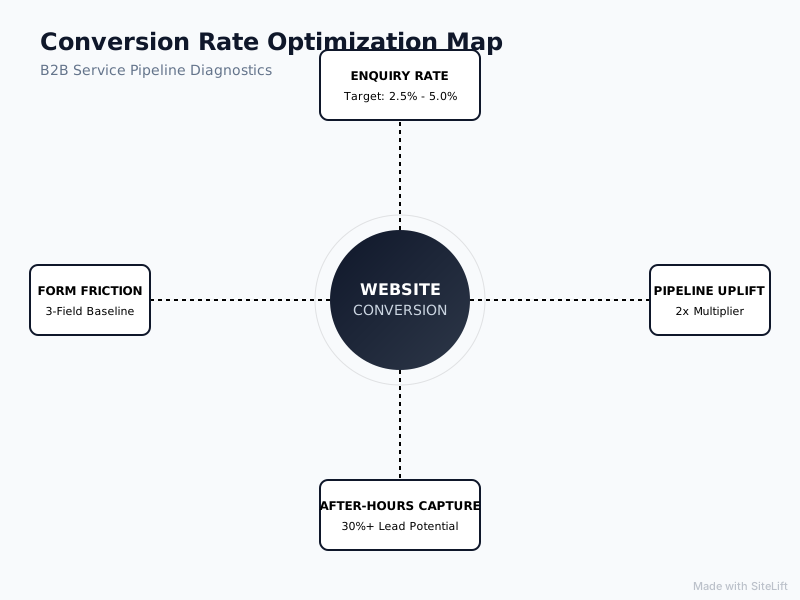
Infographic by SiteLift
B2B and Professional Services Benchmarks
According to research from Ruler Analytics, the average conversion rate across professional services sits around 2.9% to 4.6%, varying by sub-vertical. Highly technical or high-ticket corporate services often operate on the lower end of that range because buying cycles are longer and require committee approval. Specialized consultants and commercial agencies frequently hit between 3% and 5% on well-targeted organic landing pages.
Local and Home Services Benchmarks
Local trades, emergency repair specialists, and consumer services often see higher average rates, sometimes reaching 5% to 8%. The reason is immediate intent: a homeowner dealing with a broken pipe or an individual needing an urgent legal consultation is looking for a solution right away, leading to fast telephone enquiries.
Why Conversion Rates Fluctuate Across Traffic Channels
Traffic intent changes drastically based on where your visitors come from:
- Paid Search (Google Ads): High commercial intent. Visitors are actively looking for a provider, which should yield above-average conversion rates if your landing page aligns with the search query.
- Organic Search (SEO): Varies widely. Informational blog readers may convert at 0.5%, whereas visitors landing on dedicated service pages often convert at 3% to 6%.
- Organic Social / Cold Traffic: Low immediate intent. These visitors are browsing passively, meaning conversion rates to direct enquiry often sit below 1.5%.
Moving an overall site baseline from 1.5% to 3.0% does not sound dramatic on paper, but it doubles your inbound lead volume without spending an extra dollar on traffic generation.
Why Optimizing for Enquiries Beats Buying More Traffic: Our Editorial Take
The digital marketing industry has spent years convincing service business owners that every revenue problem is a traffic problem. Agencies pitch expensive SEO retainers and paid media budgets to send hundreds of new clicks to pages that are structurally ill-equipped to convert the visitors they already have.
It is an expensive, backward strategy.
When you double your traffic at a 1% conversion rate, you double your customer acquisition costs alongside your visitor count. But when you lift your conversion rate from 1% to 2% on your existing traffic, your cost per acquisition drops by half, and your profit margins expand instantly.
Most established service sites do not need a complete, expensive digital rebuild to see this lift. They simply need to eliminate clarity deficits in their messaging, remove unnecessary friction from their contact forms, and provide direct answers to the questions buyers ask before booking a call. Focusing on traffic volume before fixing conversion leaks is like pouring water into a bucket full of holes—buying a bigger hose does not solve the problem.
Prioritizing visitor volume over visitor conversion is the most expensive mistake a service firm can make. Fix the friction on your pages first; scale your traffic second. — growth-kings.com
Where Are Your Conversion Leaks Hiding?
If your calculation reveals that your conversion rate sits below industry benchmarks, visitors are dropping off at specific friction points across your user journey. Running a structured conversion rate optimization audit will reveal exactly where these breakdowns happen.
Friction in Forms and Contact Methods
The easiest way to lose an enquiry is to ask for too much information too early. Long contact forms make users feel like they are doing administrative work.
Research from Unbounce's Conversion Benchmark Report reveals that reducing form fields from four to three can increase conversions by nearly 50% across B2B service landing pages.
Common contact form leaks include:
- Demanding phone numbers when an email address would suffice for the initial contact.
- Asking for precise budgets before explaining scope options.
- Using multi-step forms with slow page transitions or unclear progression bars.
- Failing to optimize form fields for mobile keyboards (such as displaying text inputs instead of number pads for phone fields).
The Missing Trust Signals and Clarity Deficit
Visitors leave service websites when they cannot quickly determine what you do, who you do it for, and why they should trust you over a competitor.
Clear trust signals include:
- Verifiable Social Proof: Client logos, video testimonials, and concise case studies showing tangible outcomes.
- Explicit Scope: Clear explanations of what happens after someone reaches out, eliminating the fear of high-pressure sales calls.
- Upfront Guidance: Direct discussion of service criteria, timelines, and general price ranges.
The After-Hours Drop-Off: Uncaptured Evening and Weekend Inquiries
A significant portion of your potential clients research service providers outside standard business hours—in the evening after their own workday finishes, or over the weekend.
If your only conversion mechanism is a static contact form that promises a reply "within 24 to 48 business hours," modern buyers will click back to search results to find a competitor who answers immediately. Websites that implement responsive, automated entry points capture high-intent leads while their competition is offline.
Pro Tip: Review your analytics by hour of the day and day of the week. If you see healthy visitor traffic on weekends but zero enquiries, your site has an after-hours leak that a static form cannot solve.
How to Forecast Revenue and Enquiries from CRO Improvements
Once you understand how to use a conversion rate calculator website approach for diagnostic baselines, you can use those same formulas to project revenue growth.
The Compounding Value of Conversion Lift vs. Traffic Acquisition
Consider an established service firm with 5,000 monthly visits, an average deal value of $5,000, and a sales close rate of 25% on qualified enquiries.
| Metric | Baseline Performance | Traffic Growth Strategy (+50%) | Conversion Lift Strategy (+50%) |
|---|---|---|---|
| Monthly Unique Visitors | 5,000 | 7,500 | 5,000 |
| Enquiry Conversion Rate | 2.0% | 2.0% | 3.0% |
| Total Inbound Enquiries | 100 | 150 | 150 |
| Sales Closes (25% close rate) | 25 deals | 37.5 deals | 37.5 deals |
| Gross Monthly Pipeline Value | $125,000 | $187,500 | $187,500 |
| Added Traffic/Media Cost | $0 | High (Ad Spend/SEO) | $0 Ongoing |
Both approaches yield the same gross revenue increase, but the conversion lift strategy does not require ongoing advertising spend to maintain those gains.
Forecasting Pipeline Growth: A Step-by-Step Model
To forecast your potential returns, work backward through your sales funnel:
- Traffic (T): Your current monthly unique visitor baseline.
- Target Conversion Rate (CR): A realistic uplift (such as moving from 2% to 2.8%).
- Projected Inquiries (I): $T \times CR$
- Close Rate (SR): The percentage of inbound leads your team converts into clients.
- Average Client Lifetime Value (LTV): The net revenue generated by a closed deal.
The formula for projected monthly revenue is:
$$\text{Projected Pipeline Value} = (\text{Visitors} \times \text{New Conversion Rate}) \times \text{Close Rate} \times \text{Average Deal Value}$$
If you want a detailed look at how to run this optimization process from research to launch, check out our guide on the steps of conversion optimization.
Actionable Optimization Strategies to Lift Enquiries Without Rebuilding
You do not need to tear down your website to fix these issues. You can create immediate lift through targeted adjustments:
- Clarify Your Hero Section: Ensure your primary headline clearly explains what you solve within five seconds of landing.
- Elevate Calls to Action: Place simple, low-friction enquiry buttons above the fold, mid-page, and at the end of every case study.
- Adopt Conversational Capture: According to HubSpot's State of Marketing report, websites optimizing user experience and conversational entry points see an average lift of 10% to 20% in qualified inbound leads.
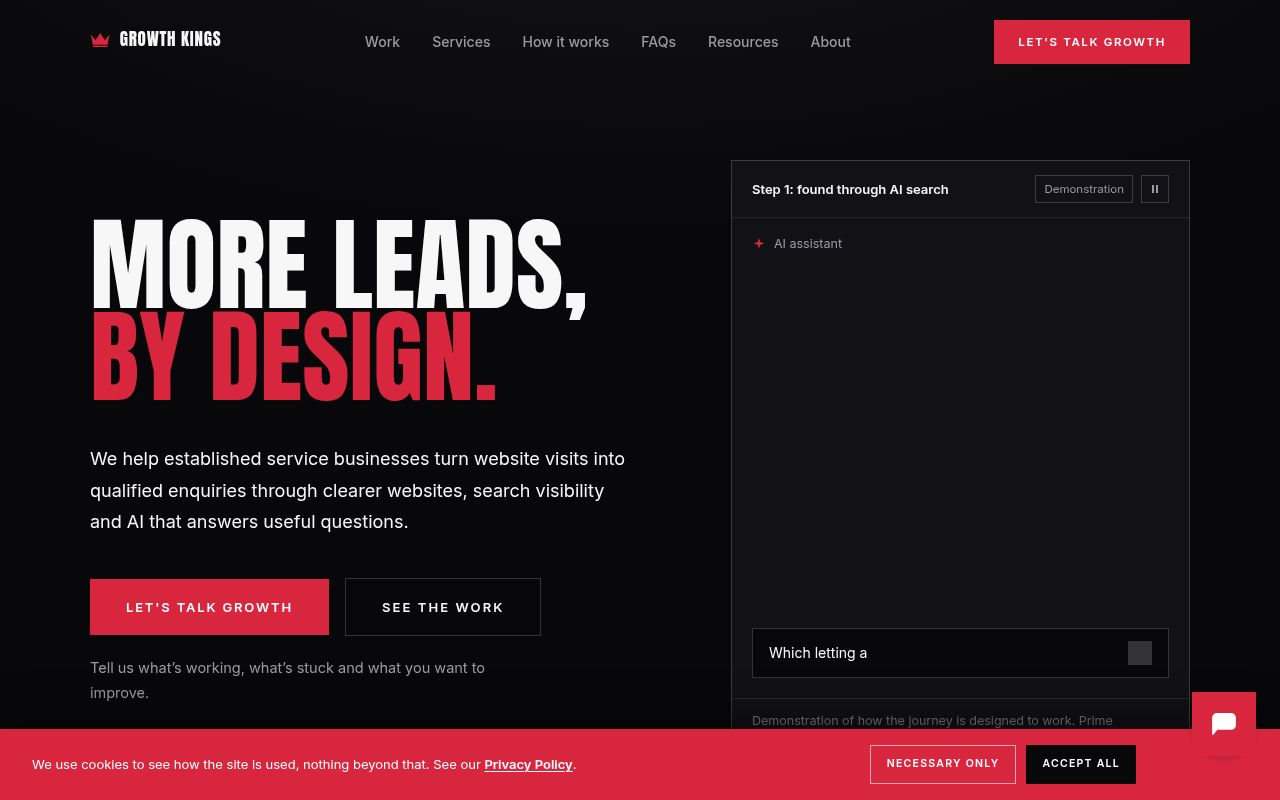
At Growth Kings, we focus on these practical, high-impact fixes rather than pushing unnecessary site redesigns. By addressing unclear copy, strategic CTA placements, and deploying AI-powered conversational assistants that capture and qualify leads 24/7, we help established service firms turn their current website traffic into a predictable stream of booked calls.
Frequently Asked Questions
What is the standard formula to calculate website conversion rate?
The standard website conversion rate formula is:(Total Conversions / Total Unique Visitors) * 100.
For a service business, conversions should only include qualified macro-enquiries like completed forms, direct calls, and scheduled consultations, rather than passive page views or clicks.
What is considered a good conversion rate for a service-based website?
For most professional service and B2B websites, a conversion rate between 2.5% and 5.0% is healthy. Specialized local services can often see rates reaching 5% to 8%, while complex, high-ticket enterprise services may average closer to 2% due to longer decision cycles and multi-stakeholder evaluations.
How does lead conversion tracking differ between e-commerce and B2B sites?
E-commerce conversion tracking measures direct, transactional events like "Add to Cart" and immediate credit card checkouts. B2B and service lead conversion tracking focuses on relationship-driven milestones, measuring form submissions, inbound phone inquiries, calendar bookings, and subsequent offline sales qualification steps.
Why should I improve my conversion rate before investing more in paid ads?
Improving your conversion rate lowers your effective Customer Acquisition Cost (CAC). If your website converts at 1%, you need 100 paid clicks to generate a single enquiry. Lifting your conversion rate to 2% means you need only 50 clicks for that same enquiry, instantly doubling the return on your advertising spend and preventing wasted marketing budget.
How do conversational assistants impact conversion rates for service businesses?
Conversational assistants eliminate friction by providing instant answers to buyer questions and pre-qualifying leads in real time. They prevent drop-off during evenings and weekends when offices are closed, capturing high-intent prospects who would otherwise abandon a static contact form to look for a competitor.
Want this working on your own site?
Tell us what’s working, what’s stuck and what you want to improve. We will reply personally.