Boutique SEO Company vs Growth Partner: What Service Firms Should Choose
Boutique SEO company or growth partner? Compare features, conversion impact, and pricing to pick the right search partner for your service firm.
By Growth Kings. Published , updated . 13 min read.

Boutique SEO Company vs Growth Partner: What Service Firms Should Choose
When an established service firm reaches an organic plateau, leadership invariably hits a fork in the road. You know your website should be generating high-value client enquiries, yet your current inbound pipeline feels unpredictable at best. As you look for external expertise to fix the problem, the debate usually narrows down to two models: hiring a specialized boutique seo company or partnering with an integrated digital growth partner.
On the surface, both promise better visibility on Google. Beneath that promise lies a fundamental difference in philosophy, execution, and commercial impact.
A boutique search agency focuses primarily on search engine mechanics—rankings, crawl health, and keyword footprints. A growth partner, by contrast, views search traffic as just one piece of an end-to-end commercial system that includes on-site positioning, trust architecture, and lead qualification.
Before committing a five-figure annual retainer, you need to know which model actually solves your firm's bottleneck.
Boutique SEO Company vs Growth Partner: At-a-Glance Comparison
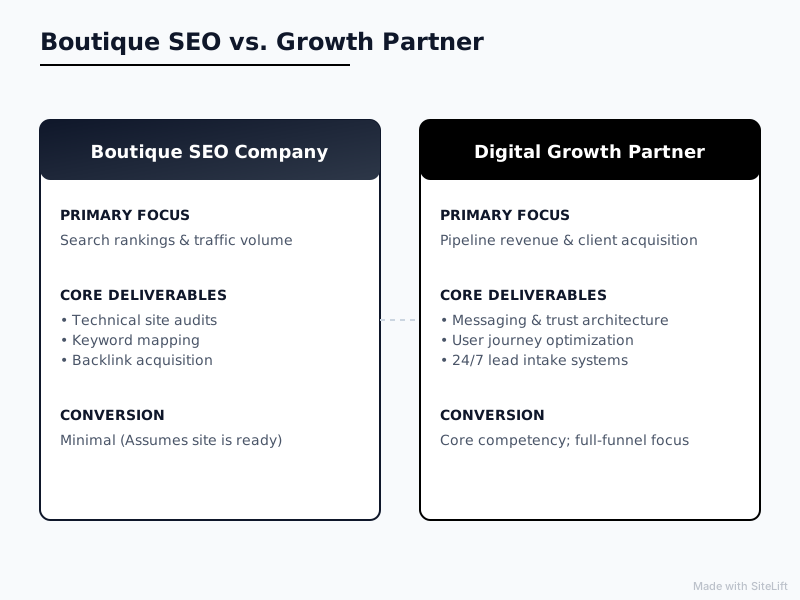
Infographic by SiteLift
The table below breaks down the foundational differences between a specialized boutique search agency and an integrated growth partner.
| Feature / Dimension | Boutique SEO Company | Digital Growth Partner |
|---|---|---|
| Primary Objective | Organic search rankings & non-branded impression volume | Pipeline revenue, qualified consultations, and client acquisition |
| Core Deliverables | Technical site audits, keyword mapping, backlink acquisition, content optimization | Search visibility, messaging refinement, trust architecture, 24/7 lead intake |
| Conversion Focus | Minimal; assumes existing website converts well | Core competency; optimizes user journeys and conversion touchpoints |
| Lead Handling & Intake | Out of scope; leaves forms and lead routing to the client | Built-in; integrates instant response and conversational qualification |
| Primary KPIs | Keyword positions, organic impressions, organic sessions | Qualified sales opportunities, cost per qualified lead, pipeline velocity |
| Pricing Model | Fixed monthly retainer or project-based technical sprints | Performance-influenced retainers or milestone-based commercial sprints |
| Best Suited For | Firms with exceptional, high-converting websites needing pure search volume | Service firms losing inquiries due to friction, unclear messaging, or slow response |
5 Critical Criteria for Evaluating Search & Growth Partners
Evaluating service providers in the search marketing space is notoriously difficult because technical jargon often obscures commercial utility. Whether you are vetting a small seo agency for services or a broader growth firm, evaluate both models through these five practical criteria.
1. Technical Execution and Personalized Search Visibility Services
Search engines reward deep technical health and relevance. According to Ahrefs' search studies, the vast majority of published web pages receive zero organic search traffic, often due to poor intent matching or structural deficiencies. Your partner must deliver personalized search visibility services tailored to how B2B buyers actually evaluate service providers, rather than targeting generic informational terms that do not indicate buying intent.
2. Conversion Architecture and Trust Optimization
High rankings do not equal revenue. Research from Gartner indicates that B2B buyers spend only 17% of their total purchase journey meeting with potential suppliers, spending the majority of their time conducting independent online research. If your website fails to articulate clear positioning, relevant proof points, and visible pricing or scope parameters within seconds, those hard-won visitors bounce. A search partner that ignores conversion optimisation services puts all the commercial burden back on your existing web design.
3. Lead Qualification and Inquiry Handling
What happens the moment a prospective client decides to reach out? BrightLocal's Local Consumer Review Survey highlights that 87% of consumers use Google to evaluate local and regional professional service providers before reaching out. If an executive visits your site outside regular business hours and faces a static "contact us" form with a 48-hour response turnaround, you lose deals to competitors who answer immediately.
Pro Tip: Never evaluate a search strategy purely on clicks. If your inquiry-capture mechanism relies solely on standard forms, you are likely discarding up to a third of your mobile and after-hours traffic.
4. Commercial Alignment and Revenue Attribution
Traditional agencies celebrate when an article reaches position 3 for a broad industry phrase. However, HubSpot's State of Marketing report found that over 50% of professional service firms identify generating qualified leads—rather than total traffic volume—as their top marketing challenge. Commercial alignment requires tying marketing activities directly to pipeline value rather than vanity analytics.
5. Direct Access to Senior Strategic Talent
Large holding-company agencies frequently pitch prospective clients with senior directors, then quietly hand day-to-day accounts to junior graduates. Both boutique SEO companies and dedicated growth partners tend to solve this problem by offering direct access to veteran strategists. The question is whether those strategists focus exclusively on search algorithms or understand broader business operations.

Option 1: The Boutique SEO Company Analyzed
A boutique SEO company is an agile, highly specialized firm run by seasoned search professionals. Rather than attempting to handle full-funnel creative campaigns, PR, and paid advertising, they deliberately restrict their focus to mastering search engine mechanics.
Where Boutique SEO Agencies Excel: Dedicated Attention & Deep Craft
The distinct advantage of hiring a boutique SEO agency is precision. Because their client rosters are typically capped, you avoid the bureaucratic bloat and account churn associated with massive traditional agencies.
You get:
- Meticulous Technical Audits: Deep crawls that uncover rendering errors, schema markup deficiencies, and crawl-budget inefficiencies that generalist agencies miss.
- White-Hat Authority Building: Strategic, manual outreach to earn contextually relevant backlinks from reputable industry publications.
- Senior Attention: You collaborate directly with people who spend their days tracking search algorithm shifts, rather than account managers managing ticketing queues.
For businesses with complex site architectures or severe legacy penalties, this deep technical craft provides immense value.
The Blind Spots: The Conversion and Revenue Attribution Gap
The vulnerability of the boutique search model lies in where their scope ends. In a typical contract, an SEO boutique considers their job finished once qualified traffic lands on your URL.
If your service pages are dense, confusing, or lack credibility markers, that traffic leaks away immediately. When you ask why those page 1 positions have not generated new discovery calls, the answer is predictable: "Our remit is search visibility; conversion is your internal responsibility."
For service firms without an in-house team of conversion rate optimization (CRO) specialists and copywriters, this divide creates immense commercial frustration.
Option 2: The Digital Growth Partner Analyzed
A digital growth partner approaches the challenge from the opposite direction: beginning with the sales conversation and engineering backward into search visibility. Instead of isolating SEO as an independent silo, a growth partner connects search intent, website positioning, and automated lead capture into a unified pipeline.
Where Growth Partners Excel: End-to-End Pipeline Engineering
A specialized growth partner recognizes that rankings mean nothing if your site cannot clearly explain what you do, who you serve, and why a prospective client should trust you.
Key capabilities include:
- Search Built on Commercial Intent: Focusing on bottom-of-funnel keywords where buyers are actively looking to solve a high-value operational problem, rather than chasing inflated traffic numbers on informational blog posts.
- Trust & Clarity Optimization: Systematically refining on-page messaging, case proof, and user journeys so visitors immediately understand your firm's distinct edge—without forcing you into an expensive, months-long website rebuild.
- Conversational Lead Qualification: Implementing intelligent, 24/7 conversational assistants that greet high-intent visitors, answer common scoping questions, filter out tire-kickers, and book consultations directly onto your calendar.
- Unified Commercial Attribution: Monitoring the entire trajectory from the initial search click to the signed service engagement, aligning agency incentives directly with your firm's bottom line.
Pro Tip: If your average client value exceeds $5,000, missing an inquiry because an executive visited your site at 8:00 PM on a Sunday is an expensive failure. Ensure your growth stack includes an interactive, automated triage mechanism.
Potential Trade-Offs: Scope, Investment, and Cultural Alignment
Working with a growth partner demands greater internal transparency than a hands-off SEO contract. A growth partner requires insight into your sales cycles, lead quality feedback, and margins to properly optimize your conversion systems. If your organization prefers a siloed supplier who works quietly on meta tags in the background without questioning your existing sales messaging, a growth partnership may feel uncomfortably hands-on.
Why Traffic-Only Retainers Are Failing Service Firms (Our Take)
We have seen countless consulting practices, specialist healthcare clinics, and commercial service firms spend $4,000 to $8,000 a month on specialized SEO for service businesses, only to cancel their contracts eighteen months later with zero demonstrable increase in revenue.
The reason is simple: B2B and professional services are high-trust, high-consideration purchases.
Consumers buying shoes make impulsive purchases based on a search result and a discount code. Institutional decision-makers hiring a forensic accounting firm, an architectural design group, or an IT consultant do not behave that way. They read case studies, verify credentials, evaluate your point of view, and test your responsiveness.
When an agency drives search clicks to a corporate brochure website that reads like a bland template, those clicks bounce. Focusing on search engine crawlers while ignoring what happens when a human being arrives on your page is a legacy mindset that wastes capital.
Deciding on a Boutique SEO Company vs a Growth Partner
Choosing an SEO partner or an integrated growth team should depend strictly on the current maturity of your marketing and sales infrastructure.
                     ┌───────────────────────────────────┐
                     │ Do you currently have high on-site │
                     │ conversion rates & fast follow-up?│
                     └─────────────────┬─────────────────┘
                                       │
                      ┌────────────────┴────────────────┐
                      ▼                                 ▼
                   [ YES ]                            [ NO ]
                      │                                 │
         ┌────────────────────────┐        ┌─────────────────────────┐
         │  Hire a Boutique SEO   │        │     Engage a Digital    │
         │        Company         │        │      Growth Partner     │
         │  • Pure keyword focus  │        │  • Search + CRO + Intake│
         │  • Technical link work │        │  • Pipeline engineering │
         └────────────────────────┘        └─────────────────────────┘
When to Hire a Boutique SEO Company
A boutique search specialist is your best investment if:
- Your conversion rates are already proven: Your website consistently turns 5% to 8% of cold visitors into booked discovery calls.
- You have an active in-house sales development team: You already have the personnel to immediately field, qualify, and nurture inquiries as soon as they submit a form.
- You have an acute technical problem: You are migrating a 10,000-page enterprise portal, resolving server-level indexation issues, or recovering from a manual Google penalty.
When to Choose an Integrated Growth Partner
An integrated growth partner is the superior choice if:
- Your current traffic isn't converting: You already generate several thousand organic impressions a month, but your inbound sales inbox is quiet.
- You suffer after-hours lead drop-off: Your buyers browse outside standard business hours, but your team has no mechanism to qualify them in real time.
- You want pipeline, not reports: You care about qualified meetings and client acquisition costs rather than impression graphs and average keyword ranking positions.
- You want to avoid an unnecessary rebuild: You want to refine your existing digital assets for clarity, speed, and trust without blowing your budget on a complete website overhaul.
Screening Questions for Your Discovery Calls
Before signing an agreement with either agency model, ask these four questions to uncover their operational philosophy:
"If our organic traffic increases by 60% over the next six months but qualified discovery calls remain flat, what specific adjustments will your team make?"
- A traditional SEO boutique will typically say conversion is outside their scope.
- A growth partner will immediately audit your page architecture, copy, call-to-action friction, and lead intake channels.
"How do you approach keyword intent for high-ticket service engagements versus high-volume consumer terms?"
- Listen for strategies that prioritize low-volume, high-intent phrases that indicate direct commercial need.
"What happens to an inbound enquiry on our site at 9:00 PM on a Friday?"
- This reveals whether the partner understands the reality of modern multi-channel lead capture or still relies on archaic web forms.
"How do you measure and report on bottom-line commercial impact?"
- Ensure their reporting incorporates lead quality, booked appointments, and revenue attribution rather than stopping at Google Search Console data.
Turning Search Visibility into Signed Clients
At Growth Kings, we believe that driving organic search traffic without optimizing for clarity and conversion is an incomplete strategy. Service firms do not need inflated visitor counts; they need a predictable stream of qualified consultations.
Our approach pairs high-intent search visibility with practical website improvements. Instead of pushing for costly, disruptive website redesigns, we focus on what moves the needle: refining your messaging for instant trust, eliminating conversion friction, and installing 24/7 AI-powered conversational assistants that capture and qualify inquiries the moment intent is highest.
If your service firm is ready to turn search visibility into measurable pipeline velocity, evaluate your growth strategy through the lens of client acquisition, not vanity metrics.
— growth-kings.com
Frequently Asked Questions
What is the difference between a boutique SEO company and a traditional digital agency?
A boutique SEO company is a small, highly specialized firm dedicated almost exclusively to search engine optimization, technical crawling, and link acquisition. Traditional digital agencies typically offer a broad, diluted suite of services—including social media management, brand identity design, public relations, and paid media—often delegating day-to-day search work to junior team members.
Why isn't organic traffic growth enough for service businesses to generate revenue?
Organic traffic measures visits, not buyer interest or engagement. In professional and B2B services, purchasing decisions involve high risk and significant financial investment. If traffic lands on confusing pages that lack social proof, clear service scoping, or responsive inquiry mechanisms, visitors leave without booking a call. Revenue requires combining targeted traffic with high-trust conversion design.
What should a service firm look for when choosing an SEO partner?
Service firms should look for partners that understand commercial search intent, demonstrate experience with long-cycle service sales, and examine the entire user journey. Key indicators of a capable partner include transparent reporting tied to pipeline metrics, a willingness to review on-page messaging, and a clear methodology for capturing and qualifying inbound inquiries.
How does a digital growth partner handle lead conversion differently than an SEO specialist?
An SEO specialist typically treats the click as the end of their obligation, leaving on-page experience and sales follow-up entirely to the client. A digital growth partner optimizes the post-click experience by refining value propositions, restructuring page hierarchy to build immediate trust, and deploying conversational tools to engage, qualify, and book prospective clients in real time.
Can a service business transition from an SEO-only strategy to a growth partner model?
Yes. Many service businesses begin with an SEO-only agency to build their initial organic footprint. Once base traffic is established, they often transition to an integrated growth partner to fix conversion bottlenecks, improve lead qualification, and capture higher-value opportunities from the visibility they have already built.
Want this working on your own site?
Tell us what’s working, what’s stuck and what you want to improve. We will reply personally.