About Us on Website: 7 Trust Fixes That Turn Your Story Into Enquiries
Turn your about us on website into an enquiry engine. Discover 7 practical trust fixes, E-E-A-T best practices, and wireframes for service businesses.
By Growth Kings. Published . 16 min read.
About Us on Website: 7 Trust Fixes That Turn Your Story Into Enquiries
Most service business owners treat their company profile as a digital vanity project. When you audit the about us on website pages across the B2B sector, you see the same predictable pattern: corporate clichés, generic stock photos of handshakes, and an uninspired mission statement copied from a textbook.
That is an expensive mistake.
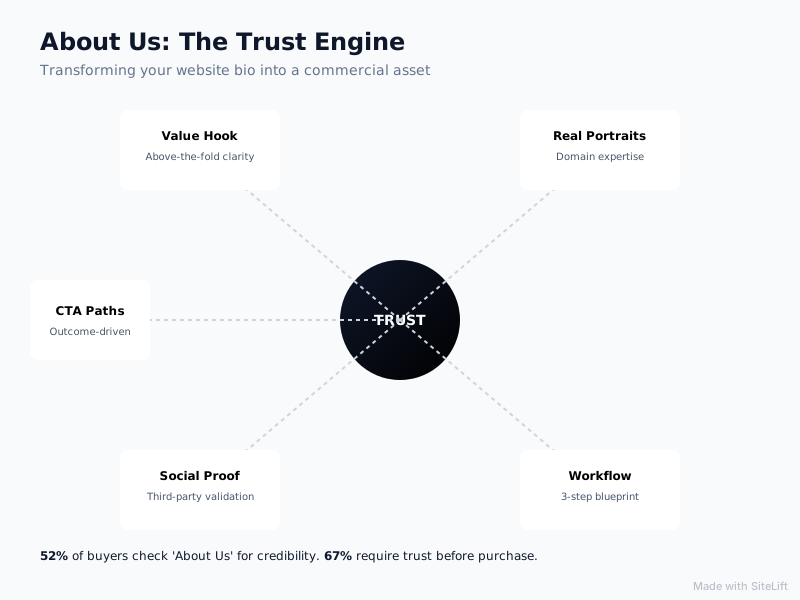
According to research from the KoMarketing B2B Web Usability Report, 52% of buyers want to see 'About Us' information on a vendor's website to establish initial credibility before engaging. Furthermore, the Edelman Trust Barometer consistently shows that 67% of consumers must trust a brand before buying from or working with them. Your prospective clients do not browse this page to stroke your ego. They visit to de-risk a high-stakes commercial decision right before they submit an enquiry.
Here is the straightforward breakdown of how to turn an overlooked brand bio into a dependable commercial asset.
Key Takeaways: Transforming Your About Page
| Core Element | The Common Mistake | The High-Trust Fix | Expected Impact |
|---|---|---|---|
| Above-the-Fold | Corporate mission statements ("We deliver excellence") | Clear value hook focused on client outcomes | Lower immediate bounce rates |
| Team Section | Stock imagery or faceless avatars | Real portraits with specific domain expertise | Immediate relational trust |
| Social Proof | Unverified text quotes | Third-party review widgets and client logos | Measurable credibility boost |
| Workflow | Total operational mystery | Visual 3-step engagement blueprint | Reduced onboarding anxiety |
| Calls to Action | Passive "Contact Us" links | Outcome-driven qualification paths | Higher enquiry volume |
Why Does the About Us on Website Matter More for Conversions Than You Think?
If you inspect your analytics, your company overview is likely sitting in your top three or four most visited URLs. Organic visitors, referral leads, and repeat prospects all cycle through this page.
Yet many firms treat it as an afterthought.
Visitor Discovers Service Page
              │
              ▼
   Needs Risk Validation
              │
              ▼
    Visits "About Us" Page
  (Verifies People & Trust)
              │
              ▼
Submits High-Value Enquiry
The Hidden Conversion Bridge for Service Businesses
High-ticket service engagements carry professional risk. When an operations manager, director, or founder decides to hire an agency, an engineering consultant, or a commercial contractor, their own reputation is on the line.
They do not jump straight from reading a service feature list to handing over thousands of dollars. They hit your profile to answer one silent question: Are these people experienced, competent, and legitimate enough that I will not regret hiring them?
When executed properly, your bio serves as the bridge between general interest and commercial action. It resolves lingering hesitations that standard service descriptions fail to answer.
The Ego Trap: Why Self-Absorbed Brand Bios Repel High-Value Clients
The biggest flaw in B2B copywriting is the "ego trap." This happens when an organization spends 800 words reciting its internal milestones: the year it opened an office, its pride in core values, and sweeping claims about being "industry leaders."
Clients do not care about your company history for its own sake. They care about what your history means for their bottom line.
Every sentence on your page should frame your capabilities in terms of how they solve the client's high-stakes problems. If a paragraph does not clarify how you save time, reduce risk, or boost revenue, cut it.
How Modern Buyers Use the About Page to De-Risk Decision Making
Research from Nielsen Norman Group on website usability shows that users spend 57% of their viewing time above the fold and scan content in an F-pattern. Visitors do not read your profile sequentially like a novel; they hunt for verifiable signals of legitimacy.
They scan for:
- Proof that real humans with verifiable track records work here
- Evidence of relevant experience solving problems similar to theirs
- Clues on how your organization operates behind closed doors
- Clear indications of physical location and operational stability
If they find stock photography and vague buzzwords, their risk alarm triggers. They bounce back to search results and reach out to a competitor who makes their credibility obvious.

What Are the 7 Trust Fixes for an About Us on Website to Generate Enquiries?
If your current story reads like an internal HR document, you do not need a complete site rebuild. You just need to apply deliberate trust signals. Here are the seven practical adjustments that turn a passive company bio into an active enquiry driver.
1. Clarify the Value Hook Above the Fold
Do not force visitors to scroll past a massive, generic hero image to figure out what you do. Within five seconds of landing, state:
- Who you serve
- The core operational headache you eliminate
- The business outcome you deliver
Instead of writing "We are a passionate multidisciplinary consultancy driven by innovation," write: "We help established B2B logistics firms modernise their supply software without costly workflow interruptions." That simple shift replaces empty fluff with sharp commercial positioning.
2. Humanize the Team Behind the Work
People buy from people, especially in professional services. Ditch every piece of stock photography showing generic corporate models pointing at blank whiteboards.
Introduce your core team using authentic, high-resolution photography. Accompany each portrait with a concise bio focused on their real-world contributions:
- Their specialized role and daily focus
- Previous enterprise backgrounds or certifications
- Direct links to their professional LinkedIn profiles
This immediately eliminates the "faceless agency" perception and builds foundational rapport before a sales call ever takes place.
3. Embed Third-Party Proof Over Self-Praise
Self-praise on the web is cheap. Anyone can type: "We provide industry-leading customer satisfaction." High-intent buyers ignore unverified claims.
Incorporate hard, verifiable proof:
- Live widgets from trusted review networks (Clutch, Google Business Profile, Trustpilot)
- Recognized client logos displayed with permission
- Specific, quantifiable metrics (e.g., "Managed over $40M in ad spend across 12 years" rather than "Extensive paid ads experience")
When you prove your competence through outside verification, you do not need to brag. The data handles the persuasion for you.
4. Showcase Your Operating Methodology
Uncertainty breeds hesitation. When a prospective client has never hired you, they worry about onboarding chaos, missed deadlines, and opaque communication.
Eliminate that friction by showing a simple 3-step visual blueprint of how an engagement works:
- The Diagnostic: How you analyze their current bottleneck
- The Implementation: What the active working sprint looks like
- The Handoff & Support: How results are maintained and reported
Demystifying your workflow makes your service feel tangible, professional, and safe to buy.
5. Remove Operational Mystery
Prospects want to know you are an established, stable business entity. Hidden contact details, missing business numbers, or anonymous PO boxes raise instant red flags.
Display genuine operational details directly on your page:
- Physical office locations or primary operating hubs
- Direct company phone lines and registered company identifiers
- Clear disclosures of typical client sizes or minimum project commitments
This level of operational transparency instantly sets you apart from fly-by-night operators and offshore lead-arbitrage operations. Building this degree of credibility ties directly into applying proven website trust signals for service companies across your entire digital presence.
6. Tie Core Values Directly to Commercial Outcomes
Most "Values" sections are filled with meaningless filler words like Integrity, Innovation, and Excellence. These words have been used so often they mean almost nothing to buyers.
If you choose to highlight operational principles, make them concrete:
| Weak Corporate Value | Outcome-Focused Working Principle |
|---|---|
| Communication | "We send weekly asynchronous status videos so you never have to ask where your project stands." |
| Excellence | "Every line of code undergoes peer review and automated stress testing before production." |
| Integrity | "If our initial diagnostic reveals you do not need our primary service, we refer you to a better-fit tool." |
Translate internal ethics into observable client benefits.
7. Replace Dead-End Page Bottoms With Actionable CTAs
Most company bios simply end. The text runs out, leaving the user with an empty footer. This is a massive leak in your conversion funnel.
Conclude your narrative with a direct, low-friction next step:
- A direct link to an audit or diagnostic intake
- A pathway to view industry-specific case studies
- An interactive qualification module
Never leave an engaged prospect wondering what page to click next.
Pro Tip: Place your primary CTA in two spots: immediately following your methodology section, and once more at the very bottom of the page. Visitors consume information at different speeds; provide clear exits for both scannners and deep readers.
Infographic by SiteLift
How to Structure and Write an About Us Page That Converts
Knowing the fixes is one thing; arranging them into an intuitive layout is what actually drives enquiries. Let's look at how to write about us page that converts using a clean, 5-part architecture.
The 5-Part Service Business Wireframe
To balance storytelling with commercial performance, structure your page in this order:
- The Positioning Hook (Above the fold): What you do, who you do it for, and why your approach works.
- The Empathy & Problem Statement: Validating the primary friction points your target market faces every day.
- The Differentiator & Framework: Your unique process, proprietary methodology, or operational model.
- The Proof & Team: Real faces, domain backgrounds, case study metrics, and external reviews.
- The Commercial Next Step: A conversion block built for ready-to-act buyers.
Copywriting Formulas That Balance Authority With Empathy
To strike the right tone, avoid passive corporate jargon. Use active, direct phrasing that speaks directly to the reader's day-to-day challenges.
A reliable structure to follow is:
"Most [Industry] firms struggle with [Common Operational Nightmare]. We built [Company Name] around a single operational standard: [Unique Delivery Mechanism]. This ensures you get [Measurable Outcome] without [Common Industry Headache]."
This framing instantly validates the prospect's pain point while demonstrating that your business was designed specifically to fix it.
Integrating Interactive Elements and AI Conversational Qualifiers
High-intent prospects do not always arrive during your local business hours. When someone reads your story at 9:30 PM on a Tuesday, waiting twelve hours for an email response introduces drop-off risk.
Modern service firms are now embedding automated qualification modules on their high-intent pages. Deploying smart AI enquiry assistants allows visitors to ask specific questions about your services, confirm operational fit, and book discovery calls right when their interest is highest.
This bridge captures high-value opportunities that would otherwise slip away overnight.
The Underrated Power of the Candid Origin Story
There is an ongoing debate in B2B marketing circles regarding whether an origin story has any place on a commercial website. Some conversion purists argue that every square pixel must be dedicated purely to product features and direct offers.
In our view, that approach is short-sighted.
A sharp, unfiltered origin story is one of the most underutilized sales assets in a service company's arsenal. When you explain the honest, unvarnished reason why you founded your business—specifically highlighting the industry shortcomings, broken agency models, or frustrating inefficiencies that pushed you to build a better alternative—you create instant alignment with buyers who share those exact frustrations.
High-value clients are exhausted by sterile corporate pitches. They do not want another vendor claiming perfection. They want a dedicated partner who genuinely understands why the typical approach in their sector is broken, and who had the conviction to build a practical solution.
Do not hide your origin story. Strip away the self-congratulatory corporate fluff, spotlight the problem that forced your business into existence, and let your market see that you understand their frustrations better than anyone else.
— growth-kings.com
Real-World About Us Page Examples for Service Businesses
Let's examine how this approach works across two distinct business models to see what high-converting execution looks like in practice.
The B2B Professional Services Blueprint
Consider a boutique accounting and financial advisory firm targeting mid-market SaaS companies:
- The Value Hook: "Fractional CFO advisory for software founders scaling from $2M to $10M ARR."
- The Friction Addressed: Eliminates the overhead of a full-time executive while ensuring cap-table hygiene.
- The Proof Mechanism: Prominently displays aggregate metrics: "Guided 34 client acquisitions totaling $180M in transactional volume."
- The Visuals: Clear, unedited working shots of the lead partners, alongside direct Calendly integration links for qualified founders.
The result is a direct, commercial argument for why a SaaS executive should trust them with their balance sheet.
The Technical & Specialized Agency Model
Now consider a high-performance web development and technical consultancy:
- The Positioning: Rather than offering "custom web solutions for everyone," they focus on speed optimization and database security for healthcare portals.
- The Story: Founded by former health-tech systems engineers who grew tired of watching agencies deliver insecure, bloated code.
- The Methodology: A transparent audit workflow breaking down their 48-hour compliance diagnostic.
- The E-E-A-T Anchors: Badges showing active HIPAA and SOC2 compliance certifications, along with verified developer accreditations.
By narrowing their focus and backing it with technical credentials, they justify premium pricing without haggling.
Actionable Takeaways You Can Implement Without a Full Redesign
You do not need to pause operations or spend months rebuilding your site to upgrade your conversions. Focus on these fast, high-impact fixes:
- Rewrite your H1 headline: Change it from "Who We Are" to a clear positioning statement.
- Replace two stock images: Swap out generic stock graphics for authentic photographs of your leadership or operational workspace.
- Pull in 3-4 verifiable client quotes: Use full client names, job titles, and company names rather than anonymous praise.
- Add a structured 3-step timeline: Clearly show what happens after a prospect submits your contact form.
Pro Tip: Audit your current bio on a mobile device. Over half of business research happens on phones. If your team portraits and social proof take six aggressive thumb-swipes to find, move them up immediately.
Essential About Us Page SEO Best Practices
An effective company overview does more than convince human visitors; it also plays a central role in your search engine visibility. Search engines pay close attention to your company page to verify entity authenticity and editorial authority.
Mastering Google E-E-A-T and Entity Signals
Google's Search Quality Rater Guidelines place heavy emphasis on E-E-A-T: Experience, Expertise, Authoritativeness, and Trustworthiness. Your primary profile page serves as ground zero for these verification signals.
Make these entity markers obvious:
- Explicitly state the legal business entity name and foundational details.
- Highlight industry awards, professional associations, and accreditations.
- Link author bios from your technical blog posts back to specific executive profiles on the company page.
When search algorithms cross-reference your leadership profiles against external digital footprints, it reinforces your domain authority across your entire topic cluster.
Implementing Organization and Person Schema Markup
Structured data provides direct, machine-readable facts to search crawlers. To get the most technical SEO value out of your company page:
- Implement Organization Schema that lists your official brand name, logo URL, corporate address, and verified customer service channels, as outlined in Google Search Central documentation on Organization schema.
- Use the
sameAsarray within your JSON-LD markup to link your profile directly to your verified LinkedIn, Crunchbase, and directory entries. - Implement Person Schema for primary founders and executives to reinforce entity associations.
{
  "@context": "https://schema.org",
  "@type": "ProfessionalService",
  "name": "Acme Engineering Consulting",
  "url": "https://www.example.com",
  "logo": "https://www.example.com/assets/logo.png",
  "sameAs": [
    "https://www.linkedin.com/company/acme-engineering",
    "https://twitter.com/acme_eng"
  ],
  "address": {
    "@type": "PostalAddress",
    "streetAddress": "123 Commercial Way, Suite 400",
    "addressLocality": "Austin",
    "addressRegion": "TX",
    "postalCode": "78701",
    "addressCountry": "US"
  }
}
Strategic Internal Linking Architecture to Revenue Pages
Your company profile naturally accumulates authoritative backlinks from media mentions, local business directories, and partner listings. Leaving this page disconnected from your revenue funnel wastes that authority.
Weave natural internal links into your narrative:
- When discussing your specialized approach, link directly to your core service pages.
- When highlighting past performance milestones, link to detailed case studies.
- When outlining executive qualifications, link to thought-leadership articles authored by those team members.
This funnels link equity directly into your commercial landing pages while providing a natural journey for interested visitors.
Turn Your Website Traffic Into Predictable Enquiries
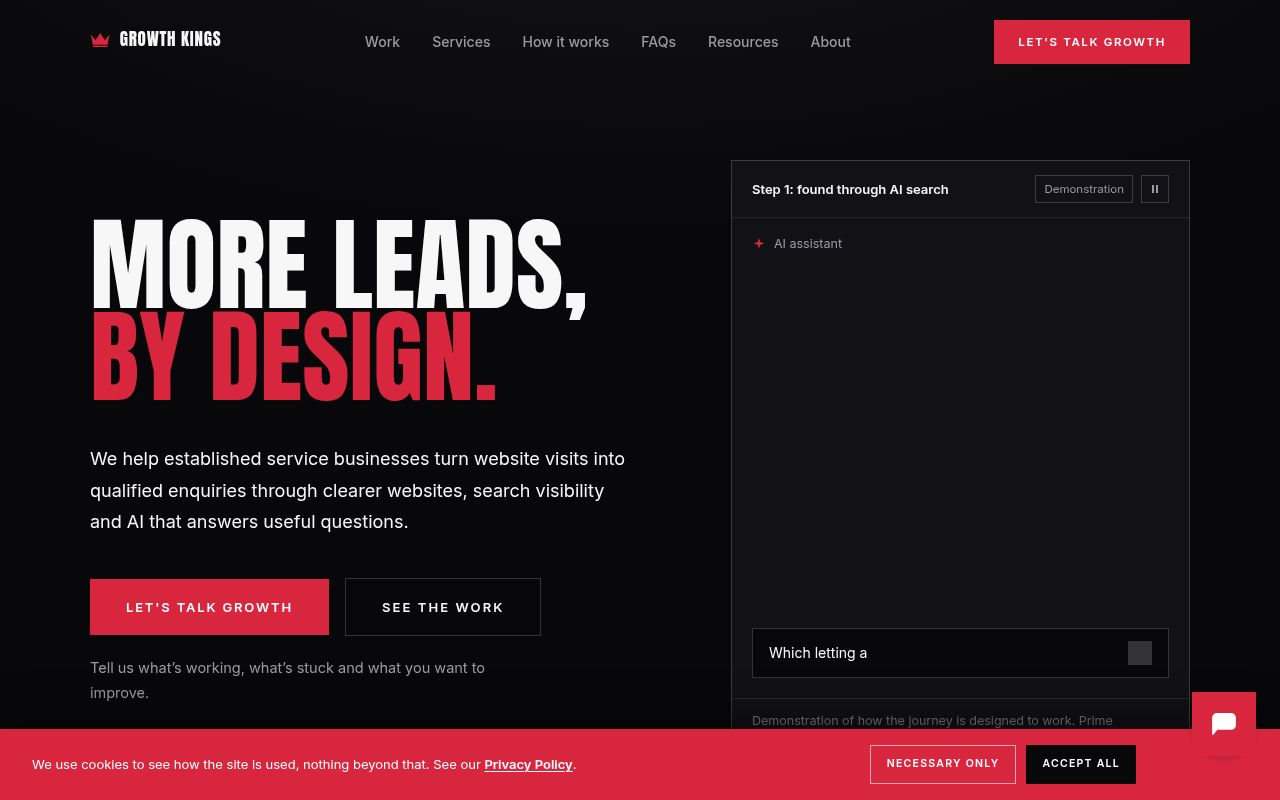
Most service business websites do not suffer from a lack of traffic; they suffer from a lack of clarity and trust. Visitors land on the site, struggle to verify who runs the business, encounter zero tangible proof, and leave without getting in touch.
At growth-kings.com, we help established service companies fix these friction points. Rather than selling costly, unnecessary redesigns, we focus on practical website improvements that deliver measurable results:
- Restructuring key landing pages to establish trust and clarify messaging
- Deploying search visibility strategies that capture high-intent buyers
- Setting up automated lead qualification tools to handle inquiries 24/7
Take a look at how we structure our own story to see these principles in practice, or get in touch with our team to turn your current website into a reliable enquiry generator.
Frequently Asked Questions About the About Us Page
What is the primary purpose of an About Us page on a service website?
Its primary purpose is risk mitigation. While service pages explain what you sell, your company overview proves who stands behind the work. Prospective clients visit this page right before reaching out to verify that your company is legitimate, experienced, and capable of solving their problem.
How long should an About Us page be to maintain reader engagement?
There is no fixed word count, but an effective B2B company page typically ranges between 600 and 1,200 words. It should be long enough to introduce your core leadership, establish your working framework, and display verifiable social proof, without dragging on with unnecessary corporate history.
Should an About Us page include direct sales calls to action?
Yes. An engaged visitor reading your company profile is evaluating your operational fit. Ending the page without an actionable next step leaves money on the table. Offer low-friction conversion paths, such as scheduling a diagnostic call, reviewing detailed case studies, or engaging with an interactive qualification assistant.
What is the single biggest mistake service businesses make on their About page?
Falling into the "ego trap." This happens when companies write solely about themselves—their founding history, internal passions, and abstract mission statements—rather than explaining how their background, systems, and expertise solve the client's commercial challenges.
How does an About Us page impact a website's SEO performance?
It plays a major role in establishing Google E-E-A-T (Experience, Expertise, Authoritativeness, and Trustworthiness). By including structured Person and Organization schema, linking to real executive profiles, and securing external trust links, your profile page validates your business as a verified entity in search engine knowledge graphs.
Want this working on your own site?
Tell us what’s working, what’s stuck and what you want to improve. We will reply personally.