Qualified vs Unqualified Leads: How Service Businesses Stop Wasting Time on Tyre-Kickers
Learn qualified vs unqualified leads differences, 5-point filter and AI tips to stop tyre-kickers and book more sales-ready jobs.
By Growth Kings. Published , updated . 10 min read.
Qualified vs Unqualified Leads: How Service Businesses Stop Wasting Time on Tyre-Kickers
If you run a plumbing company, law firm, clinic, agency, or contracting business, you already know the frustration behind qualified vs unqualified leads. One enquiry turns into a booked job in two calls. The next five eat up your week with price shopping, ghosting, and “just curious” questions.
I’ve seen service teams lose entire mornings to enquiries that were never going to buy. The fix isn’t more leads. It’s better lead qualification for service businesses — a simple filter for fit + intent + ability to buy, applied before you pick up the phone.
How Should Service Businesses Evaluate Leads? 5 Lead Qualification Criteria That Matter
Forget complex enterprise frameworks. For services, you can simplify BANT and MEDDIC into five practical checks:
1. Need / Problem Fit: Do they need the specific service you actually sell? “Boiler replacement” is not the same as “boiler service.” 2. Budget Range: Can they afford your typical price band? You don’t need an exact number, just a realistic range. 3. Decision Authority: Are you talking to the decision-maker? Homeowner vs. tenant, founder vs. intern, patient vs. curious browser. 4. Timeline & Location: Do they need it in your service area within a sensible window? Next 2-4 weeks beats “sometime next year.” 5. Engagement Quality: Are they responsive and specific? Detailed answers signal intent. One-word replies and missed calls don’t.
This is also where MQL vs SQL matters in plain English. A marketing-qualified lead downloaded a guide or browsed pricing. A sales-qualified lead — what I call sales ready service leads — has passed those five checks and is worth a call now.
Pro Tip: Score every enquiry on those five criteria 0-1. Score 4-5 = call now. Score 2-3 = nurture. Score 0-1 = politely disqualify.
Qualified vs Unqualified Leads: At-a-Glance Comparison
Here’s the quick triage I recommend for small service teams. You should be able to sort any new enquiry in under two minutes.
| Criteria | Qualified Lead (Follow Up Now) | Unqualified Lead (Nurture or Disqualify) |
|---|---|---|
| Intent & Need | Specific problem: “Leaking combi boiler, no hot water” | Vague: “Just wondering what you do / how much?” |
| Budget | Knows ballpark, budget approved or finance-ready | No budget, wants cheapest option, shocked by starting prices |
| Authority | Homeowner, practice manager, founder — can say yes | Tenant without landlord approval, student researching, third-party asking for someone else |
| Timeline & Location | In service area, wants work in days/weeks | Out-of-area, “maybe next year,” no urgency |
| Engagement | Replies quickly, provides photos, postcode, availability | Ghosts, ignores qualifying questions, only asks for free advice |
| Best Action | Call within minutes, offer site visit / consult | Send resources, add to nurture, refer out or decline politely |
Speed matters here. According to Harvard Business Review research on online sales leads, firms that contact a lead within an hour are nearly 7x more likely to qualify that lead than those that wait longer. And according to InsideSales data on response time, 35-50% of sales go to the vendor that responds first.
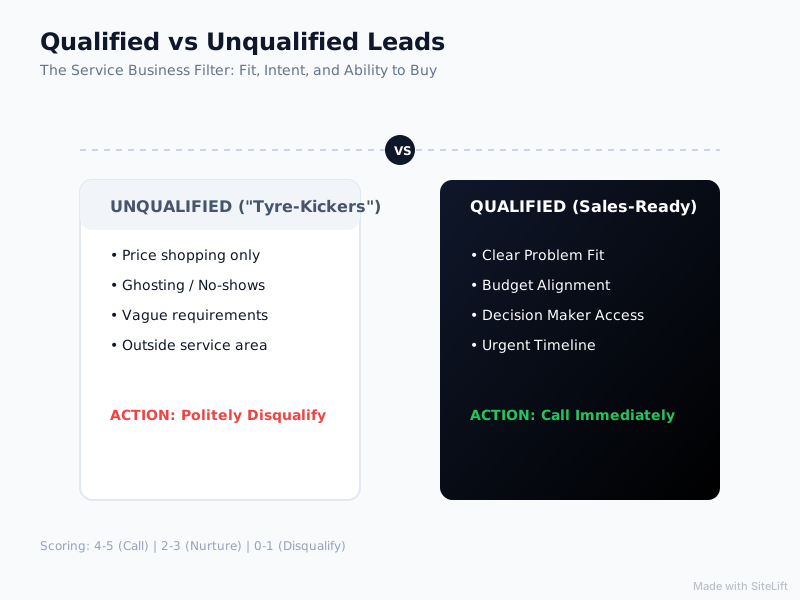
Infographic by SiteLift
What Do Qualified, Sales-Ready Service Leads Look Like?
A qualified lead isn’t just a name and phone number. It’s fit plus intent plus ability to buy.
Against our five criteria, they usually look like this:
- Specific request: “Need 3-bed house rewire in Austin, 2 weeks, own home.”
- Right fit: Your core service, your postcode, your type of client.
- Realistic budget: They’ve seen your starting prices and say “that works.”
- Decision-maker: “I’m the owner, my partner and I decide.”
- Clear timeline: Wants a quote this week, work next week.
- Responsive: Answers follow-ups, sends photos, books a slot.
Real examples:
- Plumber: Owns home in service area, boiler 15 years old, no heat, budget approved, available Thursday for survey.
- Law firm: Facing employment deadline in 30 days, decision-maker, has documents ready, asks about fees and next steps.
- Marketing agency: $4k/mo budget confirmed, founder on call, wants start next month, asks about reporting and contracts.
According to Gartner research on the B2B buying journey, B2B buyers spend only 17% of their total purchase time meeting with potential suppliers. If you’re slow or vague, sales-ready buyers will simply choose someone else.
Pro Tip: Ask for postcode, timeline, and budget range on your first form or chat. You’ll repel 30% of bad-fit enquiries without losing good ones.

What Do Unqualified Leads Look Like? 5 Tyre-Kicker Types
Unqualified doesn’t mean bad person. It means bad fit right now against those same five criteria. Here are the five I see most:
1. The Tyre-Kicker: Endless questions, no timeline. “What would you do if...?” Never books. 2. The Price Shopper: Only cares about cheapest quote. Sends your proposal to five competitors and disappears. 3. The Out-of-Area / Out-of-Scope: Wants a service you don’t offer, in a city you don’t cover. 4. The DIY Researcher: Wants free diagnosis or step-by-step instructions. Great for blog traffic, terrible for your calendar. 5. The Spam / Low-Intent: Wrong numbers, SEO pitches, “partner opportunities,” or blank forms.
Red flags in form fills and chat transcripts: no last name, no postcode, “ASAP!!!” with no details, refusal to answer budget/timeline, “just give me a price” without a scope, calls outside your services.
This waste adds up. According to Salesforce State of Sales research on rep productivity, sales reps spend only 28% of their work week actually selling. For service owners doing their own follow-up, every hour spent chasing tyre-kickers is an hour not doing billable work.
For a deeper breakdown of lead scoring basics, HubSpot’s guide to lead qualification and scoring is a useful reference.
How to Qualify Service Enquiries Without Adding Admin Work?
You don’t need a CRM team to learn how to qualify service enquiries. You need a 5-question filter applied everywhere — forms, chat, and phone.
Use this script:
- What exactly do you need help with?
- Where is the job / are you in our service area?
- When do you need it done?
- Have you budgeted for this? Our typical range is X-Y.
- Are you the decision-maker? What does a good next step look like?
On forms, make service needed, postcode/ZIP, and timeline required. Make budget range a dropdown (“Under $500 / $500-2k / $2k-5k / $5k+”) to reduce friction. On phone, train whoever answers to ask the same three: service, area, timeline — before quoting.
For small teams, keep routing simple:
- Score 4-5 → instant call + SMS + calendar link
- Score 2-3 → automated email with pricing guide, FAQs, and “reply when ready”
- Score 0-1 → polite decline or referral
This is where AI lead qualification criteria help, especially after hours. Most tyre-kickers arrive at 9pm on Sunday. A good AI enquiry assistant with human handoff can ask those five questions, check service area, share pricing guidance, and book only qualified calls to your calendar. It hands over to a person when nuance is needed. Before you buy one, run through this buyer’s checklist for AI sales assistants — it separates a useful assistant from an expensive chat widget.
What Should You Do With Unqualified Leads Instead of Ignoring Them?
My take: most service businesses are too binary. They either chase everyone or ignore everyone. Both burn money.
I’ve audited enquiry inboxes where 60% were unqualified, but 20% of those would buy in 3-6 months if nurtured. Ignoring them hands future revenue to competitors. Chasing them now kills your week.
Here’s my rule:
Nurture when: Fit is right, timing is wrong. Send a pricing guide, 2-3 case studies, and a 30/60/90-day check-in. Example: “Not replacing until spring — send maintenance checklist and quote validity.”
Refer when: Wrong scope or area but real need. Refer to a trusted partner. You’ll get referrals back and protect reviews.
Say no politely when: No budget, no authority, or abusive/low-effort. Use a template:
Thanks for reaching out — based on what you described, we’re not the best fit because [area / budget / service]. If [condition changes], happy to help. Here’s a resource that might help in the meantime: [link].
Clear websites pre-qualify for you. Pricing ranges, service-area maps, “who we’re not for,” FAQs, and strong calls-to-action filter tyre-kickers before they ever hit submit. That clarity-and-trust approach is exactly what turns traffic into enquiries worth calling. Browse more practical breakdowns in the Growth Kings resources library.
Qualified vs Unqualified Leads: Verdict on Where to Spend Your Time
So, qualified vs unqualified leads — which should you choose? You don’t choose one. You build a system that finds one fast and handles the other without your time.
Prioritize manual qualification if: You get under 20 enquiries a month and each job is high-value. A 5-minute phone filter will lift close rates immediately.
Prioritize automated AI qualification if: You get after-hours chats, missed calls, web forms with no follow-up, or a small team drowning in admin. Let automation ask, score, and route, so humans only talk to sales-ready leads.
My verdict: Stop trying to convert tyre-kickers on the phone. Fix the top of the funnel — clearer services, visible starting prices, service areas, proof, and instant after-hours response. Then triage ruthlessly: call 4-5s in minutes, nurture 2-3s automatically, decline 0-1s kindly.
Do this exercise this week: pull your last 30 enquiries and score them on need, budget, authority, timeline, and engagement. I promise you’ll see exactly where your time went — and where your next three jobs were hiding.
If missed enquiries and late-night tyre-kickers are eating your evenings, growth-kings.com helps established service businesses turn visits into qualified enquiries with clearer websites and AI assistants that pre-qualify before you call back.
— growth-kings.com
FAQ
What is the difference between qualified vs unqualified leads?
A qualified lead matches your service, location, budget, and timeline, and the contact can make a buying decision and responds with specifics. An unqualified lead fails one or more of those checks — wrong area, no budget, no authority, no timeline, or very low intent.
How do service businesses qualify incoming enquiries quickly?
Ask five questions every time: What service do you need? Are you in our service area? When do you need it? What’s your budget range? Are you the decision-maker? Score the answers and call now, nurture, or disqualify politely.
What are examples of qualified leads for a service business?
“Homeowner in Dallas needs AC replacement within 2 weeks, budget $7k-$9k, available for survey” or “Founder with $3k/mo budget wants SEO starting next month and booked a discovery call.” Specific, in-area, funded, and time-bound.
What should I do with unqualified leads?
Don’t just ignore them. Nurture future-fit leads with guides and timed follow-ups, refer out-of-scope leads to partners, and politely decline bad-fit leads with a clear reason and helpful resource to protect your reputation.
How can AI help qualify service leads after hours?
An AI assistant can answer FAQs instantly, ask AI lead qualification criteria like service, postcode, timeline and budget, share pricing ranges, route qualified prospects to booking, and hand complex cases to your team in the morning — so you never lose a sales-ready lead to voicemail.
Want this working on your own site?
Tell us what’s working, what’s stuck and what you want to improve. We will reply personally.